

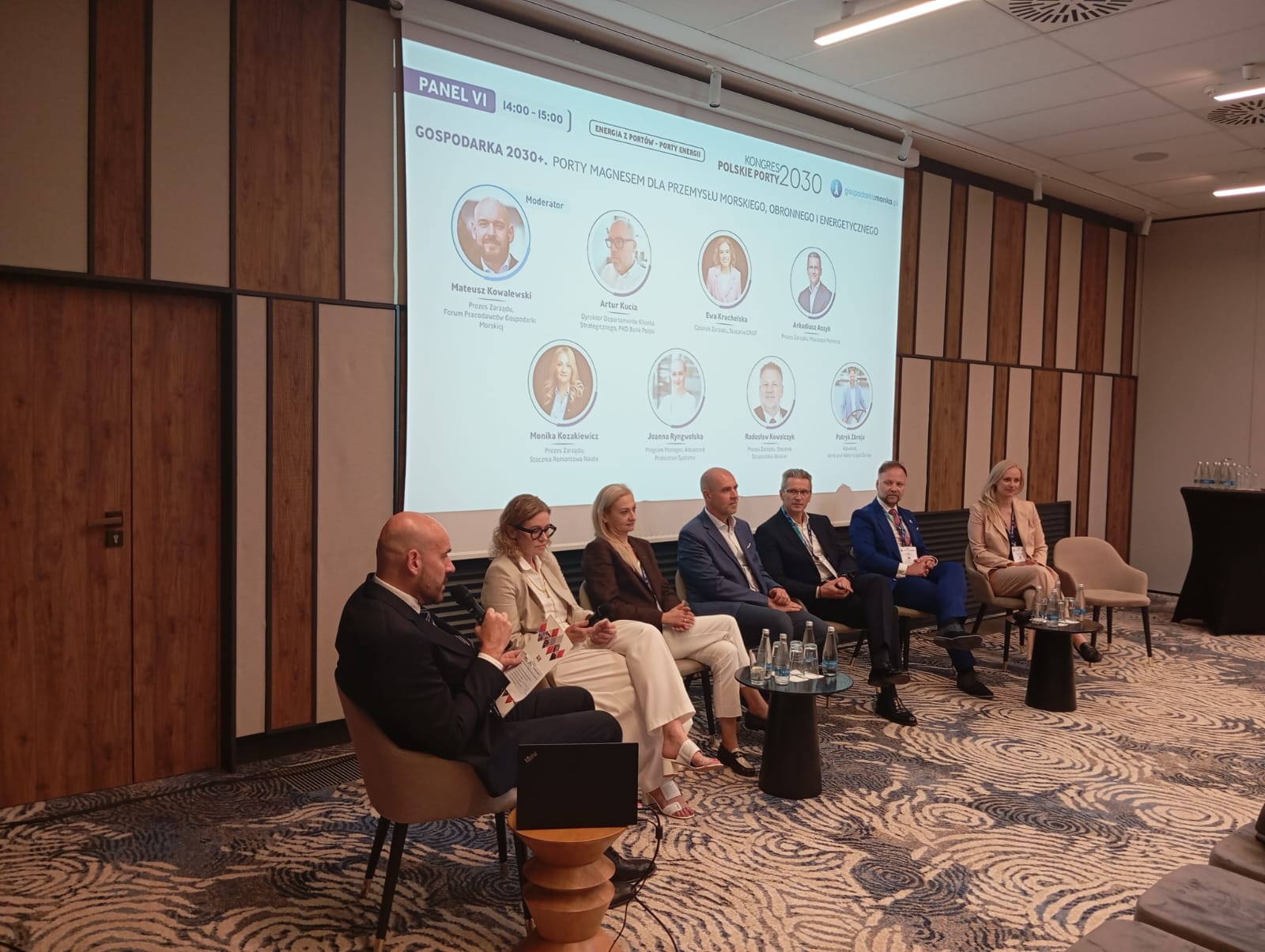


During the Polish Ports 2030+ Congress in Sopot, the presidents of Poland's major seaports discussed how growing cargo volumes, expanding port infrastructure and new sectors such as offshore wind and defence are reshaping the maritime economy.
Offshore wind – a missed opportunity
Over the past decade, Poland's maritime sector has pinned high hopes on several flagship development programmes. Offshore wind has been seen as the greatest opportunity, and significant progress has indeed been made. New installation terminals and service bases are being built, supply chains are expanding, and global manufacturers are establishing production facilities in Poland.
However, for many Polish shipyards, the expected wave of domestic orders has largely failed to materialise. This issue dominated the discussion moderated by Mateusz Kowalewski during the Polish Ports 2030+ Congress.
One company that had hoped to secure a stronger position in offshore wind is Crist Shipyard, which has already delivered numerous offshore projects—but almost exclusively for foreign markets.
– The situation is bleak. We are working on one Polish offshore project, but it is not for a Polish company—it is an offshore substation for a foreign investor – said Ewa Kruchelska, Member of the Management Board of Crist.
Kruchelska has spent years lobbying decision-makers to recognise the capabilities of Polish shipyards. Today, however, she admits she no longer knows where to look for opportunities.
– I've been everywhere—the Sejm, the Senate—explaining why this needs to be done. But nothing has come of it. I still hear people saying that ships are no longer built in Poland. It's simply unbelievable – she said.
She also pointed out that several letters of intent signed over the past months and years regarding the construction of a Polish jack-up installation vessel ultimately led nowhere.
– Nothing came of it, and nothing will, because the window of opportunity has already passed. Then there was talk of other offshore vessels—service operation vessels, accommodation vessels—and then the discussion simply stopped. As things stand today, there will be no Polish offshore fleet, which we deeply regret, but we have to move on – Kruchelska added.
She also criticised the way local content is currently defined. Under some interpretations, Crist—despite operating in Gdynia—would not fully qualify as local content. The same applies to Mostostal Pomorze, which has been part of offshore wind and oil & gas supply chains for nearly two decades.
– Eighteen per cent of our company is owned by Florentino Pérez, the owner of Real Madrid, while the rest is publicly traded. Recently I was told they deduct 10% because of Pérez, leaving us with 90% local content. Then yesterday I heard we're no longer local content at all because everything we produce is exported. I don't know how much they deduct for that – joked Arkadiusz Aszyk, President of Mostostal Pomorze.
When Mostostal first entered the offshore wind sector, offshore projects did not yet exist in Poland. Over the past 20 years, the company has completed more than 30 offshore wind projects—none of them in the domestic market.
Aszyk admitted that the company partly missed the first phase of Poland's offshore wind rollout because it was busy with other contracts, but he also argued that developers have been sending mixed signals.
– Developers come, inspect our facilities and praise everything we have in place, only to later discover they apparently have other preferences – he said.
He also criticised politicians for equating local content almost exclusively with state-owned companies, effectively sidelining private industry.
– Even the Prime Minister said that local content means state-owned companies. Letters of intent are signed stating that these companies will pass contracts down to Tier 2 and Tier 3 suppliers, but at those levels deliveries from China are perfectly acceptable. Four offshore substations for Baltica 2 are being built in Vietnam. Nobody even wanted to discuss the project with us – Aszyk adds.
Like Crist, Mostostal Pomorze continues to rely primarily on export contracts.
– If we manage to secure work on the Polish market, we'll be delighted. But if we'd relied solely on that, we simply wouldn't exist anymore – Aszyk concluded.
A national offshore operator?
Within Poland's shipbuilding industry, the creation of a new state-owned offshore shipping company is often presented as a solution to the lack of domestic orders. Shipyards hope such an operator would commission vessels from Polish yards, although it could equally decide to acquire second-hand ships.
Artur Kucia, Director of the Strategic Client Department at PKO Bank Polski, believes establishing such an operator is nevertheless a necessary first step.
– We cannot keep fooling ourselves with another letter of intent for a jack-up vessel, only for the subject to disappear three months later. There is no operator. It is the state's responsibility to create one. At the moment there is nobody with both the incentive and the accountability to commission these vessels – Kucia said.
He also argued that ships built by Polish yards for Polish operators would not need to remain confined to domestic offshore projects.
– Let the existing vessels continue operating here. But Polish operators should be required to order ships in Poland—ships that can then work on projects anywhere in the world – he proposed.
Experience matters as much as ownership
Several participants pointed out, however, that creating another state-owned company alone would not solve the problem. Without operational experience or an established track record, a new operator would struggle to obtain financing for expensive offshore vessels—and without vessels it would be equally difficult to secure contracts.
– When we speak to shipping companies, it becomes clear this is not only about willingness but also about experience and a proven track record that allows operators to take on commercial risk. Would PKO BP really finance a vessel if the operator were an unknown company with Polish capital but no operating history? – asked Patryk Zbroja of Wind & Water Legal.
Throughout the discussion, participants repeatedly referred to Orlen Petrobaltic as a potential candidate to become a national offshore fleet operator, given its long-standing experience in the offshore oil and gas sector. Similar concepts had already been explored in the past.
According to Zbroja, the approach previously considered by the company—partnering with an experienced offshore wind operator to gain contracts and know-how, much like PGE Baltica and Orlen Neptun have done as offshore wind developers—remains the most promising path forward.
Defence
Offshore wind is not the only sector driving the transformation of Poland's seaports—and, to varying degrees, the industries surrounding them. In recent years, for obvious geopolitical reasons, defence has become an increasingly important growth area. Military cargo is now handled in ports, while new infrastructure projects are being designed according to the dual-use concept.
– There are two key trends—offshore wind and security. It is important to recognise that our domestic companies already have the capabilities and the experience. Most of the difficult period is behind them. What we need now is for the state to ensure that we are able to participate in these projects. We are based here, we pay taxes here, we employ people and work with numerous other businesses. We create demand for an entire network of suppliers through the projects we deliver. I believe decision-makers still do not fully appreciate that – said Monika Kozakiewicz, President of Nauta Shiprepair Yard.
Nauta, part of the Polish Armaments Group (PGZ), is heavily involved in naval defence projects. In fact, the company had been active in this field long before joining the PGZ group. Its largest current contracts relate to naval vessels being constructed at the neighbouring Naval Shipyard, which also belongs to PGZ.
– We have signed a contract to build the stern block for the second frigate currently under construction. Discussions are also underway regarding another vessel and one of its major sections. The geopolitical situation is generating new orders for shipyards. On the one hand, we would all prefer these contracts did not exist because they are linked to security concerns. On the other hand, we all recognise that Europe spent years in a state of complacency, during which we lost capabilities that now have to be rebuilt very quickly – says Kozakiewicz.
The drone challenge
One of the major unanswered questions regarding port security is their resilience against modern drones.
Joanna Ryngwelska, Programme Manager at Advanced Protection Systems, argued that many claims regarding anti-drone protection should be treated with caution.
– Even during this Congress we heard representatives of ports saying they have anti-drone systems in place, but in reality it is often unclear what those systems are actually capable of. If they can detect a drone, it is probably only an ordinary commercial drone. Modern systems can switch between communication methods and often communicate via satellite rather than directly with an operator, making them far more difficult to detect – Ryngwelska explained.
In her view, most commercially available anti-drone systems have only limited effectiveness against advanced threats. One notable exception, she said, is Naftoport, whose protection systems perform particularly well.
Given the strategic importance of the terminal and its immediate surroundings, any successful attack on Naftoport could have catastrophic consequences.
She also warned about the growing threat posed by unmanned surface vessels.
– We are already capable of detecting targets with a radar cross-section of just 10 cm². The crucial issue is ensuring that anti-drone systems are integrated with the armed forces. There is a widespread belief that no systems exist which connect directly to operational command centres. That is simply not true. Systems capable of communicating with the Maritime Operations Centre already exist. That enables the armed forces not only to jam hostile drones but also to engage them with kinetic weapons – continues Ryngwelska.
According to Ryngwelska, as drone threats continue to grow, Poland's planned SAN anti-drone batteries—the core element of the Polish Armed Forces' future anti-drone shield—should be deployed in every seaport. Based on the information she presented, these systems are expected to have an operational range of between 3 and 20 kilometres.
– When you consider the distance between the anchorage and the port itself, it is clear that ports need these systems – she said.
More ships mean more work—for some shipyards
Leaving defence projects aside, Monika Kozakiewicz confirmed that growing port traffic directly benefits repair shipyards.
– The port environment is the natural environment for a repair yard. Many customers deliberately schedule their voyages so that cargo operations finish in the Port of Gdynia, allowing them to use our services. We have long-standing relationships with customers from Scandinavia and Germany who value the quality of our work, so they plan their schedules to arrive here just as their classification certificates are due for renewal – says Kozakiewicz.
However, this does not mean the yard can accommodate unlimited demand. Like the Port of Gdynia itself, Nauta faces a serious shortage of space.
– Being located next to the port is both an advantage and a limitation. On the one hand, it generates business. On the other, there is virtually no land left for expansion. We simply have no room to develop infrastructure capable of servicing the largest vessels calling at the port – Kozakiewicz emphasizes.
Different paths for different shipyards
Although representatives of West Pomeranian shipyards were absent from the discussion, Patryk Zbroja shared his assessment of their current situation. Both Szczecin shipyards—Wulkan and Gryfia—operate under the supervision of Poland's Ministry of Infrastructure.
– I have a slightly different view on how to revive the Polish shipbuilding industry – Zbroja said.
In his opinion, Wulkan Shipyard is moving in the right direction.
– They are steadily building new capabilities, cooperating with the Naval Shipyard and thinking carefully about how to diversify their activities – Zbroja said.
He was considerably more cautious when discussing Gryfia.
– I have greater concerns about Gryfia. The company requires much deeper organisational and cultural change. I am not convinced that it is yet ready to compete successfully in the broader international ship repair market – Patryk Zbroja concluded.
 DOWNLOAD PDF