

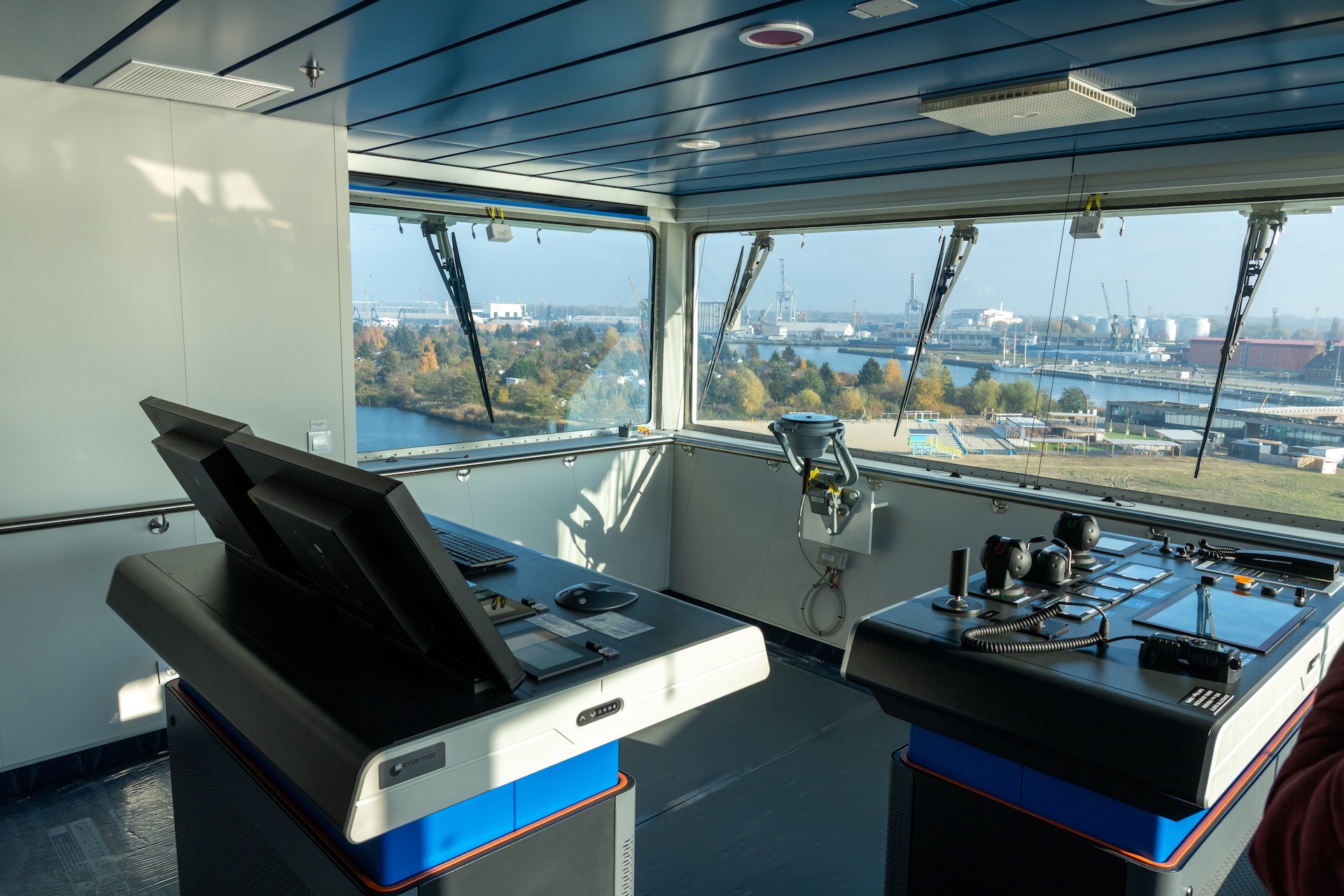


The Bursztyn Unity ferry will soon embark on its first commercial voyage under the POLSCA Baltic Ferries brand. Before entering regular service, however, it is worth taking a closer look at the systems supplied and commissioned with the involvement of Enamor. The company’s scope of work included the integrated navigation bridge, the internal communications system and GMDSS radio communications.
“In projects of this kind, there is practically no room for repeating sea trials. We cannot afford to have errors occur. Enamor’s main responsibility in the project was to supply, commission and test the integrated navigation system and internal communications system,” Filip Papierz, the company’s Commercial Division Director, says in a video published by Enamor.
One of the key solutions installed aboard Bursztyn Unity is the full integration of the systems and the ability to interchange operator workstations. This makes the individual bridge stations multifunctional.
“We have full integration and interchangeability of the workstations here. These are so-called multifunctional stations, and this is one of the main advantages of the entire system,” the Enamor representative explains.
The ferry’s open deck is fitted with a radar mast carrying three radar antennas: two operating in the X-band and one in the S-band. All three use Solid State technology. One of the antennas is used at the SRTP bridge and supports the vessel’s safe approach to port.
The company also highlights operational safety and system reliability among the key features of the solutions installed, supported, among other things, by a redundant internet network. Equipment testing was carried out in stages: the first tests took place during installation, followed by further checks during commissioning and then during harbour and sea trials.
“I believe the most important thing for the shipowner is the vessel’s operational reliability after handover. We already have this experience with the first ferry. We hope the second vessel will perform just as well, and that the third will also be a success,” Filip Papierz concludes.

The project was delivered through cooperation between the Enamor team, Gdańsk Remontowa Shipbuilding Yard and technology partners NACOS Marine GmbH and Zenitel. The company says that completing its work on Bursztyn Unity is another demonstration of the expertise and experience of its team.
Bursztyn Unity was built at Gdańsk Remontowa Shipbuilding S.A. and formally christened on 11 November at the Chrobry Embankment in Szczecin. The ferry is approximately 195.6 metres long and 32.2 metres wide, and can carry around 400 passengers.
The vessel is equipped with a hybrid propulsion system combining four liquefied natural gas (LNG)-fuelled engines with a battery system. The solutions are intended to improve the ferry’s energy efficiency and meet the requirements of modern ferry operations.
The ferry will sail under the Polish flag, with its first commercial departure from Sweden scheduled for 18 November.
Photos: 1. Cezary Spigarski; 2. ENAMOR
 DOWNLOAD PDF
