

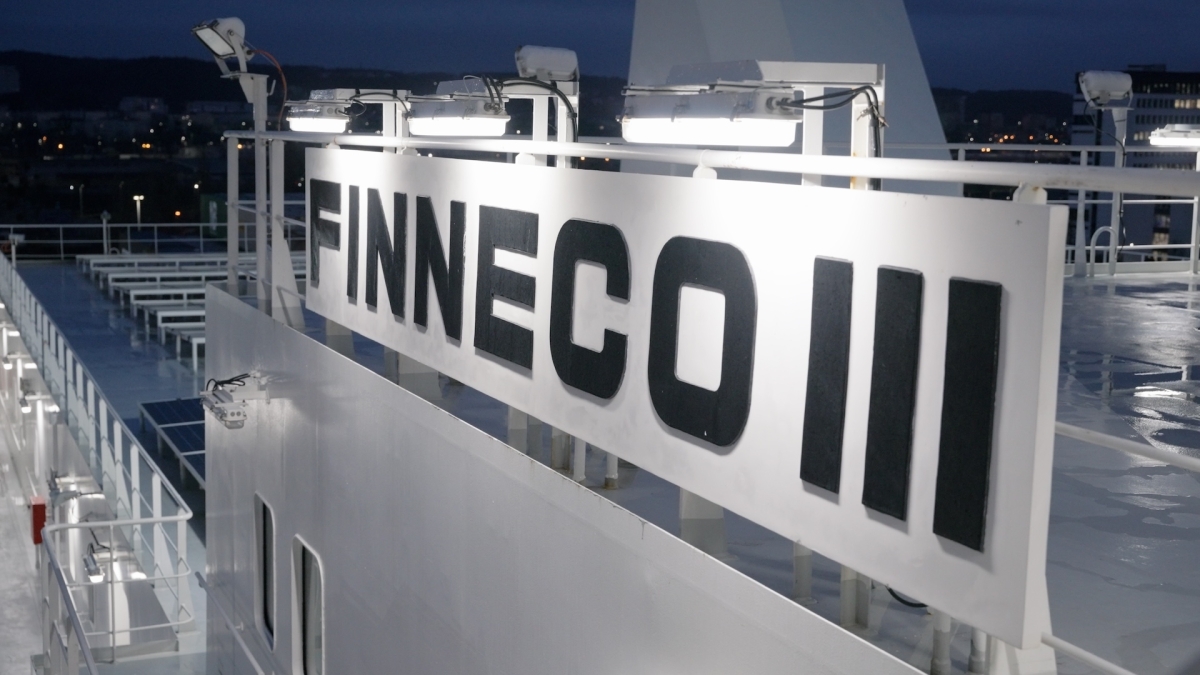


The management of the Port of Gdynia, OT Port Gdynia, and Finnlines have reviewed six months of operations of the ro-ro connection from Gdynia to Bilbao, Spain, via Sheerness in the UK and Zeebrugge and Antwerp in Belgium. While no statistical data were disclosed, all parties emphasized their satisfaction with the collaboration and expressed hope for the route’s further development.
On Friday, December 12, a conference summarizing the six-month operation of the Gdynia–Bilbao ro-ro service, operated by Finnlines, took place at the Port of Gdynia headquarters. Ships of the Finneco series are handled in Gdynia at the OT Port Gdynia terminal and also call at the GCT terminal for container transshipment. On their route from Gdynia, they also call at Antwerp, Sheerness, and Zeebrugge, and on the return journey, they additionally call at Helsinki and Kotka.
Representatives of all three stakeholders, as well as local authorities represented by Emil Rojek, the Deputy Governor of Pomerania, attended the meeting. Rojek emphasized that it is important for regional entrepreneurs that the Finns also see Gdynia as a key cargo port and recognize its development and commitment. Piotr Gorzeński, CEO of the Port of Gdynia, elaborated further on these two aspects.
“Today, we not only summarize six months of service but also confirm that the Port of Gdynia is ready to establish itself on the global logistics map,” said Gorzeński. “With this route, Finnlines has created a strategic connection for industry and people.”
Gorzeński highlighted that the collaboration with Finnlines is based on shared responsibility, including environmental concerns. The service is operated by modern Finneco-class vessels, which produce lower CO2 emissions and generate zero emissions while in port, running on battery power charged during voyages at sea. The ships are also equipped with solar panels to generate additional energy, as well as other technologies like air lubrication systems that reduce fuel consumption. According to Blasco Majorana, Traffic Manager North Sea and Biscay Line at Finnlines, these ships can carry up to 30% more cargo than older vessels while using 20% less energy. Ultimately, the shipowner calculates that emissions per ton-mile are reduced by as much as 63%. Participants at the meeting were able to tour one of the ships, seeing the cargo hold, the deck with solar panels, and meeting the ship’s captain on the bridge.
During his presentation, Blasco Majorana also explained the opportunities the Gdynia–Bilbao service offers Polish exporters. As Finnlines is part of the Grimaldi Group, whose hub is Antwerp, cargo from Gdynia can reach destinations such as Shanghai with only one transshipment en route.
In an interview with Gospodarka Morska, Jerzy Majewski, CEO of OT Port Gdynia, admitted that discussions on launching this service and building commercial and volume support took several years.
“However, the service itself has a strong foundation because ro-ro vessels operate somewhat like a tram – their arrivals and departures are very predictable. This form of transport provides a high level of certainty along a given logistics route,” emphasized Majewski.
Majewski added that in his view, the Gdynia–Bilbao connection has already established its place on the map.
“We continuously see a steady increase in cargo volumes, with new clients, partners, and types of cargo handling appearing—not only trailers but also containers transported by Finneco ships. What started six months ago is slowly bearing fruit, and cargo growth is accelerating. This is because clients need to get used to the connection and integrate it into their networks to meet their customers’ needs,” he said.
Finnlines also views the service positively. Rafał Kwapisz, Managing Director of Finnlines Poland, emphasized that interest in the route remains strong.
“We see it every day in client inquiries and discussions about what will happen next year on this line, as well as on our other services. We have been in Gdynia for over 27 years, so we are no newcomers. We are confident that providing clients with access to virtually the entire world will significantly enhance the role of Gdynia as a window to the world,” said Kwapisz.
The ability to regularly handle Finneco vessels is made possible by recent investments in the Port of Gdynia.
“The old double ramp, which had not been used for a long time, was removed, creating more space at OT Port. The existing ramp was also rebuilt to better accommodate our large, wide vessels—34 meters wide compared to 26 meters for previous generations,” emphasized Kwapisz.
“These types of ships are very welcome at the Port of Gdynia, which, as we know, is located within the city,” added Piotr Gorzeński, CEO of the Port of Gdynia. “We are surrounded by urban areas, with people living around the port, so good air quality is very important. These are modern ships that can enter and operate in the port without using combustion engines and then only activate them at sea after cargo operations are complete.”
 DOWNLOAD PDF