

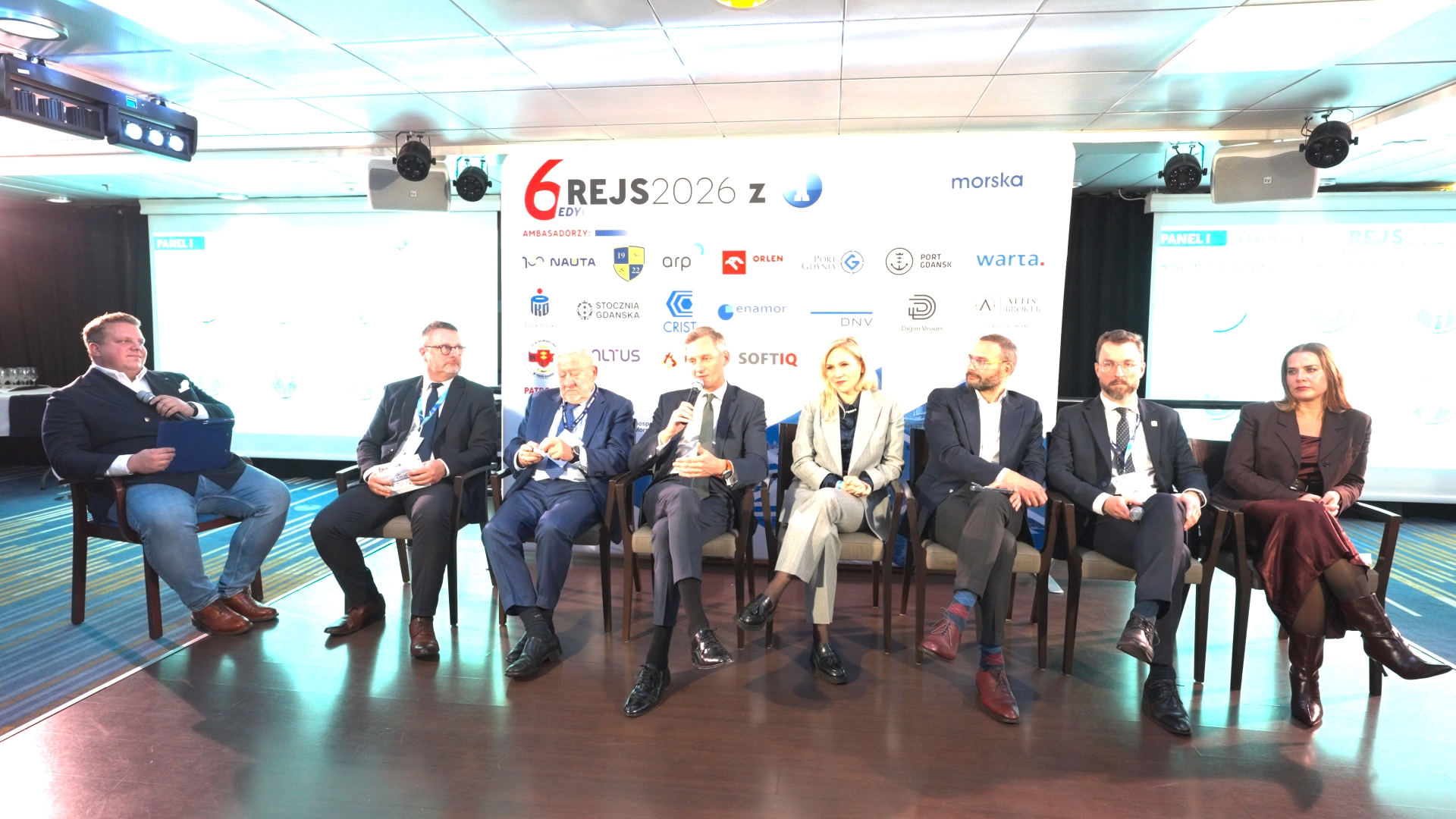


The first electricity generated by Polish offshore wind farms has entered the national grid, but the involvement of Polish companies in the first investments has left much to be desired. During the 6th Rejs z Gospodarką Morską, representatives of industry, shipyards and the offshore sector discussed what needs to change to ensure that the next stages of the sector’s development bring more contracts for domestic companies.
Offshore wind energy in the Baltic Sea is entering a new phase. After years of preparation, design and infrastructure construction, electricity is now being generated by the first Polish projects. It is a milestone the entire sector has been waiting for. However, as the moderator, Jakub Budzyński, President of PIMEW, pointed out, an equally important question for Polish industry is how much of the money spent on offshore development will remain in the country.
During the debate devoted to local content, meaning the participation of domestic companies in investment projects, there was no shortage of optimism about the future of the offshore wind industry. This did not mean, however, that participants considered the results achieved so far satisfactory. On the contrary, representatives of companies expressed clear disappointment with the scale of domestic suppliers’ involvement to date. At the same time, a growing number of businesses see opportunities to secure new orders and develop capabilities that could also be deployed beyond the Baltic Sea.
Polish shipyards want to build more than individual structures
Ireneusz Ćwirko, President of CRIST Shipyard, noted that Polish shipyards had been proposing the construction of jack-up vessels for years. These are used, among other purposes, to install offshore wind farms. CRIST has experience in building such vessels, but despite ongoing discussions, this potential has yet to be fully harnessed in domestic projects.
In his view, some offshore infrastructure components, including offshore substations, are sometimes presented as more complex than the actual scope of work would suggest. High expectations arise around such projects, which can also affect employment and contract execution costs.
Jan J. Grabowski of Gdańsk Shipyard spoke about the company’s strategic development priorities. The company aims to generate 70 per cent of its revenue from offshore activities. The remainder is to come from, among other things, smaller steel structures. The shipyard is investing around PLN 400 million in infrastructure and therefore needs a stable market and further orders. Grabowski pointed out that building entire ships in the current market is considerably more difficult than manufacturing blocks, components and structures for other contractors. In his view, offshore substations could become one of the key areas of development for domestic industry.
Contracts are not gifts to Polish companies
Not all participants viewed local content primarily in terms of the participation of Polish companies in individual orders. Kacper Kostrzewa of Ocean Winds pointed out that developers are not institutions that award contracts to domestic companies at their discretion. Their task is to deliver investment projects, and companies must secure a place in the supply chain by submitting bids that meet the project’s requirements.
“Offshore wind does not hand out contracts; we do not give anything away. And if we do ‘give’ anything, it is an opportunity to acquire expertise in favourable domestic conditions, so that companies can then compete in the international market,” Kostrzewa stressed.
This is an important distinction. The fact that major projects are being carried out in Polish waters does not automatically mean that domestic companies will receive contracts. They need the right technologies, experience, competitive prices, production capacity and track records.
This is where one of the most significant problems facing Polish local content becomes apparent. Companies want to enter supply chains but often encounter requirements relating to previous experience, the scale of operations and delivery deadlines. When the conditions are not suited to the capabilities of new suppliers, securing a first order becomes particularly difficult, even prohibitive.
Ernest Czermański, President of Bota Green Offshore Services, said that his business community had spent four years trying to overcome barriers to entering the market for long-term contracts.
Czermański noted that Polish-capital companies had begun looking for alternative development paths, including in shipping. In his view, there is an opportunity to develop Polish CTV vessels, used to transport crews and technicians to wind farms, as well as SOVs, deployed for longer offshore service operations. However, requirements concerning experience and delivery deadlines have, in his assessment, sometimes been excessive. He also referred to cases in which tender conditions may have favoured particular bidders.
Local content is also about security and shorter supply chains
Ilona Deręgowska of the Industrial Development Agency (ARP) recalled the launch of the “Ready for Offshore” programme, aimed at smaller Polish companies seeking to join the offshore wind supply chain. The programme includes financial instruments intended to help businesses expand their operations and also supports the development of long-term capabilities needed to compete in the market. This is important support for smaller businesses, which often have the necessary potential but need capital and time to adapt to the requirements of major offshore projects. The programme is intended to strengthen their position against larger, often foreign, competitors and improve their chances of participating in future investments.
Not all participants focused on the difficulties of accessing contracts. Jakub Wnuczyński, head of Baltic Towers, pointed out that developing domestic suppliers is a process that takes time but can benefit the entire sector. Manufacturing towers for offshore wind turbines is a complex undertaking. Baltic Towers operates as an integrator, supplying a finished product ready for installation. A network of companies providing services such as loading and maintenance develops around this activity. Wnuczyński stressed that the company was steadily increasing the number of suppliers it works with.
An important distinction exists between a single investment project and production carried out across successive projects. A developer focuses on a specific undertaking, whereas a manufacturer operating over a longer period can provide subcontractors with demand forecasts covering many years. This makes it easier to plan investment, recruitment and skills development.
Wnuczyński also highlighted the importance of domestic capabilities for project security. Shorter supply chains and the ability to respond quickly can reduce the risk of delays. A component ordered abroad at a lower price may ultimately prove much more expensive if its delivery is interrupted or delayed.
In this context, local content does not have to mean abandoning competitiveness. Rather, procurement decisions should take account of the full cost and risk, not just the price of an individual component. A stable order book, predictable schedules and efficient cooperation with subcontractors can, in turn, help reduce production costs.
Dialogue, not just declarations, is needed
Aleksandra Jampolska of Orlen Neptun drew attention to the changing market environment, the development of the “Ready for Offshore” programme and preparations for terminal infrastructure. She also emphasised the role of technical dialogue, which should make it possible to clarify requirements before tender procedures begin and contracts are concluded. This is particularly important for smaller businesses, which do not always have the resources to adapt quickly to complex procedures and non-standard requirements. Early discussions between contractors and clients can help establish what the domestic market can realistically deliver and prevent procurement conditions from restricting competition from the outset.
The development of local content therefore depends not only on the declared level of domestic companies’ participation, but also on how investment projects are prepared. Predictable schedules, reasonable technical requirements and sufficiently early information about planned procurement can give businesses time to expand production capacity and recruit specialists.
The discussion during the 6th Rejs z Gospodarką Morską showed that Poland’s offshore sector already has tangible capabilities, its own projects and companies ready to grow. This does not mean, however, that the level of domestic suppliers’ participation achieved so far can be considered satisfactory. Disappointment with the initial results remains an important part of the market assessment.
Expectations are now focused on the next stages of investment, the development of domestic infrastructure and greater predictability in procurement. The key question will not simply be how many Polish companies enter the supply chains, but whether they can establish a lasting position, expand their operations and win contracts abroad.
Ernest Czermański pointed to an apparent paradox: the success of Polish local content may be demonstrated not only by a sufficiently high level of domestic companies’ participation in Baltic Sea projects, but, above all, by their ability to export services and compete in international markets.
The ambassadors of the sixth edition of the event were TUiR WARTA, the Port of Gdańsk Authority, PGZ Naval Shipyard, Attis Brokers, the Polish Register of Shipping, SALTUS Ubezpieczenia, the Industrial Development Agency, Nauta Shiprepair Yard, Bank PKO BP, Gdańsk Shipyard, CRIST Shipyard, DNV, Dig in Vision, PSP Florian, Softiq and WUŻ.
The conference was organised by the publisher of GospodarkaMorska.pl, MarinePoland.com and ZielonaGospodarka.pl.
Photo: GospodarkaMorska.pl
 DOWNLOAD PDF
