

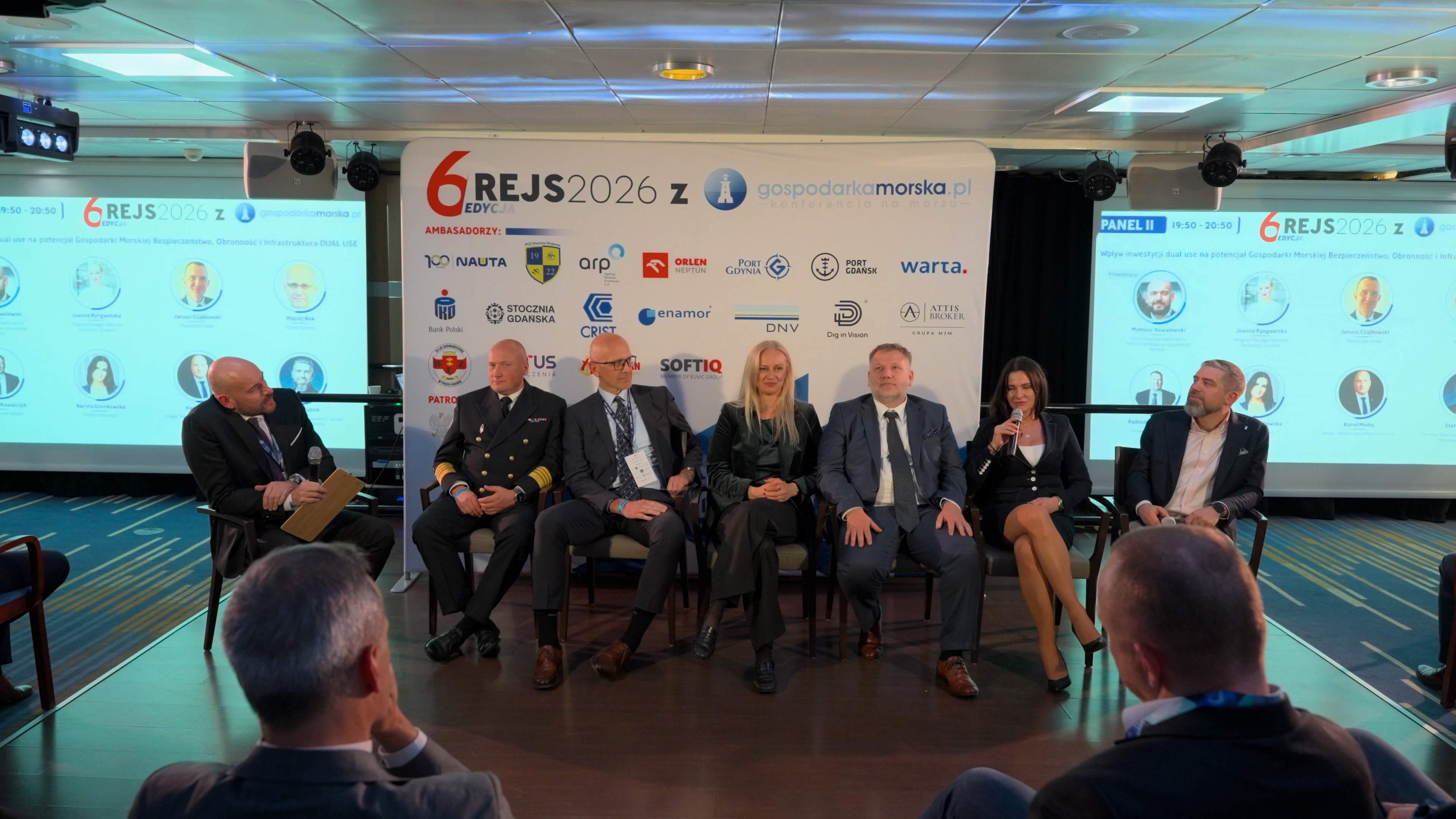


Modern ships, port infrastructure and security systems are increasingly being designed to serve both the civilian economy and defence. This is a response to the changing geopolitical situation, including the growing threat posed by Russia, but also an opportunity for the domestic industry to develop. Participants in a panel discussion at GospodarkaMorska.pl Cruise (Rejs z Gospodarką Morską) maritime event discussed the challenges associated with dual-use technologies.
Dual-use is no longer merely an additional feature of a product in the maritime economy. It is increasingly becoming one of the fundamental principles guiding the design of ships, the construction of quays, the development of information systems and the planning of port investments. Infrastructure that normally serves trade and transport can, in a crisis, support military operations, logistics and the protection of critical infrastructure.
The importance of this approach is growing as the security situation in the Baltic Sea region deteriorates. Russia poses a threat not only in military terms, but also to infrastructure security, shipping and energy supplies. Under these circumstances, the ability to make rapid use of existing resources, ensure efficient information exchange and adapt civilian facilities and equipment for defence purposes is becoming increasingly important.
From warships to information systems
Joanna Ryngwelska of Advance Protection Systems, a company that develops, among other things, complex counter-drone systems, pointed out that one of the most important challenges today is to establish an integrated system for collecting and transmitting information. Individual solutions already exist, but the key is to connect them into a single ecosystem. As she noted, the maritime domain is particularly difficult to monitor using radar. A shared system for alerts, data exchange and information transfer is therefore needed to enable a more effective response to threats. The issue also concerns the protection of naval vessels. Even a modern warship can be vulnerable to attack, particularly when it is in port.
“We are building fantastic vessels, such as the Miecznik-class frigates. But when they are alongside quays, they are the easiest targets,” Ryngwelska observed, emphasising the need to provide them with adequate protection even when they are berthed at port quays.
This serves as a reminder that maritime security does not end with a warship's technical specifications. It also encompasses infrastructure, surveillance systems, information exchange and the protection of vessels while they are alongside.
Dual-use can drive industrial development
Dual-use is not only a response to threats, but also an opportunity for businesses to grow. Maciej Rek of Enamor highlighted the importance of military contracts in enabling companies to expand their operations and plan investments. “Dual-use is a necessity of the moment. It is worth pursuing military contracts,” he stressed.
As he explained, military orders can allow companies to increase production, develop their capabilities and establish a more stable business foundation. Predictable funding is particularly important. Until now, the company has had few projects in which it could count on a long-term prospect of cooperation. The situation is now changing thanks to defence projects. “Having contracts means we can invest and think about the future with confidence,” Rek said.
For Enamor, underwater drones are among the important areas for development. The company also operates in international markets, with exports accounting for approximately 20 per cent of its revenue. Expanding domestic orders, including military contracts, therefore does not have to mean abandoning international expansion. Instead, it can strengthen the company's capabilities and production capacity.
Not just warships
A similar approach is increasingly influencing the way ships are designed and built. Radosław Kowalczyk of Wulkan Shipyard stressed that multifunctionality should be taken into account at the vessel design stage.
“Everything we manufacture should be designed and built on the assumption that it may serve different purposes,” he said. As an example, he cited a tugboat, which should be constructed so that it can tow various types of objects. In his view, dual-use is the right direction for industrial development under current conditions.
Karol Madej, head of the Port Fire Brigade at the Port of Gdańsk, in turn pointed out that the term dual-use does not always best capture the essence of the solutions being designed. In many cases, multifunctionality is a more accurate term. “We are not talking about dual-use; we are talking about multifunctionality,” he stressed.
One example, which is far from trivial, is a field kitchen. It serves to provide meals for firefighters, but must also be capable of feeding people in different circumstances, such as during weather-related emergencies. The same principle can apply to vessels. Madej referred to ships developed in cooperation with WUŻ that combine firefighting capabilities with the ability to provide other services.
The skills of the people involved are also an important element of this approach. “A port firefighter is one and a half commandos,” Madej said, drawing attention to the specific nature of the work and the range of duties associated with port security.
Port infrastructure also serving military needs
Dual-use applies not only to ships and equipment, but also to port infrastructure. Stefan Rudnik, who oversees investment projects at the Port of Gdańsk, emphasised the importance of investments that will enable ports to perform different functions depending on economic needs and the security situation. He also stressed that the design of various solutions must take account of issues such as so-called military mobility.
One example is the coal quay, which is also to be adapted to handle ro-ro cargo, meaning goods transported on wheels. This increases the flexibility with which the infrastructure can be used and expands the port's transport capabilities. Rudnik also spoke about preparing Westerplatte Quay to accommodate naval vessels, including those from countries other than Poland.
When discussing infrastructure protection measures, he highlighted the importance of securing energy infrastructure, including Naftoport and the FSRU terminal, as well as Terminal T5 — facilities that are significant from the perspective of energy security. Terminal T5 is an interesting example in this respect. On the one hand, it is intended to serve as an installation port for offshore wind projects, but it is also to be capable of handling ro-ro cargo, including military cargo, potentially broadening the range of uses for the infrastructure.
Military contracts require discipline
However, expanding cooperation with the military brings not only new opportunities. Karina Gronkowska, President of Hydromech, drew attention to the specific nature of military procurement and the stringent conditions governing contract performance.
“The specific nature of the industry must be borne in mind. There is no option of waiving contractual penalties; you cannot assume that someone will reach an understanding with the military or that someone will turn a blind eye during acceptance inspections. If a contractual penalty is due, it will be imposed,” she stressed.
This is an important caveat for companies considering entering the defence sector. Orders can provide prospects for growth and increased production volumes, but they also require appropriate organisational preparation, adherence to deadlines and the ability to fulfil contractual obligations.
Multifunctionality as the new standard
The discussion at Rejs z Gospodarką Morską showed that dual-use is a way of designing the entire maritime security system: from vessels and underwater equipment to information systems and port protection, as well as quays, energy terminals and transport links. Flexibility is the common denominator. Infrastructure and equipment must be useful in everyday economic activity while also being ready for use in a crisis. For Polish companies, this represents an opportunity to develop their capabilities, invest and secure long-term contracts. For the state, it offers the prospect of making better use of existing resources and increasing resilience to threats.
Against the backdrop of rising tensions in the Baltic, the objective is no longer simply to build more. It is becoming increasingly important to design ships, ports and technical systems so that they can perform a wider range of tasks, while ensuring that the maritime economy remains efficient, competitive and prepared for emergencies.
The ambassadors of the sixth edition of the event were TUiR WARTA, the Port of Gdańsk Authority, PGZ Stocznia Wojenna, Attis Brokers, the Polish Register of Shipping, SALTUS Ubezpieczenia, the Industrial Development Agency, Nauta Shiprepair Yard, Bank PKO BP, Gdańsk Shipyard, CRIST Shipyard, DNV, Dig in Vision, PSP Florian, Softiq and WUŻ.
The conference was organised by the publisher of the GospodarkaMorska.pl, MarinePoland.com and ZielonaGospodarka.pl.
The discussion on dual-use in the maritime economy was moderated by Mateusz Kowalewski, president of our publishing company.
Photo: GospodarkaMorska.pl
 DOWNLOAD PDF
