

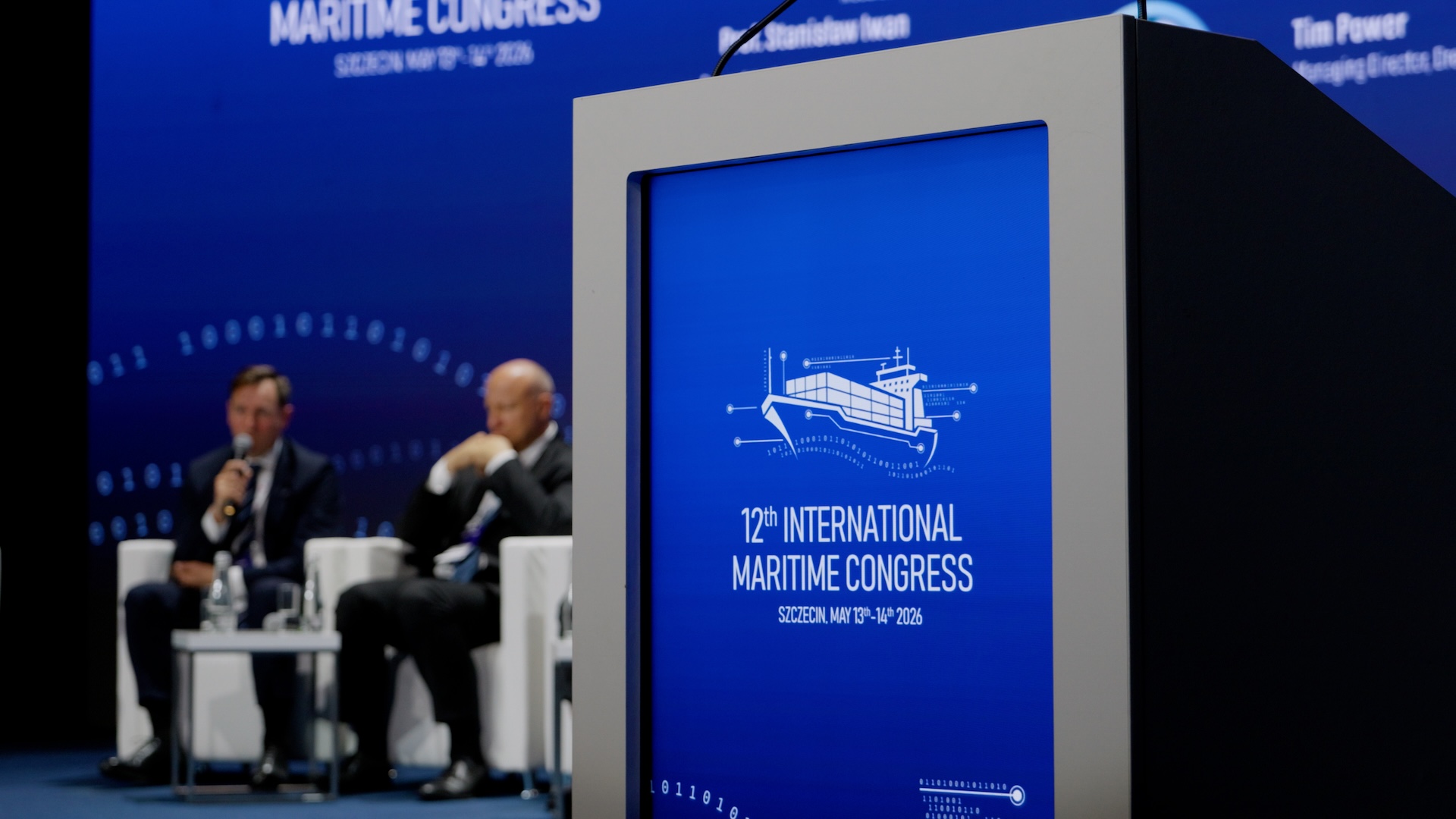


“Describing the Baltic Sea as an internal NATO sea is overly optimistic, as it downplays the threat we are facing,” said Deputy Prime Minister and Minister of Foreign Affairs Radosław Sikorski during the opening of the International Maritime Congress in Szczecin.
This morning, the 12th edition of the International Maritime Congress opened at the Polish Theatre in Szczecin. The opening ceremony was attended by Deputy Prime Minister and Minister of Foreign Affairs Radosław Sikorski and Deputy Minister of Infrastructure for Maritime Economy and Inland Shipping Arkadiusz Marchewka. The congress will last two days – the first day features three plenary debates covering security, regulation, and geopolitical challenges, while the second day will include 12 panel discussions across four thematic blocks: Shipping and Ports, Security, Maritime Industry, and Intermodal Port Infrastructure.
What about last year’s promises?
After taking the podium, Deputy Minister of Infrastructure Arkadiusz Marchewka said he would use the occasion to account for the promises made a year earlier. He outlined the current status of key projects. The first, and arguably most widely discussed over the past 12 months since the previous congress, is the return of the Polish flag to commercial shipping. Marchewka announced that the government has adopted a “Shipping Companies Support Act” aimed at creating conditions for operating under the Polish flag.
The legislation introduces three main changes: it replaces corporate and personal income tax with a tonnage tax (as the deputy minister noted, “for vessels such as those operated by Polska Żegluga Morska, these rates will be the lowest in Europe”), exempts seafarers from personal income tax (PIT), and reduces social security contributions, thereby lowering labour costs.
– “All of this will make shipping operations in Poland profitable again. The new tax regulations will come into force at the beginning of next year. That is when we will begin the process of bringing the white-and-red flag back to Polish ships. The bill is ready, adopted by the government, and has already been submitted to parliament,” said Arkadiusz Marchewka.
Other projects are also progressing. A tender is underway for the construction of a sail training vessel for the Gdynia Maritime University, and a tender for a new research and training vessel for the Maritime University of Szczecin is expected to be announced soon. The ferry Jantar Unity is already in service, and another unit is scheduled to enter operation between September and October this year.
– “More importantly, after years of competition between Polish companies, we now finally have good cooperation and the POLSCA project, which will allow us to rebuild our position in the Baltic after many years of poor decisions,” Marchewka said.
The Szczecin Shipyard “Wulkan”, which had been recording significant losses for years, closed the last financial year with a profit of PLN 36 million. Further work continues on a floating dock being built by the yard for the neighbouring Gryfia shipyard, with two of the three structural sections already launched.
The minister also reiterated that there is no turning back from the construction of the external port in Świnoujście, known as the “Pomerania Cape”. A tender is ongoing for dredging a 70-kilometre approach fairway, a technical road is under construction, and seabed clearance is being carried out at the investment site.

Deputy Minister of Infrastructure Arkadiusz Marchewka also announced new initiatives that are already underway. A tender has been published for the construction of a maritime highway to the ports of Western Pomerania. Under a PLN 150 million project, the navigation fairway at the level of Police will be widened. In the long term, over a 5-kilometre stretch, it is to reach 100 metres in width and 12.5 metres in depth, including a passing place for vessels.
– “Today we have a situation in the port where the largest, 200-metre vessels often have to wait up to a day before entering or leaving the port because it is simply too narrow. We are implementing the Police passing place to ensure that traffic and access to the port of Szczecin and the port of Police are as efficient as possible,” the deputy minister argued.
The existing approach fairway to the port of Świnoujście will also be significantly widened – over a 30-kilometre section it will reach 500 metres in width. At present, traffic is one-way: when a gas carrier enters Świnoujście, traffic is suspended for safety reasons. After the widening, vessels will be able to move in both directions. Marchewka said the government has secured PLN 200 million in European funds for this purpose.
The Baltic is not a NATO Sea
Radosław Sikorski, Deputy Prime Minister and Minister of Foreign Affairs, warned from the stage that we are living in a time of polycrisis.
– “Since the end of February, we have been watching the Middle East with concern. The Gulf states have become hostages to a conflict they did not want and did not start. For over 70 days they have been unable to use a waterway that is fundamental to their economies, budgets, and – more importantly – their security. At stake is far more than freedom of navigation. The consequences of this conflict are felt across the world. Distance matters little. It is no surprise that global attention is focused on the Strait of Hormuz. But it is not the only body of water affected by intensifying international rivalry,” Sikorski said.
One such area where competing forces are currently at play is, of course, the Baltic Sea. The deputy prime minister referred to the shadow fleet, which he described as a “scrap fleet” and “floating environmental bombs.” In his view, the presence of Russians in the Baltic Sea must not be ignored at any point.
– “Describing the Baltic Sea as an internal NATO sea, while tempting after the accession of Finland and Sweden, is overly optimistic, as it would downplay the threat we are facing,” said Radosław Sikorski.

The Polish government considers the Baltic Sea a strategic development direction, but at the same time one that requires significantly stronger security measures. This is where naval capability enhancement programmes such as “Orka” and “Miecznik” are expected to play a key role, alongside “Kormoran” vessels and unmanned systems being developed by Polish maritime companies. Moreover, Sikorski emphasised that strengthening maritime defence capabilities should not be seen solely as a reaction to threats, but also as an investment in the future—building technological competence, creating jobs, and driving innovation. In this way, security is closely linked with the economy.
– “As a member of the European Union, we form the world’s second-largest economy. We have highly qualified workers, well-developed infrastructure, a large consumer base, and substantial capital. But of course, we cannot rest on our laurels. The EU’s share of the global economy is declining, while both the United States and China are gaining advantages in key areas such as artificial intelligence, components used in renewable energy, and the shipbuilding industry. The Union faces major challenges: removing barriers in the internal market, strengthening innovation, and making better use of European financial resources so that European savings serve Europeans. Investments must serve everyone. They must not reinforce divisions between the old and new EU, nor create new ones. Our strength should be cohesion,” Sikorski said. “On the open sea, in such difficult conditions, only well-coordinated crews survive. Let us therefore not fear close cooperation and bold manoeuvres. Thanks to them, the European and Polish ship will finally sail into calmer waters,” he concluded.
Should the Baltic Sea be left to free-for-all competition?
The deputy prime minister expanded on some of these themes in an interview with Piotr Kraśko. One of the key topics was the complex relationship between the United States, China, and Europe, and to some extent also Russia.
– “Rivalry between great powers is structural and unavoidable, but the task of leaders is to ensure that this water in the pot does not boil over—to keep this competition below the boiling point,” the deputy prime minister said metaphorically.
In his view, China should be treated as both a strategic competitor and, at times, a partner. Cooperation with Beijing should take place where possible, partly because of China’s significant influence on Moscow, while at the same time Europe should not уступ ground in areas of dispute, such as China’s territorial expansion in the South China Sea.

The Deputy Prime Minister did not rule out the potential for tighter control over passage through the Danish Straits into the Baltic Sea.
– “Passage through the Dardanelles is regulated by the Montreux Convention. The Baltic Sea does not have such a convention. Originally there was the Copenhagen Treaty, but today general maritime law applies to a basin that is very specific – a very narrow access point to the sea, and a relatively shallow basin,” Sikorski said.
In this area, the Baltic Sea, there are currently threats linked to the shadow fleet, which is also responsible for around 60% of Russia’s oil and gas export revenues. This is accompanied by the destruction of subsea infrastructure and mapping activities. – “Someone is doing this with a specific purpose, and it is not a friendly one,” the Deputy Prime Minister said.
Using an analogy to other modes of transport, Radosław Sikorski stated that maritime traffic in the Baltic Sea should be monitored more closely.
– “There is a reason why we do not allow passenger aircraft from countries that do not meet safety standards into our airports. Such an aircraft is a threat not only to its crew and passengers, but also to people on the ground. The same applies to road transport: humanity invented technical inspections and mandatory insurance for a reason. So why is it still a free-for-all on seas and oceans? I believe these threats show that sensible regulation is necessary,” he said.
Asked by Kraśko whether Poland – following the example of countries such as France, Finland, or Sweden – would also detain suspicious stateless vessels, or whether it would instead avoid escalation, the head of Poland’s foreign ministry replied that “if any threat to Poland’s borders or ecosystem arises – we will respond.” He added that for this purpose, “the Border Guard and the Navy have been given clarified rules of engagement, a Maritime Security Centre has been established to centralise information, and the chain of command has been shortened.”
Radosław Sikorski also reiterated that the Baltic Sea is of key importance, among other reasons because offshore wind farms are being developed there. The situation has changed following the accession of Sweden and Finland to NATO.
– “Russia effectively has only one and a half access points to the Baltic: the Gulf of Finland and the Kaliningrad exclave, but it is not a window to the world for the whole of Russia, as it serves mainly its own supply needs. And ports in the Gulf of Finland are being effectively targeted by Ukrainians. So yes, we have threats, but Russia has far greater problems,” he stated.
The Deputy Prime Minister added that it is not new to him to view Poland as a “southern Scandinavia.” In his view, the pro-European part of Polish politics and society aspires to Scandinavian standards of public life and certain aspects of its social model – a competitive economy and high-quality public services. However, mutual understanding of shared risks is equally important.
– “These are countries that truly share our threat map. In NATO there are countries that do not actually feel threatened, and we know why: geography matters. And the Council of the Baltic Sea States – which Poland is currently chairing – is a group where no one needs anything explained, only what we can do together. It is a group where we understand each other without words, where defence budgets are high. These are the people I would want next to me in a trench if needed,” Radosław Sikorski concluded.
Photos: GospodarkaMorska.pl
 DOWNLOAD PDF