

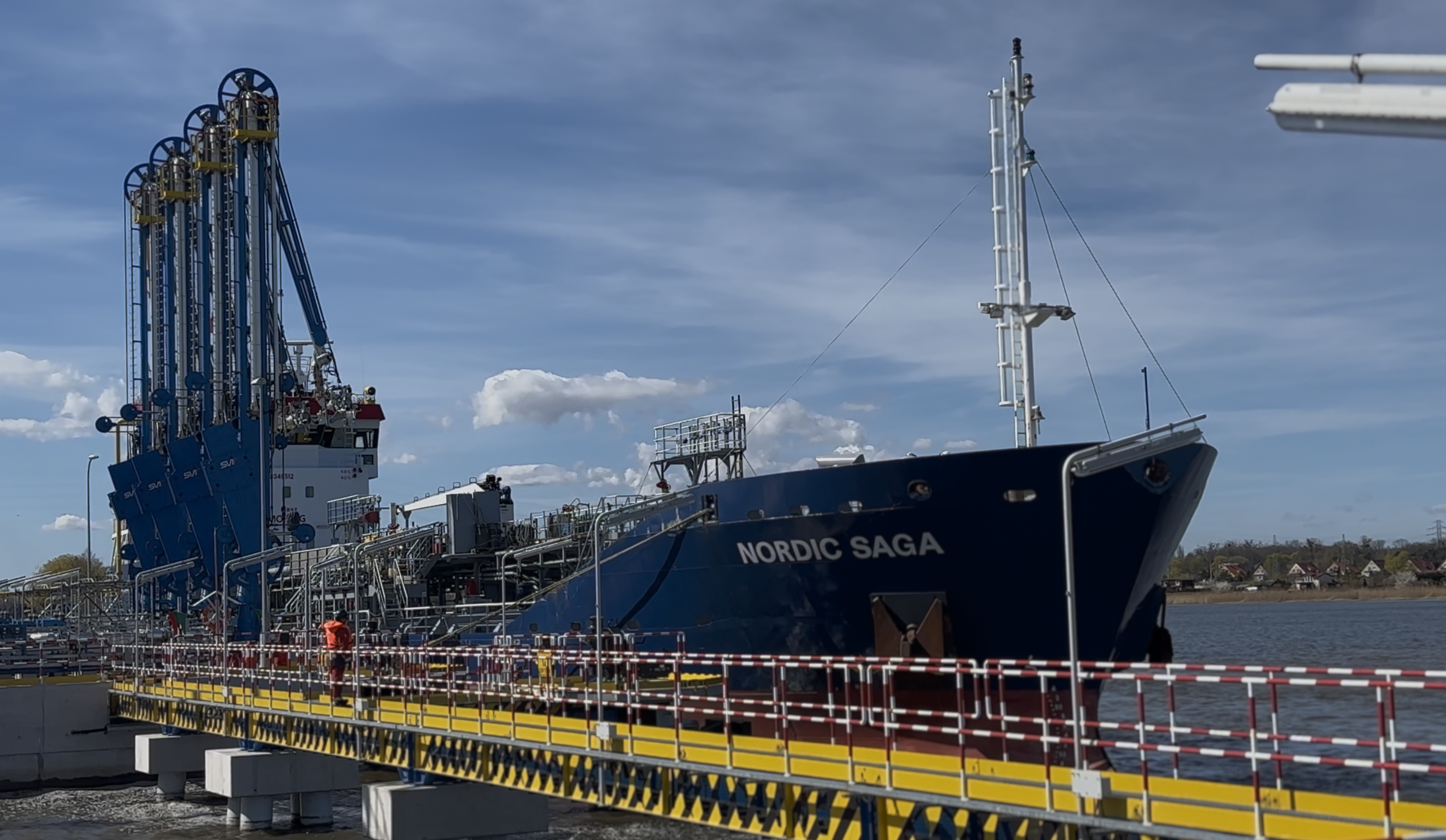


ORLEN has completed the first phase of commissioning at its Marine Transhipment Terminal on the Martwa Wisła. On Monday, 27 April, the ethanol-laden tanker Nordic Saga arrived from the Netherlands at the jetty adjacent to the Gdańsk Refinery. The vessel discharge operation was combined with an official test of the loading pumps.
According to ORLEN, the terminal is scheduled to begin commercial operations in mid-year. The investment, valued at nearly PLN 0.5 billion, is ultimately expected to handle up to 1.8 million tonnes of products annually, improving supply security for the refinery and reducing logistics costs. In its first year of operation, the terminal is set to handle around 100 vessels and tranship approximately 500,000 tonnes of products.
During commissioning, the first vessels have already berthed at the facility. ORLEN has tested eight automated, bidirectional loading arms – each weighing 18 tonnes – enabling the transfer of various product groups between tankers and the refinery.
The final testing phase has been divided into four stages, each involving the transfer of specific product groups between tankers and the refinery. The ORLEN Marine Transhipment Terminal on the Martwa Wisła in Gdańsk features a 380-metre jetty with two twin berths, enabling simultaneous handling of two vessels of up to 10,000 DWT, 130 metres in length, 17.6 metres in beam and 5.8 metres in draught. Each berth is equipped with four loading arms delivering products under 10 bar pressure, with a throughput of up to 500 m³/h.
“We have successfully completed the first stage of technological commissioning. Ahead of us are warranty operational runs and the finalisation of administrative procedures. In the first year of operation, we plan to handle around 100 vessels and tranship 500,000 tonnes of products. The terminal will shorten the logistics chain, reduce rail and road transport usage, and lower the refinery’s operating costs,” said Bartosz Hejcelman, Director of ORLEN’s Logistics Infrastructure Office.
The first set of loading arms is responsible for the export of xylene (a solvent used in the chemical industry) and the import of MTBE and ETBE (octane-enhancing gasoline additives) as well as ethanol (a biofuel blending component). The second handles discharge of FAME/UCOME (for biofuel production). The third is used for loading base oils Group I and II (for lubricants and hydraulic oils). The fourth is dedicated to loading and unloading low-sulphur marine fuels (MGO) used in ship engines and auxiliary systems.
The terminal will handle biofuel components, base oils, marine fuels and refinery intermediates. The first set of loading arms supports xylene exports and additive imports. The second is dedicated to biofuel feedstock handling. The remaining systems manage base oils and marine fuel operations.
ORLEN’s investment is the most technologically advanced transhipment terminal in Poland. Automated control systems support the entire loading process and reduce operational risk. The system automatically selects the appropriate berth, loading arms and valve configuration for each product. Operators can manage operations both from the terminal control room and remotely, directly at the vessel side.
“This is the most modern terminal in Poland, with the highest level of automation in loading, fire protection, monitoring and vessel mooring support systems, ensuring highly efficient and above all safe operations. It is also distinguished by the number of substances that can be handled bidirectionally. The terminal will operate 24/7 with a 19-person team working in shifts. As few as three operators can simultaneously manage two tankers berthed at the quay,” explained Dominik Bork, Terminal Manager at ORLEN in Gdańsk.
The investment has been equipped with extensive safety systems. Remote-controlled fire monitors, each with a capacity of 2,400 l/min, are supplied by a pumping station delivering 500 m³/h of seawater from the Martwa Wisła. The terminal also features oil spill containment booms protecting the water area during operations.
Mooring automation further enhances safety. Quick-release hooks on dolphins allow for rapid unmooring and disconnection of loading arms. Vessel crews are equipped with tablets monitoring mooring line loads and warning of potential overloads.
The new terminal will reduce pressure on the refinery’s rail siding and external ports in Gdańsk and Gdynia. Direct connection to the refinery will increase supply flexibility and enable greater diversification of logistics channels.
Commercial Calls Expected in Summer 2026
As highlighted by Bartosz Hejcelman, the first commercial vessels are expected to call at the Martwa Wisła terminal in July 2026. The new infrastructure is an important element of Poland’s energy security, ensuring continuity of fuel production – including petrol and diesel – while enabling diversification of import routes and reducing reliance on external ports.
“The launch of the Martwa Wisła terminal, through which we will export Group II base oils, will allow us to maximise production and fully utilise the developing HBO installation. At the same time, it will relieve the heavily utilised rail siding at the Gdańsk refinery. Given spatial constraints, we cannot expand it further, so building an additional logistics asset provides diversification of export and import routes,” said Bartosz Hajcelman.
“The terminal will also allow us to reduce rail transport between the Gdańsk refinery and the transhipment port, lowering costs associated with loading and unloading rail tankers and road tankers, as well as transport costs themselves. An additional advantage is the continued ability to use external ports,” he added.
Safety First
Firefighting systems with remotely controlled monitors mounted on 11-metre masts are supplied by a pumping station with a capacity of 5,000 l/min, drawing unlimited water resources from the Martwa Wisła and foam agent tanks. Loading pontoons are equipped with sprinklers. The Martwa Wisła is protected by two 220-metre oil spill containment booms deployed during vessel operations. A third 340-metre boom can be deployed from the shore or from ORLEN Gdańsk Rescue Service vessels.
Automation prevents operational errors in loading procedures. The system prepares the correct berth and loading arm configuration and adjusts valves accordingly. Operators can control loading and mooring either from the terminal control desk or directly from the vessel using remote controls. A “floating mode” enables electronic and mechanical compensation, allowing loading arms to follow vessel movement on waves.
Mooring safety is also enhanced through automated quick-release systems, enabling rapid disconnection of mooring lines and loading arms if required. Vessel crews receive tablets displaying real-time mooring line loads and alerts in case of excessive tension.
 DOWNLOAD PDF