

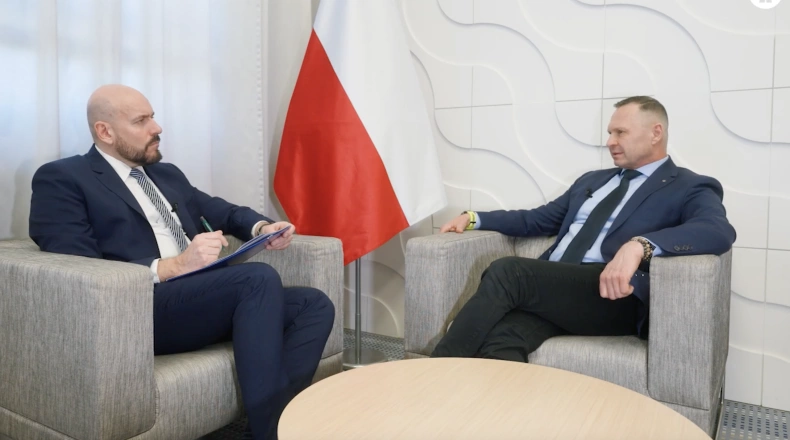


Jarosław Siergiej, President of the Management Board of Szczecin and Świnoujście Ports Authority (Zarząd Morskich Portów Szczecin i Świnoujście), spoke with Gospodarka Morska to sum up 2025 and discuss the key challenges facing both port centres in the coming years.
March is a good time for summaries. We now have a certain distance when it comes to the most important cargo handling results, but also a full spectrum of the key events and investments in the ports of Szczecin and Świnoujście over the past year. Let us begin with cargo handling results and the conclusions drawn from them by the Management Board.
It has become customary to compare successive years of our work in the port with previous ones in terms of cargo throughput and net profit generated by the ports. Starting with the first parameter, namely cargo throughput – in 2025 it increased by nearly 7.5% year-on-year, reaching a volume of 34.7 million tonnes. Let me recall that in 2022, due to extraordinary needs of the Polish economy—driven not by the market but by policy—we experienced the so-called coal surge. At that time, we handled 36 million tonnes, but this was not organic growth; rather, it was artificially created. From this perspective, I am very satisfied with last year’s result, as it reflected genuine market demand, both on the demand and supply side of cargo flows through the ports of Szczecin and Świnoujście.
I would also like to emphasise a very strong net profit of PLN 144 million, which provides us with a solid basis for accumulating capital for future investments, as own contribution is invariably required in every project.
Which cargo volumes stand out? Which are you most satisfied with? Clearly, coal is no longer the leading commodity, so other cargoes must be developing.
Let me begin with the aforementioned coal. It was highly prioritised and placed on a pedestal at a time when our economy and exports were based on coal, and district heating also relied on this “black gold”. However, today, in an era of environmental and climate protection, and the search for alternative sources of heat and energy, coal represents only a marginal share in the port. It is still present, but its volumes have fallen to normal levels for our ports—2–3 million tonnes, rather than, for example, 6 or 7 million tonnes as in 2022.
The year 2025 was dominated by LNG handling. We received the 400th LNG carrier and completed the 82nd LNG vessel call, which generated a very substantial volume within this cargo group. Ferry ro-ro cargo also performed strongly, particularly on routes between Świnoujście and Ystad and Trelleborg.
Other cargo groups also contributed to building the overall volume, which ultimately totalled 34.7 million tonnes.
Events of recent days once again highlight the fundamental role of Polish ports in ensuring energy security. We are seeing war in the Middle East, the blockade of the Strait of Hormuz, and the prospect of consequences for LNG handling, among others, in Świnoujście. How do you assess these risks?
Until now, we have viewed ports primarily as places where cargo changes its mode of transport from land to sea, heading towards its destination or arriving to meet domestic demand. The current situation has also made us realise that ports play not only a commercial role, but are also key elements in ensuring national energy and raw material security. In today’s turbulent and uncertain world, the role of ports has become critically important.
I believe that every maritime nation places significant emphasis and effort on strengthening and developing its ports. As for the situation in the Middle East, particularly in relation to LNG supplies to our terminal, it is difficult for me to predict how it will evolve. According to press reports, LNG from Qatar accounts for around 99% of Poland’s imports. I hope that developments in the Middle East—especially the closure of the Strait of Hormuz or damage to certain gas installations in Qatar—will only delay or slow deliveries, rather than halt them. If necessary, supplies could be sourced from other directions, though that lies beyond our remit. We are ready to handle any LNG carrier from any direction that calls at our terminal.
Since we are discussing security, let us also address the hard, military dimension. Such cargoes and investments are also present in Szczecin and Świnoujście. What volumes of strictly military cargo are handled, and what investments are being undertaken in this regard? How does this look within the framework of the Military Mobility programme?
This is linked to the events taking place beyond our eastern border. We have all felt a degree of anxiety, as the era of relative peace we once enjoyed has clearly passed.
We must prepare for more challenging times, and this is a positive development—we are thinking ahead and taking preventive action. Our port infrastructure is equipped to handle both traditional international trade cargo and specific requirements related to military cargo and equipment. Accordingly, in the Port of Szczecin, we are implementing dual-use investments supported by the Military Mobility programme. These include the construction of an intermodal transhipment yard on Ostrów Grabowski and the modernisation of the ramp at the Finnish Quay in Szczecin.
At present, we are not seeing large-scale military movements of the kind observed in the Tri-City area. Nevertheless, without disclosing details, we are handling military cargo—it is simply carried out discreetly.

Let us return to Świnoujście, but in the context of ferries. The strong performance of Poland’s largest ferry gateway is based on investments in port infrastructure, but in recent weeks Szczecin has also celebrated the entry into service of the new ferry Jantar Unity. How do you assess the impact of new vessels on route efficiency and the potential for further growth and improved operational results?
Ferry shipping on the Baltic Sea is highly attractive. It serves as a bridge between Europe and Scandinavia. Cargo traffic has been observed for decades and has generally grown steadily year-on-year in recent years. In Świnoujście, we operate one of the most important ferry terminals on the Baltic, of which we are very proud. The terminal plays a vital role in cargo flows. It is continuously modernised, as requirements evolve, fleets change, vessel sizes increase, and ramp load capacities differ. Accordingly, we must adapt our equipment and port infrastructure to handle these vessels.
We observe that the trend in the ferry market is towards vessels with longer lane metres. A standard lane length some 10 years ago was around 2,500–3,000 metres. Today, 4,500–5,000 metres is becoming the norm. We are observing similar developments at our terminal.
What gives me particular pride—as a Pole, a resident of Szczecin, and as President of the Port Authority—is that Polish shipowners have decided to invest in new vessels with lane capacities matching current standards. The first such signal is the ferry Jantar Unity, which we had the honour of hosting in Szczecin for its christening ceremony. Following Jantar, as far as I am aware, Bursztyn Unity will join the fleet this year as a sister vessel, with further units expected in the coming years. Undoubtedly, shipowners must keep their finger on the pulse, monitor market developments, and adapt their ferry services to customer expectations. In my view, we are likely to see fewer vessels overall, but with significantly larger capacities—an approach that is rational in terms of voyage optimisation, cost efficiency, and competitiveness.
Another highly interesting topic is the benefits arising from the completed 12.5-metre deepening programme for the Port of Szczecin. A range of investments has been delivered, both in terms of the approach channel and fairway, as well as port infrastructure. Last year was the first in which the Port of Szczecin could fully benefit from these enhanced handling capabilities.
This is indeed one of our most important infrastructure achievements in the Port of Szczecin. In the middle of last year, we completed the project to adapt quays and port basins to a depth of 12.5 metres. I must say that the second half of the year immediately brought tangible results from the deepening of the fairway, basins, and quays.
We handled over 20 vessels with a deadweight exceeding 30,000 dwt. Previously, this was not possible in Szczecin. We used to receive ships carrying around 15,000 tonnes of cargo per call. Thanks to this investment, we were able to double that figure, with a record last year of nearly 50,000 tonnes delivered by a single vessel. We are very satisfied and proud of this achievement.
I believe that this investment secures the development of the Port of Szczecin for decades to come, as further deepening of the approach channel and quays would require complex and costly hydrotechnical structures. At present, there is neither the funding nor the demand for such measures.
Certainly, one area with significant potential arising from the 12.5-metre depth is Ostrów Grabowski, where a number of industrial and port-related projects are being implemented in Szczecin.
Ostrów Grabowski is our development hinterland—an area of over 100 hectares that we are gradually developing and attracting not only port-related businesses but also adjacent industrial sectors.
I would like to mention two investments located in this area. The first is the construction of a wind tower component factory by the Spanish company Windar, which is already underway. The second is a domestic consortium led by Speed and Polski Cement, which will establish both a cement production facility and operations for handling other cargoes, with the aim of generating approximately 2 million tonnes of throughput annually from this area. This represents a significant asset for our port.
Much is currently being said about the role of ports in the energy transition, particularly in relation to offshore wind. Szczecin and Świnoujście are strongly positioned on the Baltic offshore wind map. We have an installation terminal in Świnoujście and a rapidly developing supplier base. How do you view this process within the Port Authority?
We view this process with great optimism, and we have even coined the term “West Pomeranian Offshore Valley”, as the number of entities involved in offshore wind energy here is indeed very large. This is complemented by our latest investment—the installation terminal in Świnoujście. It features over 500 metres of new quay, and, most importantly, the load-bearing capacity of the adjacent storage areas is among the highest in Europe’s offshore sector—500 kN per square metre in areas designated for wind tower installation. This is something we can be proud of and present as our flagship investment in this field.

What is the current progress on the Pomerania Peninsula project? What timeline are you assuming at present, and what is the investment’s potential for Western Pomerania?
The Pomerania Peninsula is our most important investment in the 75-year history of the Szczecin and Świnoujście Port Authority, and undoubtedly of major importance for our company, the region, and the country. It offers the potential for approximately 3 kilometres of quays capable of accommodating the largest vessels able to enter the Baltic, including the largest container ships operating in the region.
The technical depth in the turning basin will be 17 metres. The project will also include a 70-kilometre approach channel with a technical depth of 17 metres, to be delivered by the Maritime Office in Szczecin. What we aim to leave behind is a strong port hub in Western Pomerania with global reach, capable of handling the largest vessels entering the Baltic.
This is a major investment, and as such it involves multiple stages. We have already obtained the first construction permit, covering a technical access road for construction traffic. The route has been surveyed, and we will soon proceed with contractor selection. In subsequent phases—planned for 2027—the schedule предусматриes the construction of land access infrastructure, including the final road and rail connections, as well as offshore works. According to our current timeline, the first handling operations or commissioning trials are expected in 2030.
This is our present schedule. Naturally, as a marine-based investment, it carries numerous risks, which we are actively managing. The main unpredictable factor remains weather conditions—severe winters, strong winds, or heavy seas may temporarily disrupt works. However, we will address such challenges as they arise.
Beyond the container terminal, what function would be most attractive for this part of the Polish coastline?
The container terminal will occupy around 70 hectares, leaving over 116 hectares available for future development. At present, we are focused on delivering the container terminal, while preserving flexibility for future generations to design subsequent phases of the Pomerania Peninsula.
Another key topic is digitalisation—ports 3.0, 4.0, soon 5.0, artificial intelligence, digital twins, and increasing levels of IT integration. Are such solutions being implemented in Szczecin and Świnoujście, moving from concept into practice?
This represents a significant challenge. The NIS2 Directive has entered into force, obliging us to take all necessary measures to ensure cybersecurity. Our ports and IT infrastructure must be secure—this is our primary focus.
At the same time, we are implementing automation and digitalisation projects, with a key role played by Polski PCS, jointly owned by Poland’s major ports. The company has already delivered solutions facilitating cargo flows and clearance processes, integrating with customs agencies and border services to improve efficiency and reduce turnaround times, thereby enhancing competitiveness. We also use applications supporting management, including a brokerage module and an integrated management system.
Internally, we are testing the application of artificial intelligence in our daily operations. We are also seriously considering the development of a digital twin—a real-time, 1:1 digital representation of the port. This will significantly improve infrastructure management, planning of maintenance and new investments, conflict analysis, and capacity assessment.
These initiatives are underway—some are in early stages, others already in implementation, while some remain at the conceptual or pilot phase. Progress in digitalisation and automation is inevitable. We treat it with utmost seriousness and are allocating substantial resources to this area.
From the perspective of over two years under your leadership, what are the key business and infrastructure priorities for the ports of Szczecin and Świnoujście? Which areas will you focus on most?
There are many, but I will highlight the most important. One has already been delivered—the 12.5-metre deepening for Szczecin, which secures the port’s competitiveness for decades. The next step is to encourage port operators to upgrade their equipment to handle larger vessels more efficiently.
Our top priority investment is the Pomerania Peninsula. Equally important are cybersecurity and port protection, as an increasing number of operations are conducted digitally. We must safeguard this environment and prevent disruptions. Digitalisation and automation are among the key initiatives, alongside major infrastructure projects, and will remain high priorities in the near future.
In May, the next edition of the International Maritime Congress will take place in Szczecin. In June, we—as representatives of the Tri-City—invite you to the Polish Ports Congress in Sopot. What are your plans regarding these events?
The Maritime Congress in Szczecin and the Polish Ports Congress in the Tri-City are, for me, the most important events of the first half of each year. I attend both and hold them in very high regard. I encourage the entire maritime industry to participate actively.
 DOWNLOAD PDF