

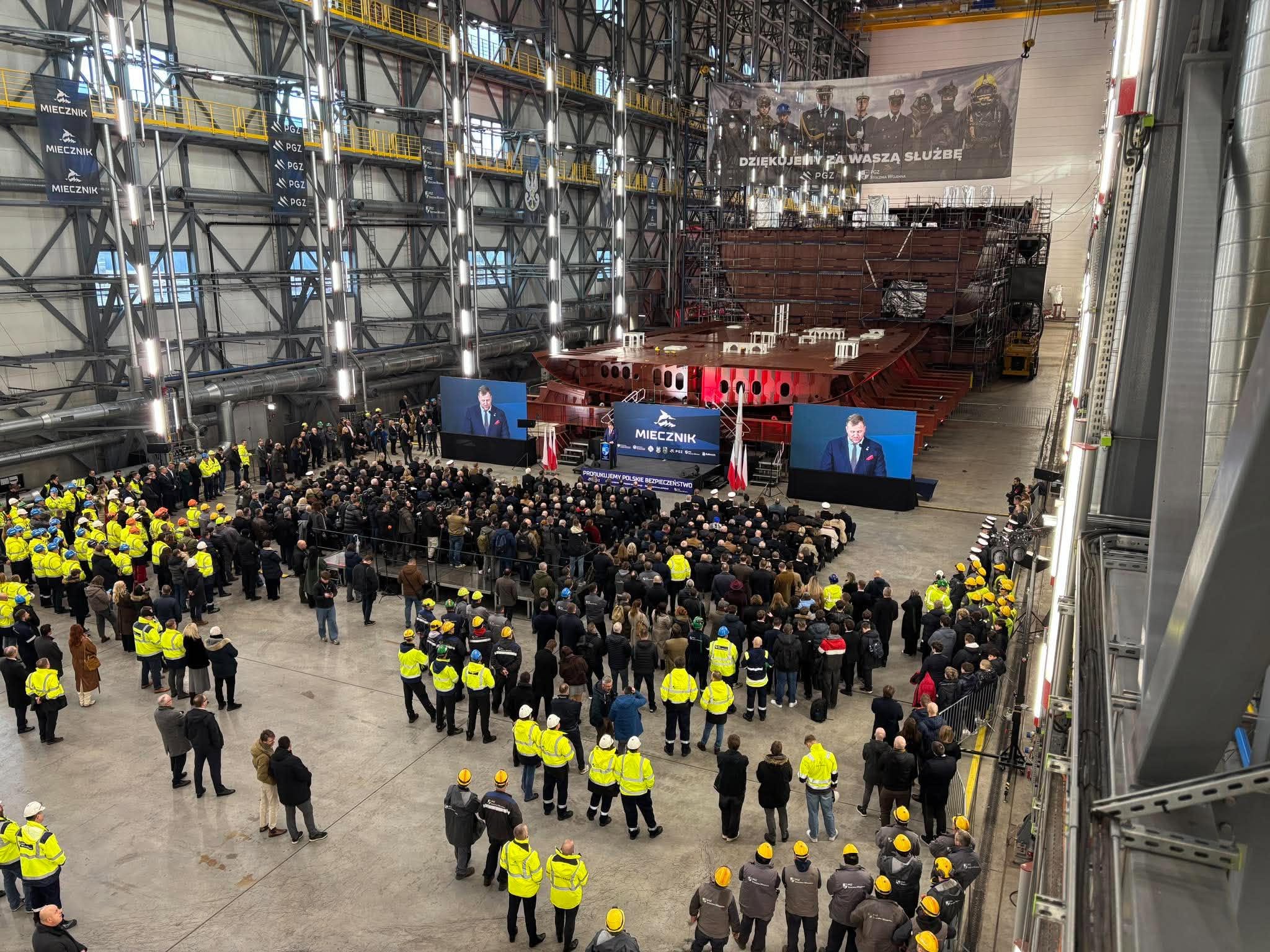


The keel has been laid at PGZ Naval Shipyard for the third frigate being built under the Miecznik programme – the future ORP Huragan. The ceremony took place on 24 November and was attended by government officials, senior naval commanders, and representatives of Polska Grupa Zbrojeniowa, PGZ Naval Shipyard and the other organisations involved in the programme. Once commissioned, ORP Huragan will join the 3rd Flotilla of Ships’ Combat Ship Squadron.
The guests were welcomed by the shipyard’s president, Marcin Ryngwelski. Following the ceremonial speeches, a formal report was delivered confirming readiness for the keel-laying ceremony. Shipyard workers then placed a commemorative medal inside a block forming part of the lower section of the future hull and welded it into place. The ceremony drew on a tradition dating back to antiquity, when coins were placed in the keels of ships to bring good fortune to the vessel and its crew. The document confirming this stage of the project had also been signed beforehand.
Work on the Miecznik programme in its current form began in 2021, when a contract was signed with the Armament Inspectorate for the construction and delivery of frigates. The project is being carried out by the PGZ-Miecznik Consortium, comprising Polska Grupa Zbrojeniowa S.A. and PGZ Stocznia Wojenna sp. z o.o. Its foreign strategic partners are Babcock, Thales UK and MBDA UK. Subcontractors include CRIST S.A. and Nauta Shiprepair Yard, which are responsible for selected sections of the new vessels.
The Miecznik-class frigates are based on the Arrowhead 140 platform, developed from the design of Denmark’s Iver Huitfeldt-class vessels. It is also worth noting that the platform forms the basis for five British Type 31 frigates and four Indonesian vessels known as the Red-White Frigates (Fregat Merah Putih).
The Polish frigates will be 138.7 metres long, with a maximum displacement of up to 7,000 tonnes. This will make them the largest vessels ever built by the Polish shipbuilding industry. Their maximum speed will be 26 knots, with a cruising speed of 12 knots. They will have a range of 8,000 nautical miles. Each vessel will have a crew of up to 187. The propulsion system will consist of four diesel engines in a CODAD (Combined Diesel and Diesel) configuration. Some engines will operate at lower, economical speeds, while the others will be brought online when speed is increased or the vessel is under greater load.

The equipment will include, among other systems, an integrated mission system comprising an integrated bridge, communications system, platform management system and combat management system. The full combat management system, sensors and effectors will include air-defence systems, missile systems for engaging surface-to-surface and surface-to-ground targets, and torpedoes for anti-submarine warfare. Under the planned final air-defence configuration, the vessels will be equipped with Mk 41 vertical launching systems (VLS) and missiles from the CAMM and CAMM-ER families.
RBS15 missile launchers will be used to engage surface and land targets. The artillery armament will comprise an OTO Melara Super Rapid Strales 76 mm naval gun, two 35 mm OSU-35K guns, remotely operated weapon stations fitted with heavy machine guns, and manually operated machine guns. The torpedo armament will consist of two twin torpedo launchers.
The frigates will be equipped with medium- and long-range multifunction radars, a fire-control radar and electro-optical reconnaissance systems, as well as hull-mounted and towed sonars. They will also carry electronic warfare systems. Their armament will enable them to repel attacks across the full spectrum of threats, with operations envisaged in a multi-domain threat environment and the ability to counter attacks from land, sea, beneath the surface and from the air.
It is worth recalling that the christening and launch of the first planned frigate, the future ORP Wicher, took place in August this year. Its place in the Hull Hall has since been taken by its sister ship, the future ORP Burza. The programme envisages the vessels entering service between 2029 and 2031/2032.
Photos: GospodarkaMorska.pl
 DOWNLOAD PDF
