

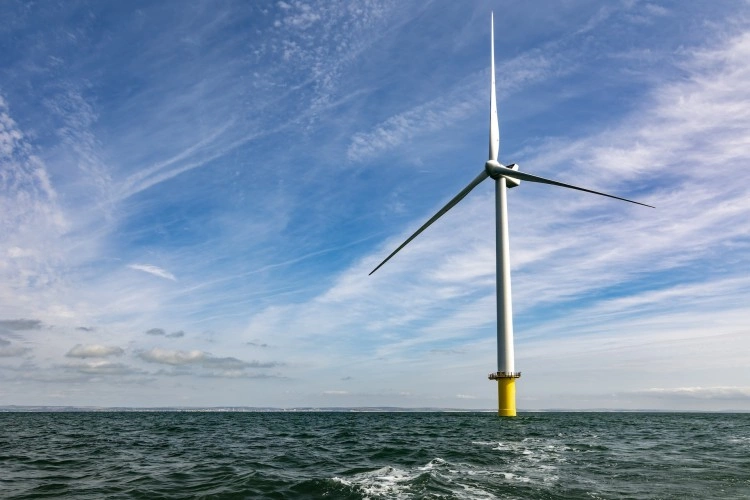


The Polish debate on offshore wind has entered a new phase. Rather than questioning whether the Baltic Sea will generate energy, attention is increasingly focused on how much of the value created will remain within Poland. With this in mind, experts from Baker Tilly TPA and CEE Energy have published a report on domestic local content in offshore wind, entitled “The Economic Impact of Offshore Wind Farm Development in Poland”.
If the full potential of 33 GW is realised, Poland’s offshore sector could generate approximately PLN 897 billion in total investment, PLN 346 billion in added value to the economy, and more than PLN 56 billion in fiscal revenues. The report’s authors also note that the share of domestic companies is not fixed. It increases from 15.64% at 4 GW to 39.56% at 19 GW, with a weighted average local content of 31.99% under the 33 GW scenario.
Offshore as a platform for a new industrial specialisation in Poland
The report was first presented at Offshore Wind Poland 2025, one of the country’s largest events dedicated to offshore wind development. It is now being released more widely at a time when the market is moving beyond ambition to tangible execution signals—following the first offshore auction, ongoing work on the updated National Energy and Climate Plan, and the commissioning of new domestic manufacturing and execution assets.
“The key conclusion from these calculations is straightforward: local content does not grow through declarations, but through market scale, predictability, and continuity of orders. If Poland wants to retain a larger share of value domestically, offshore must be treated not only as an energy project, but as an industrial one. Only then does offshore contribute not just megawatt-hours, but also factories, ports, competencies, and the broader economic balance,” said Maciej Mierzwiński, co-author of the report.
Projects under implementation – tangible outcomes
In December 2025, the Urząd Regulacji Energetyki concluded the first auction for the second phase of offshore support. Winning projects with a combined capacity of 3.435 GW secured 25-year support under Contracts for Difference (CfD), with strike prices ranging from PLN 476.88 to PLN 492.32/MWh. This marks a shift whereby local content is no longer a purely forward-looking concept, but relates to a portfolio of projects entering the execution phase.
The market is already showing tangible evidence of this shift. At the Baltic Power project, turbines are being installed with nacelles manufactured in Szczecin, and the project предусматриes a Polish content share exceeding 21% over its 30-year lifecycle. ORLEN has also declared that it aims to achieve a 45% domestic share in the Baltic East project. Ocean Winds has selected CRIST Offshore as Poland’s first Tier 1 supplier for the offshore substation of the BC-Wind project. Meanwhile, in Gdańsk, Baltic Towers has launched production of the first offshore tower sections in Poland, and a Vestas facility in Szczecin is expected to create several hundred jobs.
“In 2026, local content is becoming an element of state industrial policy and a test of regulatory maturity. The question is no longer whether to strengthen the participation of Polish companies, but how to do so effectively—while complying with competition rules and EU law, and delivering tangible market outcomes,” said Krzysztof Horodko, co-author of the report.
This shift is also evident at the institutional level. In October 2025, the Ministry of State Assets established a task force on the participation of domestic content in key investment processes, and on 19 February 2026 adopted a working definition of local content as a common reference point for strategic investments. At the same time, the concept has entered the broader public debate on state procurement policy and the development of domestic industrial capabilities.
Report methodology
The report is based on the Leontief model and input–output analysis across 33 sectors of the economy, using data from Statistics Poland. As a result, it goes beyond a simple aggregation of contracts, presenting the full spectrum of direct, indirect, and induced effects—from investment and employment to fiscal revenues. The report is available on the Baker Tilly website.
Fot. Depositphotos
 DOWNLOAD PDF