

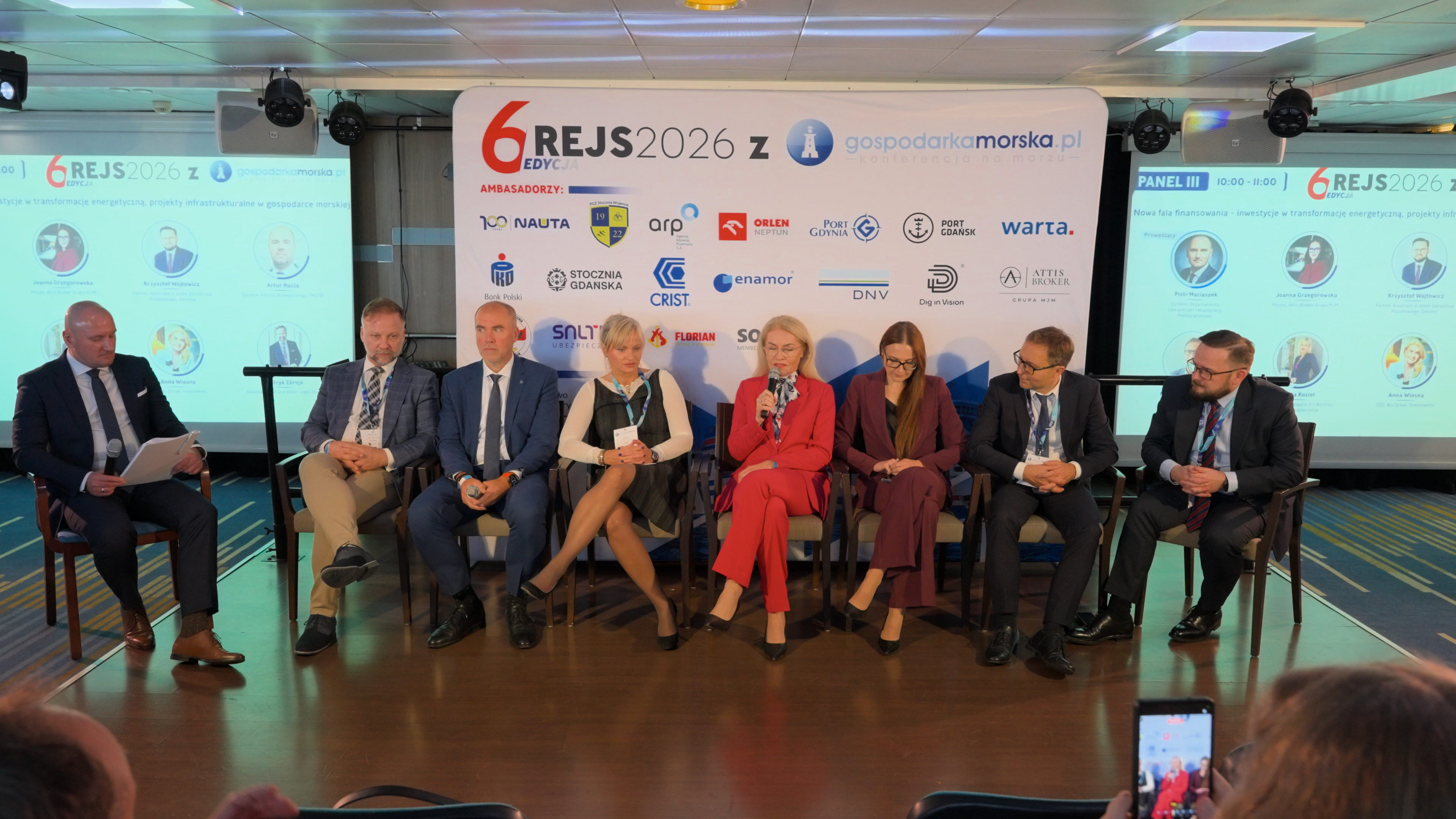


Another GospodarkaMorska.pl Cruise event has come to an end. During the traditional gathering of maritime industry representatives aboard the Nova Star ferry, participants discussed, among other topics, the financial and insurance challenges associated with investment in the sector.
During a panel discussion devoted to financing, insurance and the legal framework for the offshore wind sector, participants agreed that the Polish market is now in a considerably stronger position than it was just a few years ago. Banks have gained experience through projects in the first phase of offshore wind development, the insurance sector has expanded its capacity, and international capital remains highly interested in further investment.
Financing the second phase should not be a problem
Artur Kucia of PKO BP stressed that the first phase of investment had enabled financial institutions to develop a thorough understanding of the specific characteristics of the offshore market. Drawing on the experience they have gained, banks are now better equipped to assess risks and understand the differences between individual projects.
In his view, projects being developed as part of the second phase of offshore wind should, in principle, be able to secure financing from the banking market. In addition, the banking sector currently has excess liquidity, meaning that there is no shortage of capital in the market.
At the same time, he pointed out that banks want to participate not only in financing wind farms themselves, but also in projects undertaken by companies across the entire supply chain. To this end, PKO BP organises workshops with the Polish Offshore Wind Industry Chamber, among other initiatives, presenting businesses with the financing models available to them.
Poland remains an attractive market for investors
Anna Wiosna, CEO of Blue Ocean Investments, noted that the sector is now on the threshold of its second phase of development. Banks and investors have already gained experience from the first projects, although expectations regarding investment returns have also increased.
As she explained, there is less willingness to take risks than there was a few years ago. This does not, however, change the fact that the Polish offshore wind market remains highly attractive. In Wiosna's view, Poland has become one of the most active offshore markets in Europe. Financial institutions involved in the first projects are interested in continuing to participate in further investments, while the high standard of preparation of projects completed to date provides an additional advantage.
Insurers are ready, but risks remain
Joanna Grzegorowska, President of Attis Broker (MJM Group), pointed out that brokers' role today is not limited to arranging insurance cover; it also involves reconciling the expectations of all parties involved in an investment project. As she emphasised, the earlier a broker becomes involved in discussions between the investor, banks and contractors, the easier it is to develop solutions that meet the needs of all parties. In practice, brokers are increasingly becoming market integrators.
However, the specific characteristics of the offshore sector present a challenge. Some of the equipment used is of a prototype nature or is manufactured in small numbers, making risk assessment more difficult. The limited amount of historical claims data also remains a problem.
At the same time, the insurance market is maturing. Just a few years ago, it was practically impossible to obtain insurance for certain war risks in Poland. Today, such solutions are available.
Grzegorowska also pointed out that the principle of local content cannot always be applied effectively to projects on this scale. From an insurance perspective, access to international markets and foreign sources of capital is essential.
Agata Kozieł of Saltus Ubezpieczenia likewise noted that the scale of offshore investment and future nuclear power projects exceeds the capacity of the Polish insurance market to finance them independently.
At the same time, conditions on the global market remain favourable. Reinsurance capital is available, while price pressure is tending to reduce the cost of cover.
This does not mean that there are no challenges. Insurers are reluctant to commit to long-term projects and to the concentration of multiple investments within a single geographical area. Polish offshore wind, however, is characterised both by long development and construction timelines and by a significant concentration of investment in the Baltic Sea.
Cables are a source of claims
Marek Lewandowski of TUiR Warta said that insurers view the development of the offshore market very positively. A new business segment is emerging, creating opportunities for numerous financial and insurance institutions.
He also noted that the sector is using increasingly large and sophisticated turbines. Until recently, turbines with a capacity of 5–7 MW were standard, whereas turbines rated at up to 15 MW are now appearing on Polish wind farms.
According to Lewandowski, however, cables remain one of the largest sources of claims. Approximately 80 per cent of reported incidents concern this part of the infrastructure. Importantly, losses do not arise solely from damage to the cable itself. Much greater costs can be generated by delays, the need to hire specialised vessels or downtime affecting entire projects. In such cases, losses can reach millions of euros.
The greatest need: stable tax legislation
Krzysztof Wojtowicz of Deloitte argued that predictability in the regulatory environment is crucial for investors. In his view, many instruments to support investment are already in place, including a wide range of tax reliefs. The problem is therefore not a lack of tools, but a lack of stability and consistency in how they are applied.
Wojtowicz urged the state administration not to complicate the existing system. In this context, he recalled the investment agreement mechanism, which was introduced several years ago but continues to be used to a very limited extent.
According to him, investors, banks and insurers primarily expect stable rules that will remain in force for many years, as predictability is crucial when assessing infrastructure projects worth billions.
Projects are now credible to the market
Lawyer Patryk Zbroja, in turn, stressed that the strongest argument in favour of Poland's offshore wind sector is the investment now under way. The construction of the first wind farms itself demonstrates that projects have moved beyond the planning and analysis stage. This, in turn, builds confidence among financial institutions and strengthens the credibility of the industry as a whole.
In Zbroja's view, the legal framework for the sector's development is already relatively robust. Contractual matters, effective contract negotiations and the protection of the interests of individual market participants are becoming increasingly important. He also urged companies involved in projects to provide for arbitration and settlement proceedings in their contracts, rather than resorting to litigation, particularly in foreign courts. Legal proceedings generally escalate claims rather than resolve disputes. Mediation and arbitration offer a different approach: by allowing both parties to make some concessions, they can help bring disputes to an effective conclusion and enable the parties to continue working together.
Although panel participants highlighted risks associated with prototype technologies, cable infrastructure, regulatory changes and potential future grid constraints, the discussion was dominated by a sense of cautious optimism. Banks have declared their readiness to finance further projects, the insurance market has access to international capital and reinsurance, and investors continue to regard Poland as one of Europe's most promising offshore wind markets.
The ambassadors of the sixth edition of the event were TUiR WARTA, the Port of Gdańsk Authority, PGZ Stocznia Wojenna, Attis Brokers, the Polish Register of Shipping, SALTUS Ubezpieczenia, the Industrial Development Agency, Nauta Shiprepair Yard, Bank PKO BP, Gdańsk Shipyard, CRIST Shipyard, DNV, Dig in Vision, PSP Florian, Softiq and WUŻ.
The conference is organised by the publisher of the GospodarkaMorska.pl, MarinePoland.com and ZielonaGospodarka.pl.
Photo: GospodarkaMorska.pl
 DOWNLOAD PDF
