
One Frigate After Another. Second Miecznik-Class Vessel Being Built for Polish Navy
Date of publication: 17.08.2026
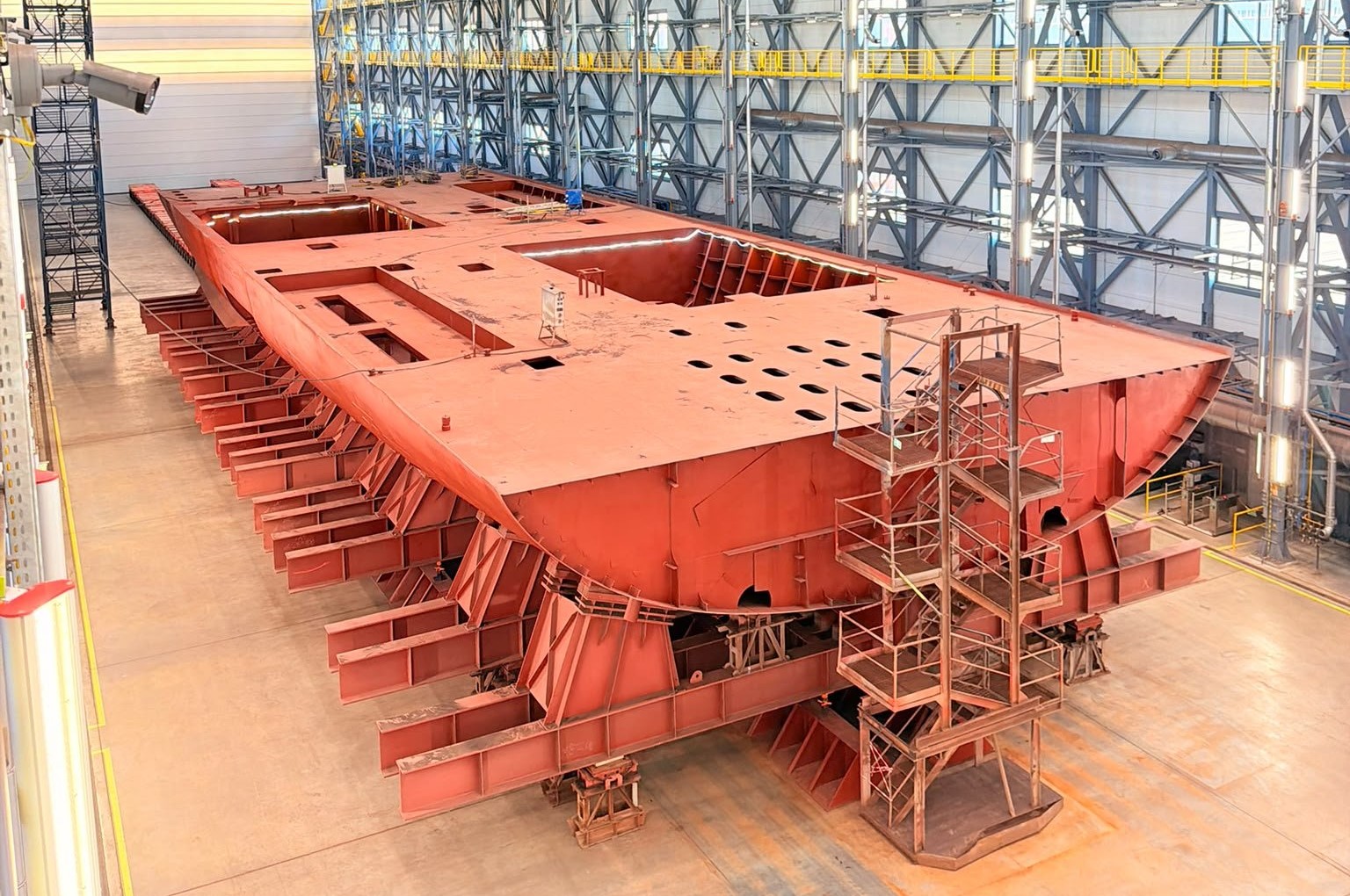
The launching and christening of the Wicher frigate’s hull is connected with the next stage in the construction of the sister vessel. PGZ Stocznia Wojenna reports that segments of the future ORP Burza have already been placed in the Hull Construction Hall. Work on the “Miecznik” programme is progressing.
The photographs presented by the Gdynia shipyard show an element of the future second frigate for the Polish Navy. The plan assumes that its launch is to take place as early as next century. The pace of work is to be accelerated thanks to modernised infrastructure, as well as the involvement of subcontractors. It should be recalled that some of the components are being produced at other Gdynia-based facilities. The bow section of the hull is being built at the CRIST shipyard, while the stern section is being built at the Nauta Shipyard.
Work on the future ORP Burza has been under way since May last year. The keel was laid in December last year. The plan assumes that the vessel will be handed over to the customer in 2030. It will become part of the 3rd Flotilla of Ships’ Combat Ship Squadron, stationed at the Gdynia Naval Port.
In recent times, two milestones have taken place for the “Miecznik” programme: the christening ceremony of the Wicher frigate, described by GospodarkaMorska.pl, and its launch in the waters of the Gulf of Gdańsk using a semi-submersible barge. The ship’s hull is currently at the quay of PGZ Stocznia Wojenna, where it will undergo further fitting-out. The vessel will then undergo shipyard and sea trials before being handed over to the customer. At the same time, intensive training of the ship’s future crew is under way.
The contract for the delivery of three multi-purpose frigates was signed in July 2021. They will replace two older Oliver Hazard Perry-class vessels. The PGZ-Miecznik consortium responsible for the project comprises Polska Grupa Zbrojeniowa S.A. (leader) and PGZ Stocznia Wojenna sp. z o.o., while the project partners are CRIST S.A., NautaShipyard, as well as the foreign companies Babcock, Thales UK and MBDA UK.
The frigates of the “Miecznik” programme will be 138.7 metres long, with a maximum displacement of up to 7,000 tonnes. Their maximum speed will be 26 knots, while their cruising speed will be 12 knots. Their range will be 8,000 nautical miles. The ship’s crew will consist of 187 personnel. The propulsion system consists of four diesel engines in a CODAD (Combined Diesel and Diesel) configuration, MTU 20V8000M71 engines from Rolls-Royce, with some operating at lower, economical speeds and the remainder additionally activated as speed is increased or in the event of a greater load on the vessel.
The ships will be equipped with an integrated mission system from Thales, comprising an integrated bridge, communications system, platform management system and combat management system. The full combat management system, sensors and effectors will include air-defence systems, anti-missile systems, water-to-water and water-to-ground weapons systems, as well as torpedoes for combating submarines. The ships will have medium- and long-range multifunction radars, as well as a fire-control radar and imaging reconnaissance systems, together with hull-mounted and towed sonars. They will be equipped with electronic warfare systems.
Launchers for NSM (Naval Strike Missile) missiles will be used to engage surface and land targets. The artillery armament, in turn, will include an OTO Melara Super Rapid Strales 76 mm medium-calibre gun, two 35 mm OSU-35K guns, remotely controlled weapon modules equipped with multi-calibre machine guns, as well as manually operated machine guns. The weapons will have ranges starting from 40 km, with missiles reaching up to 100 km, while anti-ship missiles will be capable of covering distances of up to 200 km. The torpedo armament will comprise two torpedo launchers. In the target configuration for the ships’ air-defence systems, the vessels will have Mk41 VLS vertical launchers and missiles from the CAMM family, including CAMM-ER.
Individual subsystems are intended for defensive and offensive operations, including the engagement of specific targets. The equipment will also include radars capable of detecting air targets at distances of more than 400 km and surface targets at distances of up to 80 km, a fire-control radar with a range of up to 120 km, sensors for detecting submarines and a towed sonar providing a theoretical range of up to 60 km (this will depend on the target and sea conditions).
Work is also under way at PGZ Stocznia Wojenna on the third of the planned frigates, the future ORP Huragan. Steel cutting took place in April this year. The keel of the vessel is due to be laid in the near future. The ship is scheduled to be launched in 2028 and handed over three years later.
The construction of the multi-purpose frigates has also involved the modernisation of the infrastructure at the Gdynia shipyard. Alongside the Hull Construction Hall, where the hulls of the new ships are being assembled, other new production and administrative facilities have also been built. The quay has also been rebuilt. As a result, work on the new vessels for the maritime forces, as well as their servicing, is expected to proceed more efficiently.