

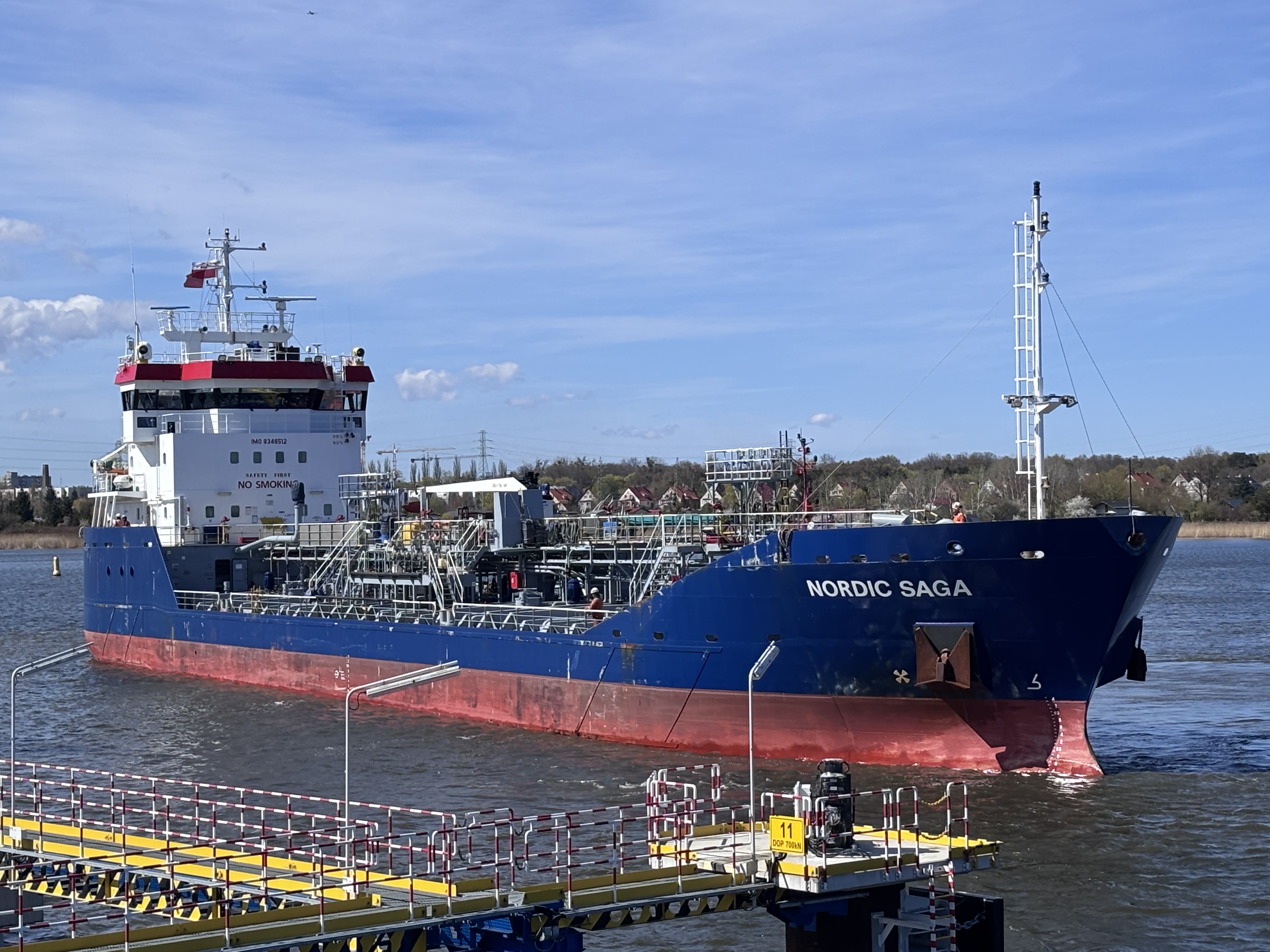


ORLEN has officially commissioned its new Marine Transhipment Terminal on the river Martwa Wisła in Gdańsk, one of the most significant logistics investments completed at the Gdańsk Refinery. The terminal handled its first commercial cargo operation on 15 July, when it welcomed the tanker ECOMAL II.
The new facility is designed to strengthen the security of feedstock and biofuel component supplies for fuel production while improving the efficiency of seaborne exports of refined petroleum products.
The landmark first cargo operation took place in the morning, with ECOMAL II becoming the terminal's inaugural commercial customer. The Polish-flagged bunker tanker, owned by the Gdańsk-based company COMAL, is used to transport and supply marine fuels to vessels.
Built in 1977 at the Wisła Shipyard in Gdańsk, ECOMAL II sails under the Polish flag and carries IMO number 7704057. The vessel measures 64.6 metres in length and 10.4 metres in beam, with a gross tonnage of 999 GT and a deadweight of approximately 1,345 DWT. It primarily operates in the ports of Gdańsk and Gdynia, providing bunkering services and transporting petroleum products across the waters of the Gdańsk Bay.
A Critical Logistics Hub
The terminal has been built on the Dead Vistula River and features a 380-metre quay with two cargo-handling berths, enabling the simultaneous servicing of two vessels up to 130 metres in length and 10,000 DWT. The facility is equipped with eight automated loading arms and a dedicated pipeline system directly connected to the Gdańsk Refinery, allowing products to be transferred without intermediate transport.
The investment was worth nearly PLN 500 million. Once fully operational, the terminal is expected to handle 1.8–2 million tonnes of cargo annually. During its first year of operation, it is expected to serve around 100 vessels and handle approximately 500,000 tonnes of products. The facility is designed to reduce logistics costs, improve supply chain flexibility and decrease reliance on rail and road transport.
The first phase of commissioning was successfully completed, following a series of trial port calls, including one in May 2026, when the tanker Nordic Saga discharged a cargo of ethanol imported from the Netherlands.
Independent of Naftoport
The Dead Vistula Marine Transhipment Terminal further strengthens Gdańsk's role as one of Poland's key fuel logistics hubs. While the Port of Gdańsk is already home to Naftoport—a strategic terminal essential to the country's energy security—ORLEN's new facility operates as an independent commercial terminal.
Naftoport currently has five loading berths capable of handling crude oil and petroleum product tankers, including VLCC (Very Large Crude Carrier) vessels at one of its existing berths. In 2025, preparations began for the construction of a sixth loading berth ("W") at the Northern Quay. The new facility will become Naftoport's second berth capable of accommodating the world's largest crude carriers, measuring more than 300 metres in length and drawing approximately 15–17 metres.
The expansion project includes the construction of a new quay, pipeline bridges, access roads, process infrastructure and environmental protection systems. Once completed, the new berth will increase Naftoport's annual handling capacity by around 9 million tonnes, raising the terminal's total throughput potential to approximately 49 million tonnes of liquid fuels per year. The investment is valued at around PLN 455 million (net), with completion and the start of commercial operations scheduled for the second half of 2028.
Naftoport is part of the PERN Group.
Photo Mikołaj Pilecki/GospodarkaMorska.pl
 DOWNLOAD PDF