

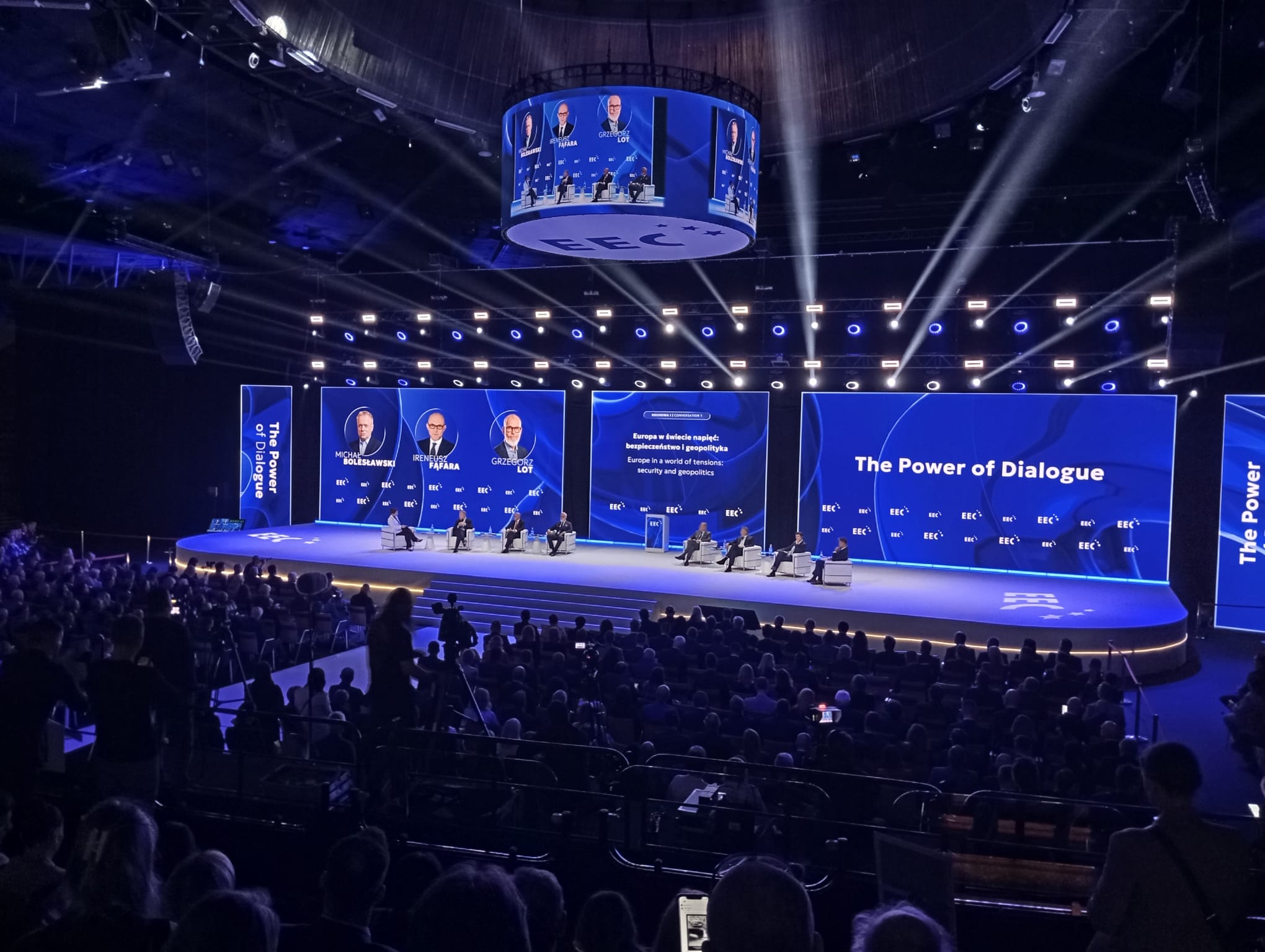


Administrative barriers, delayed procedures, and an overly complex legal framework on the one hand; on the other, increasingly frequent successes of Polish companies on foreign markets and a steadily improving condition of the Polish economy. All of this unfolds against a backdrop of geopolitical chaos and market instability. The opening debate of the European Economic Congress was intended to map Poland’s and Europe’s current situation and to place within it the most important task – the energy transition.
The opening of the European Economic Congress took place on the main stage of the iconic Spodek arena in Katowice. After speeches by the organisers and Jerzy Buzek, who stated that “we must learn to live in a completely different world” and that the “extraordinary peace dividend has come to an end,” discussions turned to entrepreneurship and the economy. The stage was divided into two parts. On one side, alongside Aleksandra Helbin, editor-in-chief of WNP.pl, guests discussed the energy transition: Michał Bolesławski, CEO of ING Bank Śląski, Ireneusz Fąfara, CEO of Orlen, and Grzegorz Lot, CEO of Tauron. On the other side, together with Piotr Kraśko from TVN, business representatives debated the gap between ambition and market reality in Europe’s reindustrialisation: Krzysztof Pawiński, CEO of Maspex Group, Michał Sołowow, owner of Synthos, and Johan Pelissier, CEO of Airbus for Europe.
Politics, commodities and energy
Aleksandra Helbin asked Ireneusz Fąfara whether it is currently possible to separate energy and raw materials issues from politics and leave them entirely to market forces, or whether Orlen is already not only a business entity but also a tool of state policy. The Orlen CEO made no attempt to hide that the company operates in both dimensions.
“On the one hand, raw materials are the foundation of the economy; energy is indispensable and conditions economic development. On the other hand, they are also a tool we must be prepared to use. In this sense, energy, security and resilience are essential for us in Europe,” Fąfara said. He has no illusions that energy is also a “weapon used by some.”
In his view, Orlen is part of the national resilience mechanism, similar to other state-owned fuel and energy companies in different countries.
“This is not a contradiction – being such a tool and at the same time an economic entity,” the Orlen CEO said.
Grzegorz Lot, CEO of Tauron Nowa Energia, stated that the greatest influence on the energy sector comes not from politics but from customers – “how we behave, consume and invest.” However, he acknowledged the scale of transformation currently affecting the sector.
“There is enormous pressure for energy not to be just a business, but an element of the economy. Today, energy determines development and investment,” he said.
Lot also encouraged rejecting the idea that, in times of geopolitical instability and threats, decarbonisation efforts should be postponed to an unspecified future.
Michał Bolesławski, on the other hand, argued that politics does significantly influence investment, including in energy. Paradoxically, however, he noted that the situation in the Persian Gulf is having a positive impact on perceptions of the Polish economy.
“We are relatively far from that region, and we have a fairly well-secured energy mix. This situation will continue to contribute to deglobalisation and highlight the need to locate investments closer to end consumers,” said the CEO of ING Bank Śląski.
Migration, geopolitics, transformation
Piotr Kraśko and his guests sought answers to the question of what must happen for Europe to be considered a suitable location for industrial investment. Krzysztof Pawiński identified three key areas that governments and societies should address: appropriate migration policy, energy transition, and regulation. In his view, in several respects Poland has avoided mistakes made by Western countries, due to its restraint and more limited resources. However, the country still faces a major problem with lawmaking.
“We must stop the legislative diarrhoea – producing tens of thousands of pages of law every year, which creates administrative burden. The weaker the state, the more laws it produces,” he said.
Michał Sołowow expressed a similar view.
“Poles are earning more and living in an increasingly better environment, but we are losing competitiveness. We need a rationally designed migration process. The last element is fast, effective and bold implementation of technology and its continuous improvement,” said the head of Synthos.
Johan Pelissier, in turn, drew attention to defence. Over the past years, Europe’s defence budget has doubled, and he expects it to double again within the next five years. However, in 2023, 70% of defence equipment was purchased outside Europe. Today, Europe is increasingly gaining the capability to procure it within the continent.
 DOWNLOAD PDF