

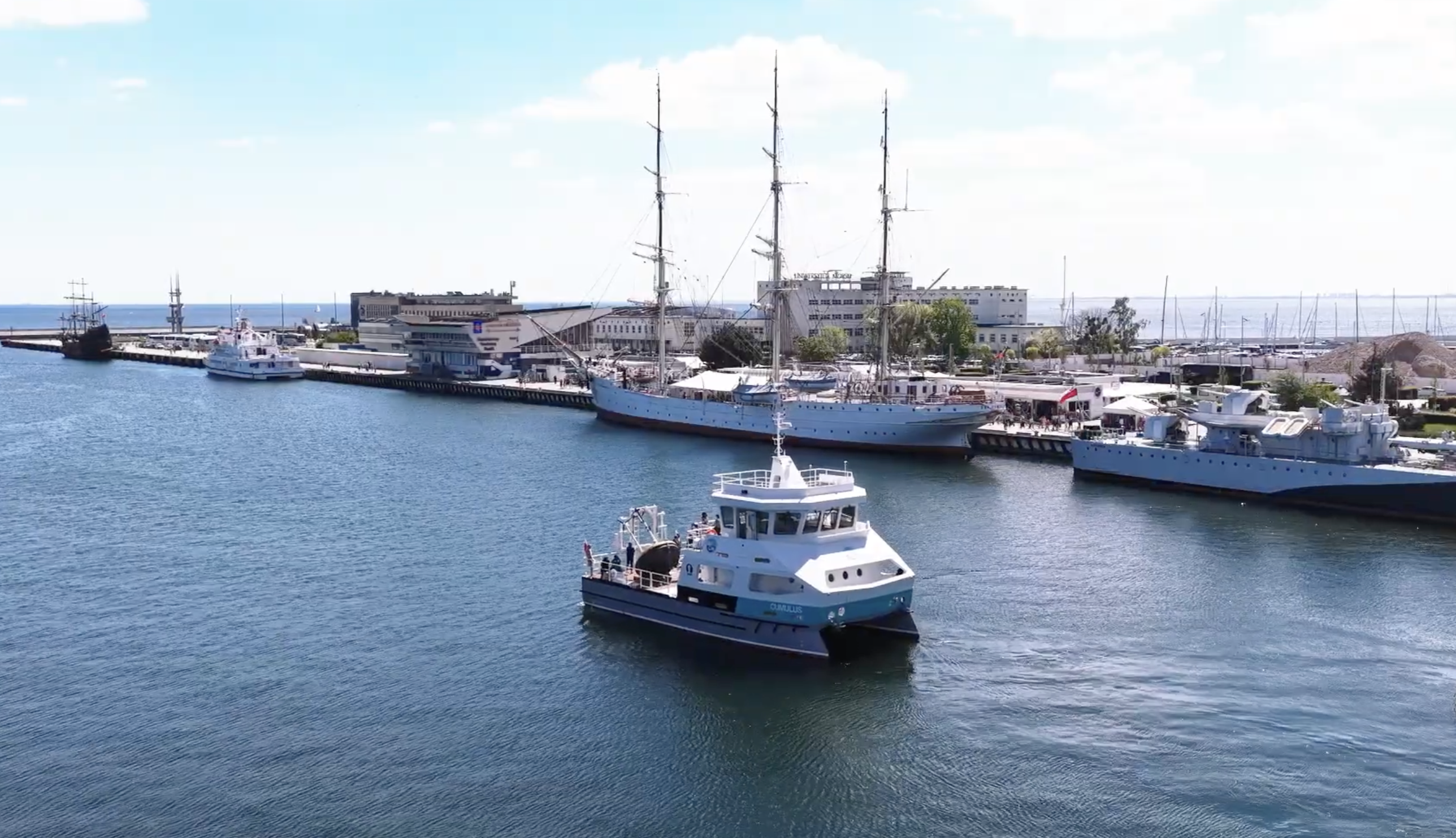


Polish designer, Polish shipyard, Polish operator, Polish flag, Polish crew, Latin name – Cumulus is the new catamaran of the Polish Institute of Meteorology and Water Management.
Cumulus is a new catamaran delivered to Poland’s Institute of Meteorology and Water Management (IMGW). The 18-metre vessel will support the marine measurement system in the Baltic Sea, while also being used for a range of additional tasks. Last week, the vessel officially received its name in Gdynia and is now ready to enter service.
Cumulus ready for operations
The new catamaran was christened in Gdynia, with Professor Tamara Zalewska, Head of the Department of Oceanography and Baltic Monitoring at IMGW-PIB, serving as the vessel’s godmother. Guests gathered at the President’s Quay were given the opportunity to board the vessel and speak with the crew. During the ceremony, IMGW Director Professor Robert Czerniawski also officially handed over command of the vessel to Captain Bartosz Zakrzewski. In practice, the ship was ready to commence operations immediately afterwards.
– All the paperwork is already in place, so the vessel is fully operational. The only thing missing was its name – said Director Robert Czerniawski.
Cumulus is an aluminium catamaran measuring 18 metres in length and 9.2 metres in beam. It was specifically designed and built for IMGW-PIB. Its primary role will be servicing meteorological and oceanographic buoys in the Baltic Sea, although Director Czerniawski admitted that the vessel may also be tasked with additional duties.
– The vessel is primarily intended to service measurement equipment deployed in the Baltic Sea, collecting data on wave conditions, pressure, wind and temperature, but it will also be used as a platform for moving between water sampling stations for water quality monitoring. I also believe – in fact, I am convinced – that this vessel will contribute to the country’s military security, as all collected data will be continuously shared with the institutions responsible for Poland’s defence – Director Robert Czerniawski told Gospodarka Morska.
The vessel has been fitted with modern research equipment. It features a full set of winches, a stern lift and a deck crane, but that is not all – there is also space for an ROV capable of operating at depths of up to 150 metres. Importantly, despite the vessel’s relatively compact dimensions, designers managed to provide a sizeable working deck. Cumulus is also equipped with an underwater navigation system for the precise positioning of measurement equipment.
One notable technical feature is the prototype stern-mounted buoy handling system implemented aboard the catamaran. Instead of simply hauling buoys onto the deck in the conventional manner, the system allows them to be lifted and secured alongside the hull, enabling personnel to safely board the buoy and carry out maintenance work.
The choice of a twin-hull configuration was also deliberate. It is intended to provide Cumulus with high stability, even in difficult sea conditions. The vessel’s operational range exceeds 400 nautical miles.
– Crew safety is, of course, the priority, but thanks to this vessel we will be able to repair equipment even in challenging meteorological and hydrological conditions – explained Professor Czerniawski. – The previous vessel was much smaller, which made such work extremely difficult, yet these tasks still had to be carried out in the interest of public safety. Here, that risk has been significantly reduced.
The standard crew of Cumulus will consist of four people, although additional personnel can be accommodated if required.
Cumulus is entirely Polish-built
At a time when discussions surrounding the Polish flag registry remain highly topical, it is worth noting that Cumulus has been registered in Poland and therefore sails under the white-and-red national flag. Naturally, as the vessel is operated by IMGW, it will also be manned by a Polish crew. The catamaran itself is entirely a Polish product – it was designed by the Gdańsk-based design office Seatech Engineering and built at the Jabo shipyard in Gdańsk.
Cumulus was developed on the basis of Seatech’s SE-216 design. The company prepared not only the vessel’s overall technical design, but also the working drawings for the hull and onboard equipment. The shipyard was responsible for the interior architecture and electrical systems. The vessel was built under the supervision of the Polish Register of Shipping, while model testing was carried out by the Ship Design and Research Centre in Gdańsk.
Speaking to Gospodarka Morska, Jabo Shipyard President Paweł Wierzchowski admitted that building Cumuluspresented a challenge for the company.
– Due to the vessel’s length, which was strictly defined by the technical specification and tender requirements, meeting the required speed parameters proved challenging – said President Wierzchowski. He added that the vessel achieves a cruising speed of 10.5 knots and a maximum speed of 11.5 knots.
– The vessel was also required to be fitted with an SCR exhaust gas cleaning system, which in practice is still not commonly found on many vessels in Poland. It was therefore, in many respects, a pioneering installation – he added.
The shipyard signed the contract for the delivery of the vessel in mid-2023. The construction cost amounted to approximately PLN 12 million. For Jabo, this is another project delivered in cooperation with Seatech Engineering. However, the shipyard’s president also stressed that the project serves as a textbook example of local content.
– It demonstrates that Polish companies are capable of building such complex vessels entirely in-house – from the design stage through to turnkey delivery – and these vessels would, incidentally, be very well suited for servicing the offshore market. In my view, this is exactly the type of vessel that should be built and supplied to other public institutions by Polish companies in order to support our domestic industry. They could later also serve as training vessels for crews. At present, there is significant demand for this type of unit to support the offshore wind farms currently under development, but there is a shortage of crews and operational experience that still needs to be gained in this field – noted Paweł Wierzchowski.
Photo: GospodarkaMorska.pl
 DOWNLOAD PDF