
Yet Another Polish Wind Farm Starts to Rise Above the Baltic Sea. First Foundations Are Being Installed - MarinePoland.com
Yet Another Polish Wind Farm Starts to Rise Above the Baltic Sea. First Foundations Are Being Installed
Date of publication: 25.05.2026

Installation works have commenced on another offshore wind farm in the Polish Baltic Sea — the third such project already under construction. Following the Baltic Power and Baltica 2 projects, overseen by Polish state-controlled companies, a privately led development has now entered the installation phase: the Bałtyk 2 and Bałtyk 3 offshore wind farms owned by Equinor and Polenergia.

Polenergia, the largest private energy group in Poland, announced that the first foundations for the Bałtyk 2 and Bałtyk 3 offshore wind turbines have been successfully installed in the Baltic Sea. The project is being developed jointly by Polenergia and Norwegian energy giant Equinor.

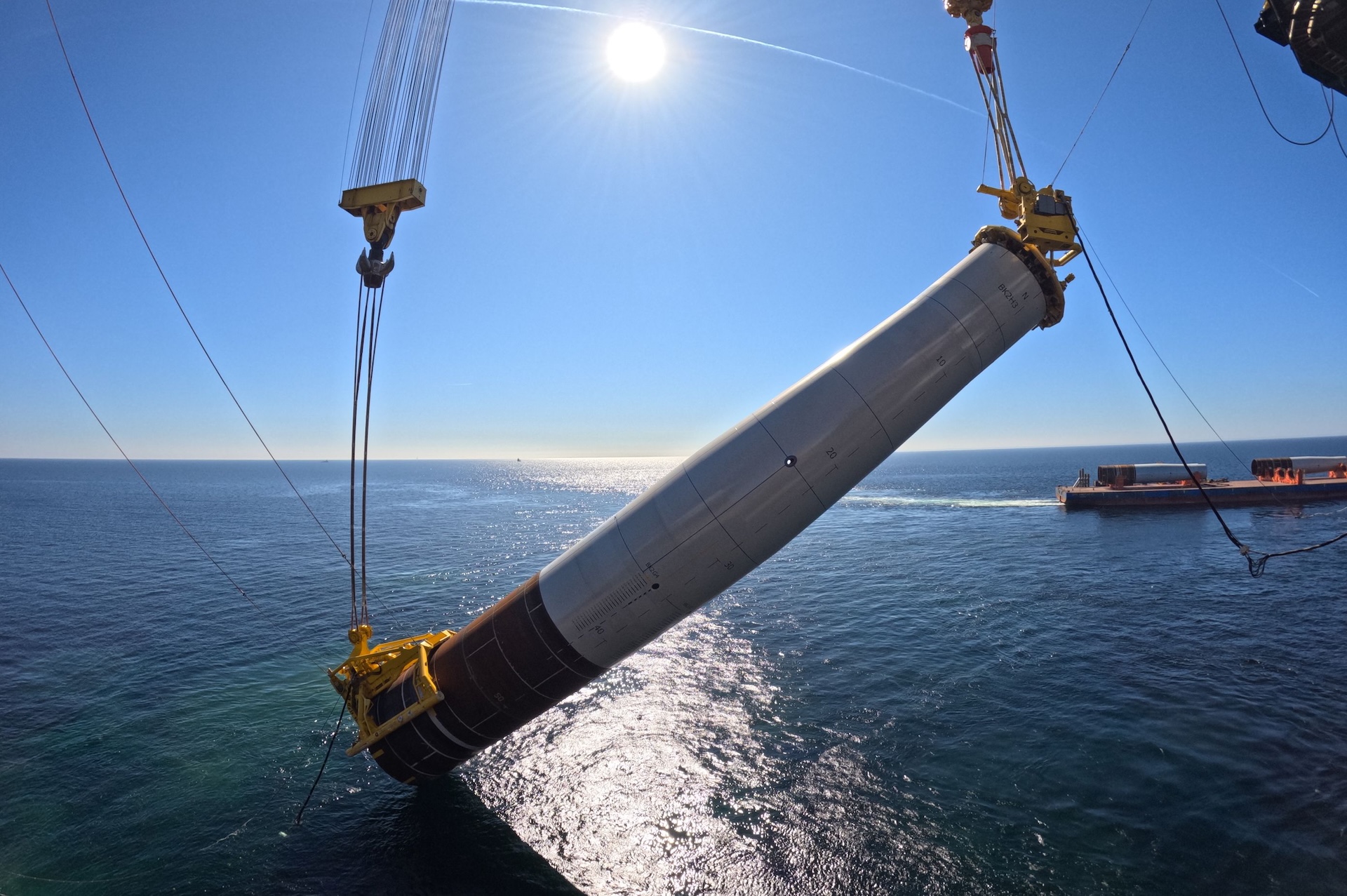
According to information provided by Polenergia, the first several sets of monopiles and transition pieces have already been installed. Monopiles constitute the foundations of the turbines — massive steel tubes driven dozens of metres into the seabed, onto which transition pieces are mounted. These transition pieces will subsequently support the wind turbine towers and additional equipment, including infrastructure used for mooring service vessels.

Installation works on the Bałtyk 2 and Bałtyk 3 projects are being carried out by one of the world’s largest offshore installation vessels, the Thialf, operated by Heerema Marine Contractors. The crane vessel, measuring 201.6 metres in length and more than 88 metres in width, lifts the monopiles from the heavy-lift transport vessels Rolldock Sun and Rolldock Sea before positioning them vertically and installing them into the seabed.

Depending on the planned location, each monopile measures between 50 and 70 metres in length. The dimensions of the foundations have been designed so that their tops extend several metres above sea level. Transition pieces approximately 17 metres high are mounted on top of them. Wind turbine towers and, ultimately, the turbines themselves will then be installed on these structures. Those works are scheduled for next year. Polenergia added that the installation of jacket support structures for the two offshore electrical substations is also planned for later this year.

The developer also stated that particular emphasis is being placed on maintaining high environmental protection standards during the works. Before the installation campaign commenced, numerous environmental surveys were carried out in order to eliminate any potential interference with marine mammal habitats.

The installation itself is being conducted using a so-called “soft start” procedure — beginning with the weakest and quietest hammer strikes from the Thialf, with the force gradually increased over time. This approach ensures that marine mammals present in the area are effectively warned and have sufficient time to move away to other parts of the sea basin. The installation area is also surrounded by a bubble curtain system, which further reduces underwater noise levels.

Twelve vessels are currently involved in the construction works on the Polenergia and Equinor offshore wind farms in the Baltic Sea. In addition to the installation vessel itself, the fleet includes support ships responsible for transporting components and crews, as well as auxiliary units tasked, among other things, with ensuring the safety of the entire operation. According to the developer, “the campaign is supported by ports in Poland and other European countries”. The service base in Łeba is also involved in the project.

“We have successfully commenced offshore installation works for Bałtyk 2 and 3. This is a complex and demanding stage, based on close cooperation and precise coordination between numerous teams and vessels. The initial works are progressing according to schedule, while maintaining high standards of safety and quality,” said Michał Jerzy Kołodziejczyk.

“Poland’s energy security is becoming increasingly dependent on the Baltic Sea. Offshore wind energy is entering the phase of tangible implementation, and our Bałtyk 2 and Bałtyk 3 projects are beginning to take shape as infrastructure of strategic importance. This is an important step not only for the projects themselves, but also for the development of domestic competencies, a modern economy, and the growing role of Polish companies in the offshore sector,” commented Adam Purwin.

The simultaneously developed Bałtyk 2 and Bałtyk 3 projects will have a combined installed capacity of 1,440 MW, sufficient to meet the electricity demand of approximately 2 million households. The wind farms are scheduled to commence operations in 2027, although full commissioning is planned for 2028.

Bałtyk 2 and Bałtyk 3 are the latest Polish offshore wind farms to enter the offshore construction phase. More advanced works are currently underway on the Baltic Power project, developed by ORLEN and Northland Power, as well as Baltica 2, a project implemented by PGE and Ørsted.


Photo: Thomas Sola/Equinor
Most recent