
Port of Gdańsk and Port Gdański Eksploatacja Expand Agricultural Cargo Handling Capabilities - MarinePoland.com
Port of Gdańsk and Port Gdański Eksploatacja Expand Agricultural Cargo Handling Capabilities
Date of publication: 27.07.2026

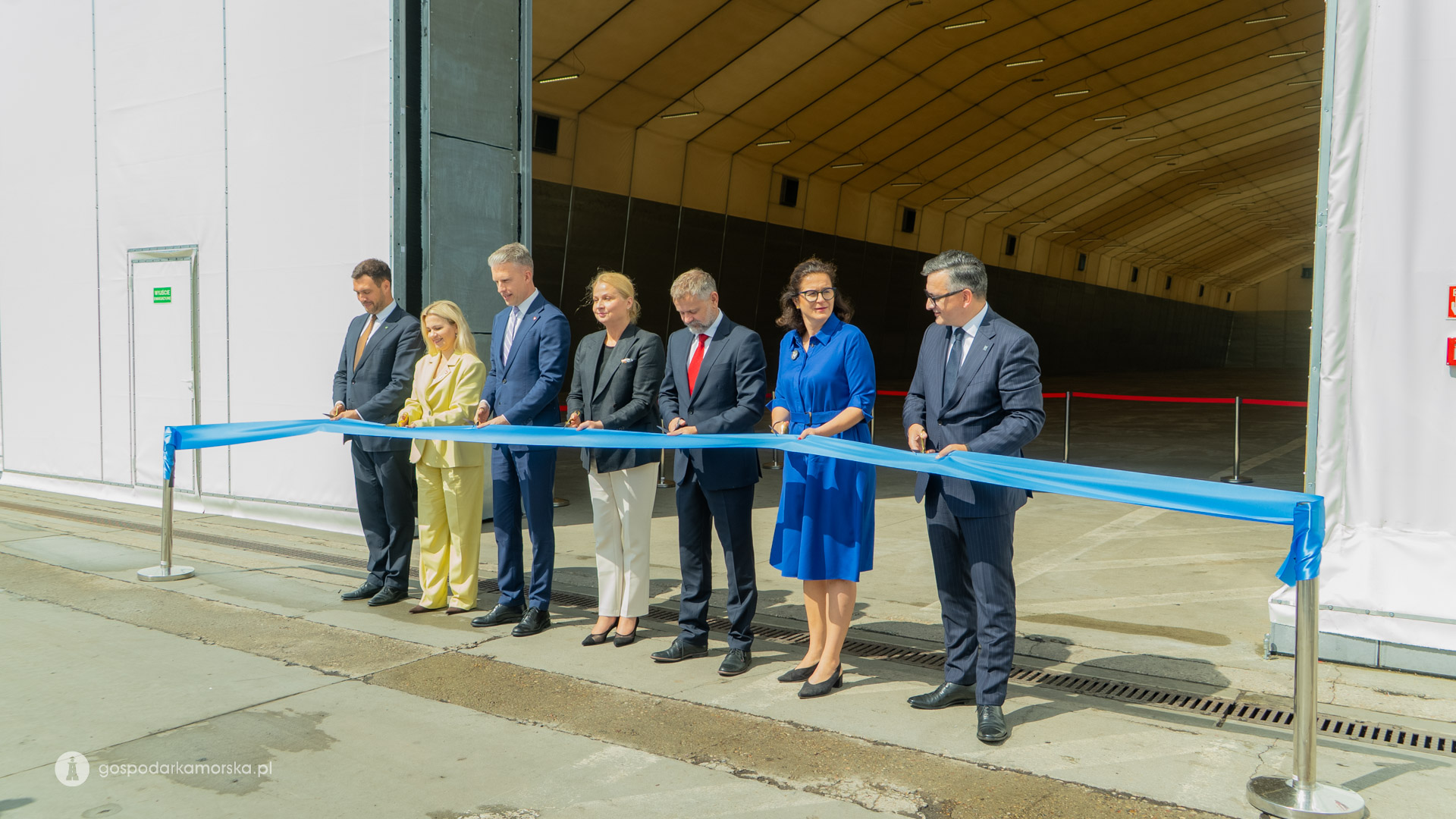
Port of Gdańsk and its subsidiary Port Gdański Eksploatacja have expanded their capabilities for handling agricultural cargo. The first phase of the Gdańsk Agro Terminal (GAT) project has been completed—an investment that will ultimately increase the terminal's handling capacity to 3 million tonnes per year and establish one of the Baltic region's leading grain hubs. During the inauguration ceremony on Monday, 27 July, representatives of the government, the port and the agri-food sector underlined the terminal's strategic importance for Polish exports and the country's food security.

The first completed element of the complex is a modern storage warehouse built at the heart of the port's operational area, at Szczecińskie Quay. The ceremony was attended by Arkadiusz Marchewka, Secretary of State at the Ministry of Infrastructure; Małgorzata Gromadzka, Secretary of State at the Ministry of Agriculture and Rural Development; Adam Nowak, Secretary of State at the Ministry of Agriculture and Rural Development; Grzegorz Wrona, Undersecretary of State at the Ministry of State Assets; Beata Rutkiewicz, Pomeranian Voivode; Aleksandra Dulkiewicz, Mayor of Gdańsk; Dorota Pyć, President of the Port of Gdańsk Authority; and Andrzej Kuźmicz, President of Port Gdański Eksploatacja.

An Investment That Will Strengthen Poland's Export Potential


– The Gdańsk Agro Terminal is an investment that will strengthen Poland's export potential while also enhancing our national security – said Arkadiusz Marchewka, Secretary of State at the Ministry of Infrastructure.

He emphasised that the concept of security today is far broader than it was in the past.

– Security today encompasses much more than just the economy, energy and defence. It also includes food security, and we are investing record levels of funding in strengthening all of these areas – he stressed.

The Deputy Minister highlighted the scale of the newly completed warehouse, which measures 140 metres in length, 46 metres in width and 18 metres in height.

– It is comparable in size to a small stadium, where agricultural and food products will be stored and handled before being shipped overseas, enabling Polish farmers to export the goods they produce every year – he said.

He also stressed that the project had been delivered entirely by Polish entities.

– What is particularly important is that this is a 100% Polish terminal. It has been developed by Port Gdański Eksploatacja, a company owned by the Port of Gdańsk Authority and, ultimately, by the State Treasury – Arkadiusz Marchewka said.

The Deputy Minister recalled that Poland had faced significant challenges in recent years related to grain inflows.

– Over the past few years, we have experienced a number of difficult situations connected with grain entering Poland. At that time, we made it clear that we needed a terminal capable of responding to these challenges. Although our ports already have considerable handling capacity, we want to invest even more, because investments in security are of strategic importance – he emphasised.

He added that the Gdańsk Agro Terminal demonstrates effective cooperation between several government ministries.

– This project is also an example of excellent cooperation with the Ministry of Agriculture and Rural Development and the Ministry of State Assets. Close cooperation is essential because this is a vital sector of the economy, and one that we must continue to support – he said.

The Deputy Minister also pointed to the importance of the project's subsequent phases.

– Right next door, at Wiślane Quay, a further investment worth nearly PLN 380 million is currently underway. This second phase of the Gdańsk Agro Terminal will also include a new rail and road network. Altogether, the entire project—which will expand handling capacity and, consequently, strengthen Poland's food security—is valued at more than PLN 500 million – he said.

He underlined the increasingly important role played by the Port of Gdańsk in international trade.

– The Port of Gdańsk is one of Poland's flagship assets and a source of national pride. It is here that deep-sea vessels from Asia arrive. It is home to our largest container terminal, while cargo volumes continue to grow at an impressive pace – he noted.

Finally, he pointed out that rising grain volumes confirm the growing importance of this cargo segment.

– It is worth noting that, in the first half of this year alone, grain handling volumes at Polish ports—and at the Port of Gdańsk in particular—increased by nearly 15% compared with the same period last year. This investment will undoubtedly contribute to even more efficient management of the entire logistics chain and is of strategic importance – he concluded.

We Have Expanded Our Capabilities


– Poland is among Europe's leading grain producers and generates a substantial export surplus every year, averaging between 10 and 11 million tonnes. To fully unlock this potential, modern and efficient port infrastructure is essential. It is a key element in strengthening both food security and the competitiveness of the Polish economy. It is also worth emphasising that expanding export infrastructure for Polish agricultural products is now of strategic importance. Investments of this kind give Polish producers greater access to international markets, supporting further export growth – said Andrzej Kuźmicz, President of Port Gdański Eksploatacja (PGE).

He stressed that the Gdańsk Agro Terminal (GAT) aims to become one of the key links in this logistics chain.

The first phase of the project, delivered under a design-and-build contract worth PLN 11.2 million (net), included the construction of a modern warehouse at Szczecińskie Quay with a storage capacity of 30,000 tonnes, measuring 140 metres in length46 metres in width, and offering a total enclosed volume of more than 93,000 cubic metres. The facility will enable an annual handling capacity of approximately 500,000 tonnes.

The warehouse features a modern, column-free design. It is a single-span, self-supporting structure with a large clear span, equipped with three oversized sliding gates and eight service doors. The facility can be divided into three independent storage chambers, allowing different cargo groups or customers to be served simultaneously. The roof and walls are fitted with an anti-condensation membrane that minimises moisture affecting hygroscopic cargoes. Safety is ensured through explosion-proof lighting and ventilation systems. The warehouse is equipped with 168 LED light fittings and a 66 kW mechanical ventilation system.

– The GAT project means that Port Gdański Eksploatacja now has an annual handling capacity of 800,000 tonnes. We have increased our capabilities by an additional half a million tonnes. This capacity is supported by six cargo handling berths and two flat warehouses, enabling us to store a total of 60,000 tonnes of various cargoes. However, for our customers, the most important parameter is handling efficiency. We are now capable of handling 8,000 tonnes per day – said President Kuźmicz.

– Today's ceremony does not mark the end of our plans. The second phase of the project lies ahead, involving the construction of 24 flat-bottom silos at Wiślane Quay, adjacent to Szczecińskie Quay. Once completed, total storage capacity will increase to approximately 160,000 tonnes, while annual handling capacity will reach up to 3 million tonnes, making this terminal one of the largest facilities of its kind in the Baltic Sea region – he added.

The second phase, scheduled for completion within the next three to four years, remains the project's most significant challenge. It includes the construction of 24 flat-bottom silos and the conversion of one existing flat warehouse. Once completed, storage capacity will increase by a further 110,000 tonnes, while annual handling capacity will grow by an additional 2.5 million tonnes.

– Our objective is for the Gdańsk Agro Terminal to achieve the following by 20303 million tonnes of annual handling capacity150,000–160,000 tonnes of storage capacity, depending on the final warehouse adaptation option, and 20,000 tonnes of cargo handled per day. These are parameters that correspond to modern European port infrastructure standards. Only through modern, automated solutions can we compete effectively with Europe's largest ports – said the President of PGE.

The total cost of both phases of the investment is estimated at approximately PLN 240 million.

– This investment also demonstrates that modern ports must focus above all on advanced technologies and process automation, as this is the only way to increase operational efficiency while reducing vessel handling costs – he concluded.

Below is an interview with the President of Port Gdański Eksploatacja, conducted during this year's Polish Ports 2030+ Congress.

Investment Linking Three Strategic Pillars of the State


– The ceremony held today carries particular significance. Port Gdański Eksploatacja is inaugurating an investment that brings together three strategic pillars of the Polish state: agriculture, trade and the maritime economy – said Dorota Pyć, President of the Port of Gdańsk Authority.

She stressed that the Gdańsk Agro Terminal (GAT) will strengthen Poland’s competitiveness, reinforce food security and further enhance the Port of Gdańsk’s role in handling agricultural exports.

– The Gdańsk Agro Terminal is a project that strengthens the country’s competitiveness, food security and the Port of Gdańsk’s position as a gateway for Polish agricultural products. It is also an important link in European supply chains, but from the Port of Gdańsk’s perspective above all in global supply chains – she said.

The Port of Gdańsk president noted that grain and agri-food products have long been one of the port’s key cargo groups.

– Grain and agricultural products have for many years constituted an important part of the cargo handled at the Port of Gdańsk. The completion of the Gdańsk Agro Terminal will increase our cargo handling capacity while further diversifying the range of commodities handled by the port – she said.

Pyć emphasised that, in today’s geopolitical and economic environment, investment in agricultural logistics infrastructure has become strategically important.

– In the times we are living in today – a period of geopolitical instability – food security has become just as important as energy security. That is why developing modern agri-logistics infrastructure is not merely a business decision, but a strategic one – she stressed.

She added that the investment has been designed to support Polish producers and exporters for decades to come.

– This is an investment that will support Polish producers, exporters and the national economy for decades. It is modern infrastructure built by a Polish company in a Polish port for the benefit of Polish producers and exporters – she said.

According to the President of the Port of Gdańsk, the GAT will enable Polish agricultural products to reach global markets more efficiently.

– Thanks to this investment, Polish grain and other agri-food products will be able to reach global markets even more efficiently, while a greater share of the value generated by those exports will remain within the Polish economy – she underlined.

Małgorzata Gromadzka, Secretary of State at the Ministry of Agriculture and Rural Development, also highlighted that the Gdańsk Agro Terminal is an investment delivered by Polish entities.

– For years we have heard the question: where are Poland’s ports, where are ports backed by Polish capital? Here is an example of such a port, financed and developed by State Treasury companies. For me personally, and for our ministry, this is a particularly significant moment,” she said, referring to plans for expanding Polish grain exports.

She revealed that Poland is actively seeking to open new export markets.

– At present we are working to launch the first grain shipments to Egypt, as well as further exports to Indonesia, Singapore, Malaysia and Vietnam. We see enormous potential in these markets – she said.

The Deputy Minister also stressed the need to strengthen quality control systems.

– This also requires reinforcing sanitary inspections and the Agricultural and Food Quality Inspection. We have repeatedly discussed the need to strengthen inspection services so that every shipment is properly verified, ensuring that exported cargo meets quality standards, avoids complaints and is not rejected by overseas buyers – she said.

She added that the investment will also help strengthen Poland’s strategic reserves.

– Together with the Ministry of State Assets, we are rebuilding this capacity so that State Treasury companies have greater influence over the market, grain prices and developments in the sector, while also ensuring sufficient storage space for strategic commodity reserves – she emphasised.

Grain Handling at the Port of Gdańsk


Grain cargo at the Port of Gdańsk is currently handled by eight terminal operatorsPort Gdański Eksploatacja (PGE), GBT, Magrol, Gdańskie Młyny, Handel i Minerały, Jargut, Speed and Fast Track.

In 2025, the port handled 2.5 million tonnes of agricultural cargo. During the first half of 2026, throughput reached 1.3 million tonnes, representing a 13.3% year-on-year increase, confirming continued growth in this cargo segment.

Most recent