

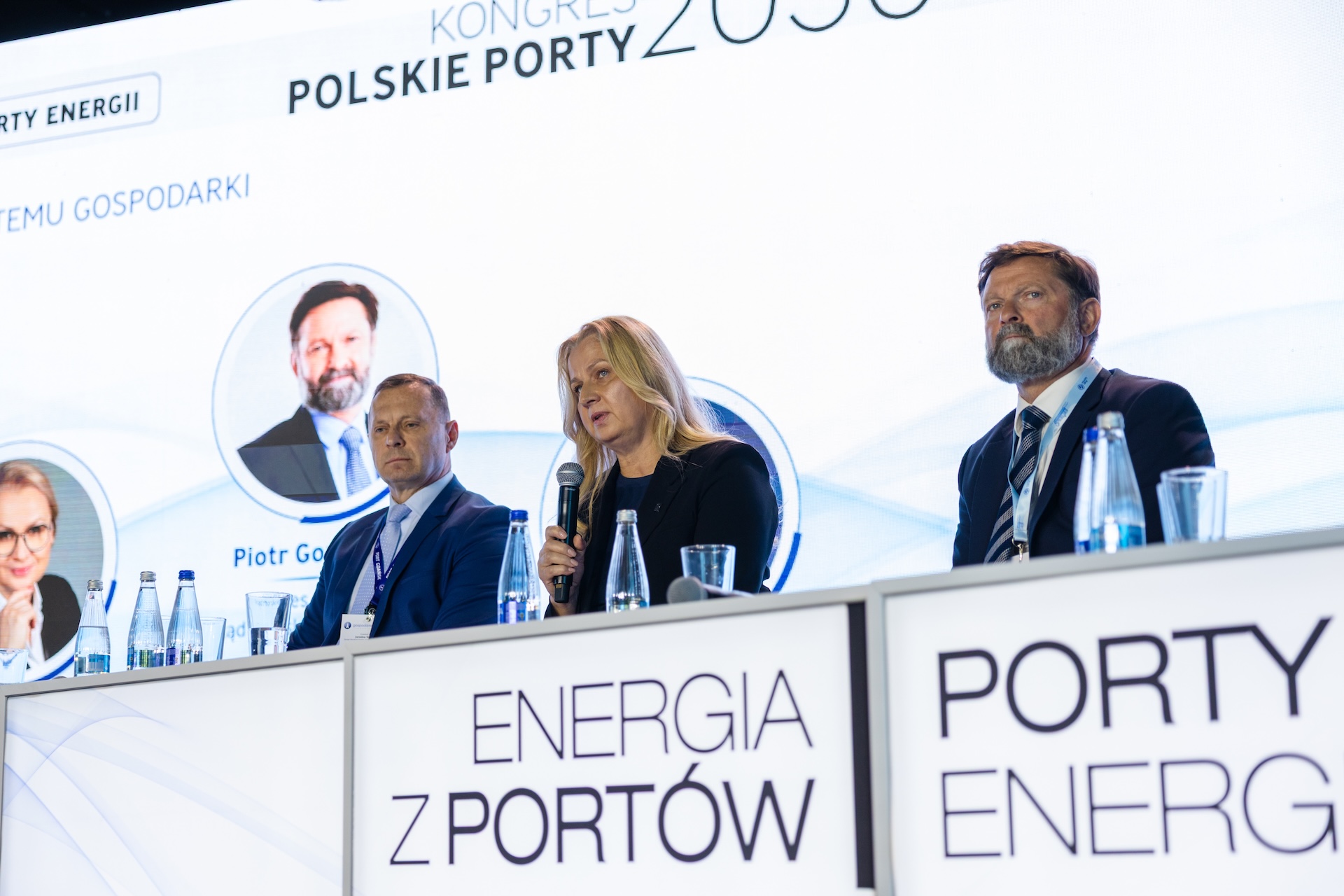


In recent years, Polish seaports have had to contend not only with rapid growth, but also with an increasingly complex threat landscape. Alongside market-related challenges, they now face hybrid activities in the Baltic Sea and the consequences of armed conflicts and geopolitical tensions, even when these unfold thousands of kilometres away. During the Polish Ports 2030+ Congress, we spoke with the presidents of Poland’s largest seaports about the key issues shaping their operations.
While the number of risks and threats continues to grow, they have not disrupted the functioning of Poland’s strategic ports. On the contrary, cargo volumes and vessel calls continue to rise, while major investment projects are progressing at pace. Many of these developments will permanently reshape the Polish coastline and rank among the country’s most significant maritime infrastructure projects in decades. At this year’s Polish Ports 2030+ Congress, we discussed the sector’s most pressing challenges with the CEOs of Poland’s key seaports, which play a strategic role in the national economy.
Should The Port Be Afraid of Anything?
The Baltic Sea has become an increasingly complex security environment. From the activities of the shadow fleet and hybrid operations targeting critical infrastructure to GPS interference and the growing use of civilian vessels for sabotage or intelligence gathering, modern ports face risks that extend far beyond commercial competition. During the Polish Ports 2030+ Congress, the heads of Poland's largest seaports discussed how they are adapting to this changing threat landscape.
Although the number of potential risks continues to grow, Poland's major seaports have maintained strong operational performance while continuing to invest in strategic infrastructure. According to the panellists, resilience today depends not only on physical security but also on investment, diversification and the ability to identify emerging threats before they materialise.
Dorota Pyć, President of the Management Board of the Port of Gdańsk Authority, stressed that ports should focus on prevention rather than fear.
"Ports should not be afraid. They should be prepared for every possible risk, act proactively and pragmatically, and continue investing in port infrastructure, because that is what builds resilience."
She argued that effective risk identification and management have become significantly more challenging in recent years. Few could have predicted that ageing tankers operating within the shadow fleet would emerge as a major security concern, or that civilian merchant vessels could be used for sabotage against subsea infrastructure, espionage or even as drone launch platforms.
According to Pyć, the security environment has changed dramatically since the pandemic.
"Maritime transport, shipowners and ports have always had to deal with risk, but today we are operating in a completely different reality than before COVID-19. After the pandemic came Russia's invasion of Ukraine, followed by the escalating conflict in the Middle East. We must continue strengthening our competitiveness while simultaneously investing in security, cybersecurity and IT systems."
She added that artificial intelligence will play an increasingly important role in helping ports detect and assess emerging risks.
Jarosław Siergiej, President of the Management Board of the Ports of Szczecin and Świnoujście Authority, said he does not currently see an immediate military threat to Polish ports, but warned that other forms of attack are already becoming a reality.
"The world is highly unstable. While the military domain remains relatively secure today, the real risks concern cybersecurity, GPS signal interference and attempts to compromise port security systems."
In his view, strengthening digital infrastructure and protecting operational data have become just as important as investing in traditional port facilities. Modern resilience, he argued, increasingly depends on secure information systems capable of withstanding hybrid threats as well as physical disruptions.
Resilience = Infrastructure + Versatility
One of the key themes running throughout the Polish Ports 2030+ Congress was resilience. While there is no single definition of resilience in the context of seaports, all stakeholders agreed that it ultimately means ensuring uninterrupted operations despite disruptions, whether caused by geopolitical tensions, supply chain shocks or hybrid threats.
For Piotr Gorzeński, President of the Management Board of the Port of Gdynia Authority, resilience is fundamentally about operational continuity.
"A resilient port is one that can continue operating smoothly and without disruption, even when attempts are made to interfere with its activities."
He noted that such disruptions may be either direct or indirect, including events affecting global trade routes that force ports to rapidly adapt their operating models.
Polish ports experienced precisely this challenge following Russia's invasion of Ukraine, when they had to quickly increase coal handling capacity to secure domestic energy supplies. While the sector successfully adapted by converting storage areas and reorganising operations, the shift also came at a cost, including the temporary loss of other cargo traffic and growing environmental concerns linked to coal storage.
Today, similar supply chain disruptions remain possible, particularly as instability continues to affect global shipping routes.
Jarosław Siergiej, President of the Management Board of the Ports of Szczecin and Świnoujście Authority, pointed to the Strait of Hormuz as a recent example of how distant geopolitical events can directly affect Polish ports.
"The LNG terminal in Świnoujście handles Poland's largest imports of liquefied natural gas. More than 20% of that gas comes from Qatar. When shipping through the Strait of Hormuz was disrupted, Qatar reduced deliveries to its customers. This is a clear example of how events taking place thousands of kilometres away have a direct impact on our ports."
The experience gained during recent crises has reinforced the importance of versatility. According to Gorzeński, ports are increasingly investing in infrastructure capable of handling a broad range of cargoes with minimal operational adjustments, enabling them to respond quickly to changing market conditions.
"That is precisely how resilience should be understood. Specialisation remains important, but on its own it does not guarantee resilience. If the cargo segment in which a port specialises is hit by a crisis, the port must be able to replace it with other cargoes. That is where versatility becomes essential."
Siergiej echoed this view, stressing that while individual terminals may remain highly specialised, the port as a whole should maintain a diversified operational profile.
"Our terminals perform different functions—some are universal, others highly specialised. We need both. What matters most, however, is that the port as a whole remains versatile, because that is what ultimately strengthens its resilience against a wide range of threats."
Infrastructure Is More Than Concrete and Steel
One of the clearest conclusions from this year's Polish Ports 2030+ Congress was that the focus of port development is steadily shifting beyond physical infrastructure towards digital resilience. As critical hubs serving both commercial and military logistics, ports must protect not only quays, terminals and transport networks, but also the information systems that underpin their operations.
Jarosław Siergiej, President of the Management Board of the Ports of Szczecin and Świnoujście Authority, stressed that cyber resilience has become just as important as traditional infrastructure.
"Besides physical infrastructure, protecting information is equally important. Today, efficiency and reliability depend on having as many processes as possible digitised and carried out through cyber infrastructure and IT systems."
Poland's largest ports are responding through the joint development of the Polish Port Community System (PCS), a nationwide digital platform being implemented by the company Polskie PCS. The system already includes cargo-handling and shipping agency modules, while future development will add rail and road transport modules to create a fully integrated logistics platform.
"This will complete our information exchange and processing infrastructure, significantly improving cargo handling across every mode of transport," explained Siergiej.
The PCS will serve not only port authorities but also terminal operators, government agencies, carriers and cargo owners. Its objective is to consolidate documentation, operational procedures and cargo information into a single digital environment, creating a common platform for everyone involved in port logistics.
According to Siergiej, Polish ports are therefore evolving into information hubs as much as cargo hubs.
"They will become both, and this transformation will happen within the next few years, not in a decade."
He also pointed to the impact of new cybersecurity legislation, including the EU's NIS2 Directive and Poland's forthcoming National Cybersecurity System Act, both of which introduce significantly stricter requirements for protecting critical digital infrastructure.
As a result, the Ports of Szczecin and Świnoujście Authority has already concluded that an entirely new organisational structure dedicated to cybersecurity governance and regulatory compliance will be required to meet the new obligations.
But Concrete and Steel Are Needed
While digital transformation dominated many discussions at the Polish Ports 2030+ Congress, port development ultimately rests on two equally important pillars. Alongside investment in cybersecurity and digital infrastructure, ports must continue expanding their physical capacity to accommodate growing cargo volumes and larger vessels.
Each of Poland's major ports is currently pursuing flagship infrastructure projects essential to its long-term competitiveness. For the Port of Gdynia Authority, these include the planned Outer Port and the Red Road (Droga Czerwona), the latter providing the critical road connection required to unlock future expansion. As the road falls under the responsibility of Poland's national road authority rather than the port itself, the port authority's role is to advocate for its delivery.
"Our role is to influence the institutions responsible for decisions that are beyond the port's competence. The Red Road is the responsibility of the General Directorate for National Roads and Motorways, just as railway connections fall under other authorities. Our task is to convince those institutions of the importance of these projects," said Piotr Gorzeński, President of the Port of Gdynia Authority.
Without the Red Road, the Outer Port project—which will provide new deep-water quays and significantly expand Gdynia's handling capacity—cannot move forward.
According to Gorzeński, the project has reached the final stage of selecting a private partner under a public-private partnership model.
"We expect final offers from potential private partners by the end of this month. If the proposals meet our expectations, we will select an operator, bringing the Outer Port significantly closer to becoming a reality."
The same transport connection is also essential for the planned Logistics Valley, a development area of approximately 260 hectares west of the existing port.
"Once the Red Road is built, we will begin developing the Logistics Valley, opening entirely new opportunities for investment and business activity," Gorzeński added.
The Port of Gdańsk Authority faces a similar challenge. While major expansion projects are planned for the port island—including new deep-water terminals alongside the Baltic Hub container terminal—the port's ambitions depend on significantly improving rail and road access.
"Without additional railway infrastructure, complementary road connections and a tunnel link, the Port of Gdańsk will not be able to fulfil its ambition of becoming a major energy and industrial hub supporting Poland's economy," said Dorota Pyć, President of the Port of Gdańsk Authority.
As in Gdynia, the port cannot deliver these projects independently. Their implementation requires close cooperation with organisations including PKP Polskie Linie Kolejowe and regional authorities.
Pyć emphasised that the benefits would extend well beyond the port itself.
"This infrastructure is also needed by local communities. It will improve mobility, create new jobs and strengthen the development of both Gdańsk and the wider Pomeranian region."
The first step has already been taken. A tender for the concept design of a new railway connection to the port is expected to be launched this year, following an agreement signed between the Port of Gdańsk and PKP PLK last year. However, completion remains a long-term prospect. Based on comparable projects, PKP PLK estimates that obtaining all necessary studies, designs and administrative approvals alone could take seven to eight years before construction can begin.
Powering the Port from Within
Another major infrastructure challenge discussed at the Congress concerns energy. Alongside large-scale construction projects such as the planned Outer Port in Świnoujście—known as Cape Pomerania—the Ports of Szczecin and Świnoujście Authority is increasingly focused on ensuring access to affordable, reliable and sustainable electricity.
According to Jarosław Siergiej, securing low-cost energy has become a strategic priority, with one potential solution being to generate electricity directly for port operations.
"Affordable energy opens up enormous opportunities. It not only reduces operating costs for terminal operators and the port itself, but surplus electricity can also be used to produce alternative fuels."
The authority is therefore exploring renewable energy projects capable of meeting much of the ports' own demand. Options include installing renewable energy facilities within the port or investing in large-scale generation assets elsewhere, such as photovoltaic farms coupled with battery storage.
"The port could own a large solar farm with energy storage capable of supplying enough electricity for port operations, while any surplus could be used to produce green hydrogen," Siergiej explained.
He noted that port authorities have traditionally focused on expanding maritime and landside infrastructure, improving access from both sea and land. However, future competitiveness will increasingly depend on integrating that infrastructure with abundant, low-cost green energy.
Electricity demand across ports is expected to rise significantly over the coming years. Many terminal operators are already electrifying cargo-handling equipment and vehicle fleets, while EU legislation will require ports to provide Onshore Power Supply (OPS) facilities for container and passenger vessels by 2030.
The Port of Gdańsk Authority has already launched procurement procedures for the design and construction of shore power installations, including facilities serving the Westerplatte Quay and the Baltic Hub container terminal, marking another step towards the decarbonisation of Polish port operations.
 DOWNLOAD PDF