

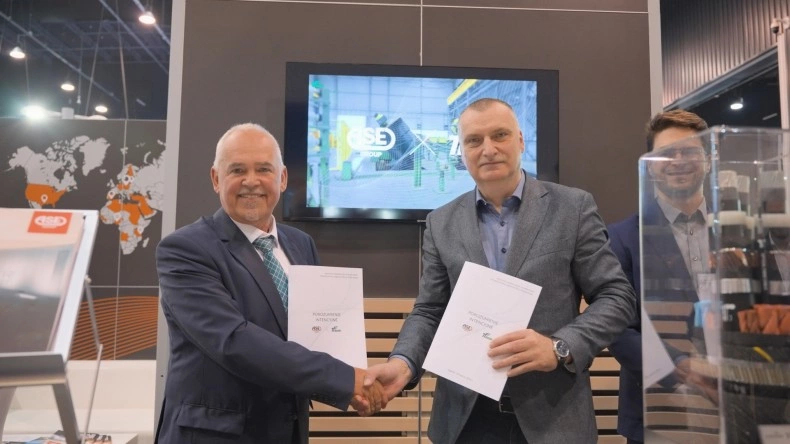


At a time when Europe’s energy infrastructure is undergoing its most extensive modernisation in decades, standalone capabilities are no longer sufficient. Increasingly, companies are forming strategic alliances rather than operating in isolation. The energy transition demands the integration of engineering expertise, advanced technologies, and industrial scale. A recent example of this trend is the letter of intent signed on 19 March 2026 during the PowerConnect Energy Summit between ASE GROUP and Tele-Fonika Kable.
In the picture from the left: Dariusz Jachowicz, Chief Executive of ASE GROUP, and Piotr Mirek, Management Board Member at Tele-Fonika Kable and Executive Director for Supply Chain and Investments at JDR Cable Systems; photo: GospodarkaMorska.pl
Tele-Fonika Kable is one of Europe’s leading manufacturers of medium-, high- and extra-high-voltage cables and cable systems, primarily used in onshore energy infrastructure. The TFKable Group develops and produces solutions for transmission and distribution networks, supporting grid modernisation and the expansion of renewable energy sources. ASE GROUP, in turn, has established one of Poland’s largest engineering hubs, bringing together designers, engineers, technologists and consultants working across the energy transition towards a low-emission economy. Within the partnership, the roles of both parties are clearly complementary: Tele-Fonika Kable contributes its manufacturing base and expertise in cable system design and production, while ASE GROUP provides engineering, integration and implementation capabilities in the field of sustainable energy.
The agreement provides for cooperation in delivering comprehensive energy infrastructure projects, both in Poland and internationally. The partners envisage collaboration under an end-to-end model, covering project design, cable infrastructure supply, as well as installation and commissioning support.
The need for such partnerships is growing in line with the accelerating pace of the energy transition. The expansion of renewable energy—particularly offshore wind—combined with the modernisation and development of transmission and distribution networks, the growth of energy storage, and the increasing importance of safeguarding critical infrastructure, is making energy projects ever more complex. This, in turn, requires the integration of engineering and industrial competencies.
ASE GROUP’s experience in this field stems from the activities of its specialised subsidiaries. PROJMORS ASE GROUP has been involved in securing construction permits for offshore wind farms in the Baltic Sea, obtaining dozens of administrative decisions since 2019. Meanwhile, EKO-KONSULT ASE GROUP has been responsible for preparing environmental documentation for offshore developments and their grid connection infrastructure. The Group’s engineering teams are also advancing port electrification projects, including onshore power supply (OPS) systems for vessels at the Port of Gdańsk.
Tele-Fonika Kable brings extensive experience in delivering cable infrastructure projects for the power sector in Poland and international markets. The TFKable Group supplies cable systems used in the expansion and modernisation of onshore transmission and distribution networks, which form the backbone of the energy transition.
The development of high- and extra-high-voltage cable production technologies at the company’s Bydgoszcz facility, including the launch of new production lines, further strengthens its capabilities in supplying advanced cable systems for infrastructure investments. This also addresses the growing demand for high-voltage direct current (HVDC) solutions.
Commenting on the agreement, Łukasz Piotrowicz, Vice President of PROJMORS ASE GROUP, emphasised the importance of the partnership in the evolving energy landscape:
“Energy transition should be built on strong local and regional capabilities. The partnership between ASE GROUP and Tele-Fonika Kable demonstrates that cooperation between Polish companies can effectively meet market needs while strengthening security, quality, and value creation domestically.”
Tele-Fonika Kable also underlined the importance of building value chains based on domestic and regional competencies, particularly in the delivery of strategically significant infrastructure projects:
“Today’s energy transition requires collaboration between companies combining technological, engineering, and industrial expertise. Our partnership with ASE GROUP enables us to integrate Tele-Fonika Kable’s experience in designing and manufacturing advanced cable systems with strong engineering capabilities, allowing us to offer comprehensive turnkey solutions for the entire process of transmitting power from offshore to onshore grids. This approach reduces investor risk while increasing local content in offshore projects.
Together with JDR Cable Systems, we have over 20 years of experience in the offshore wind sector and have delivered more than 50 projects worldwide. These global capabilities are also being deployed in key Baltic developments such as Baltic Power, Bałtyk II and III, Baltica 2, and BC-Wind. In cooperation with our partners, we deliver infrastructure projects on a comprehensive basis—from concept and design through to supply and commissioning—supporting the development of modern energy infrastructure in Poland and globally,” said Piotr Mirek, Management Board Member at Tele-Fonika Kable and Executive Director for Supply Chain and Investments at JDR Cable Systems.
The cooperation will also encompass a shared approach to quality and safety standards in line with international ISO norms, as well as ESG requirements and local content considerations in infrastructure projects. The partners also foresee joint research and development initiatives. The agreement remains open in nature, providing flexibility in project delivery while maintaining market competitiveness.
In practice, such agreements are increasingly becoming the industry’s response to the growing complexity of energy investments. Infrastructure projects now require not only the supply of components or engineering services, but coordinated management across the entire project lifecycle—from concept through to operation and maintenance.
For Poland’s energy sector, this also represents a strengthening of domestic capabilities in high-voltage technologies and critical infrastructure. In the context of accelerated decarbonisation and rising system security requirements, the ability to integrate complementary competencies may prove to be a decisive factor in maintaining competitiveness.
The agreement points to a clear direction. In the realities of the energy transition, that direction is unequivocal: collaboration, the strengthening of local content, and the integration of complementary capabilities.
 DOWNLOAD PDF