

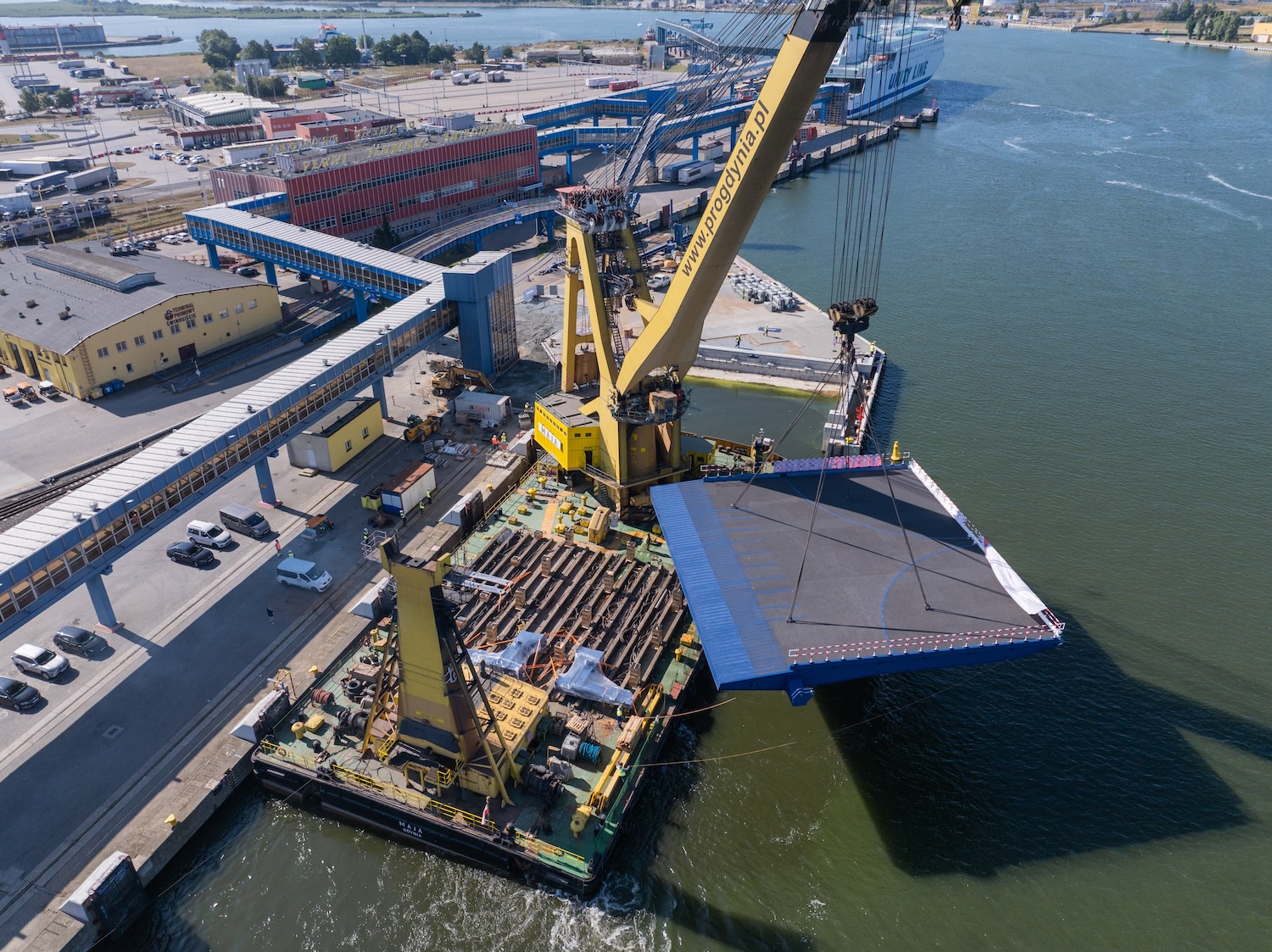


On 21 August, a new movable vehicle ramp was installed at Berth No. 4 at the Świnoujście Ferry Terminal. This is a key stage of the modernisation project, which is adapting the berth to the specifications of modern ro-pax ferries. DORACO is the general contractor for the project, which is being carried out for the Szczecin and Świnoujście Seaports Authority. The contract is worth nearly PLN 27 million.
The aim of the project is to adapt Berth No. 4 to higher load-bearing requirements resulting from vehicle traffic and to increase the dimensions of the movable vehicle ramp. The berth’s purpose will remain unchanged. It will be used, among others, by the Varsovia and Mazovia ferries.
Following the installation of the ramp, the project is approximately 90 per cent complete.
New ramp – a key element of the project
The movable vehicle ramp was prefabricated and delivered in one piece to the construction site aboard the Maja floating crane, owned by Polish Ship Salvage (Polskie Ratownictwo Okrętowe, PRO). The installation involved the approach ramp structure, together with its pylons and the components and equipment used to operate it. The new ramp was designed with the specifications of ferries currently calling at the Świnoujście Ferry Terminal in mind, as well as vessels that may be handled there in the future.
The ramp’s key specifications are:
- load-bearing capacity: 160 tonnes (1,600 kN);
- usable width: 25 metres in the bow section over a length of approximately 3.85 metres, and 24 metres over the remaining section;
- overall width including cross-beams at the locking point: approximately 28.5 metres;
- overall length: approximately 23.8 metres, including the approach plate.
New quay structure
As part of the reconstruction, a new quay line is being built to accommodate the increased dimensions of the movable vehicle ramp. The structure is supported by steel piles and a steel sheet-pile wall, while part of the port basin has been reclaimed.
The project has also involved strengthening the ground using pile foundations in the area adjacent to the berth, as well as constructing a new quay structure incorporating reinforced-concrete slabs, pile caps and ducts. The berth has been fitted with new mooring and fendering equipment, while sub-base layers for the new approach surface have also been prepared.
“The modernisation of Berth No. 4 at the Świnoujście Ferry Terminal is another stage in comprehensive efforts to expand the capabilities of the Świnoujście terminal, which is the largest such facility in Poland and one of the most important of its kind in the Baltic,” said Krzysztof Sadowski, Vice-President for Infrastructure at the Szczecin and Świnoujście Seaports Authority.
Works at an operational port
Berth No. 4 is located on the eastern bank of the Świna River, between Ferry Berths No. 3 and No. 5. The works are being carried out within the operational terminal while maintaining the continuity of ferry services at the other berths.
“Ports have to keep pace with new ships, which are becoming increasingly larger and require more efficient handling. In Świnoujście, we are building infrastructure on precisely this scale – the new 25-metre-wide ramp, with a load-bearing capacity of 160 tonnes, will serve, among others, the more than 216-metre-long Varsovia. With projects of this kind, it is not only the technical specifications that matter, but above all the port’s readiness to meet the needs of maritime transport in five or ten years’ time. This is a very tangible example of how Polish ports are preparing to handle a new generation of ferries. For DORACO, this is another major hydrotechnical project that is now entering its final phase,” said Angelika Cieśłowska, President of DORACO.
What comes next?
Work completed so far includes demolition works, installation of the new sheet-pile wall defining the new quay line, ground reinforcement, construction of the new quay structure, installation of mooring and fendering equipment, and preparation of the sub-base for the approach surface.
Work is currently under way on sanitary, telecommunications and electrical systems, along with the installation of quay equipment and laying of the new surface. The project will also include a containerised control room for the ramp, linear drainage connected to the existing stormwater drainage system, and power and telecommunications networks. The quay will be equipped with bollards, fenders, steel ladders and other infrastructure components.
Before the project is completed, the ramp will undergo testing under the supervision of the Transport Technical Supervision Authority. The works are scheduled for completion around the turn of 2026 and 2027.
Photo: DORACO press release
 DOWNLOAD PDF