

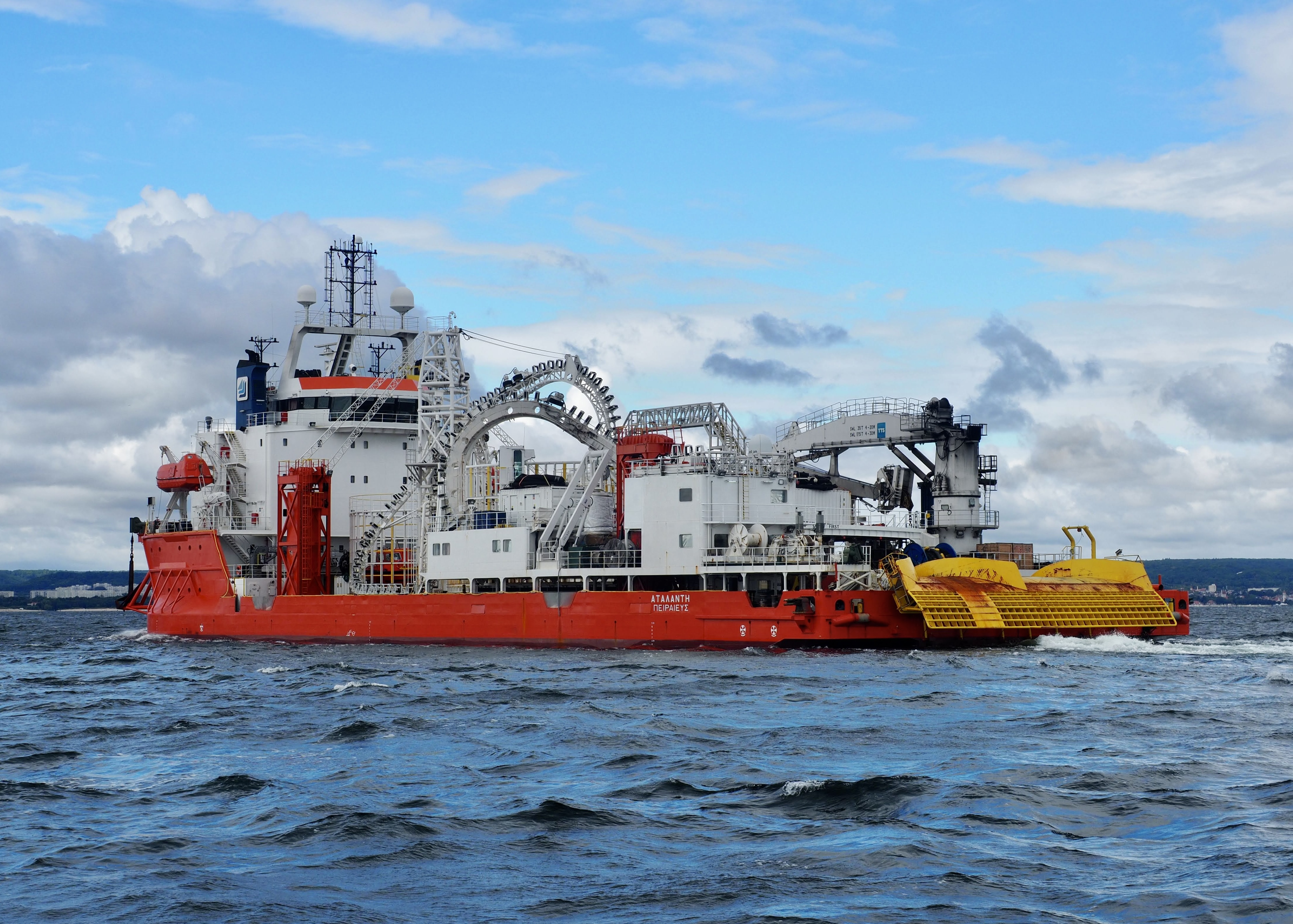


On Sunday, 23 August, the cable-laying vessel Atalanti arrived at Gdańsk Shipyard Remontowa S.A. When the vessel entered the shipyard last year, the operation was somewhat more complicated: the vessel was transported aboard a semi-submersible heavy-lift vessel and subsequently launched off the port. This time, it entered the shipyard under its own tow, escorted only by tugboats. Its arrival could also be watched by participants on sailing cruises organised as part of the Baltic Sail festival currently taking place in Gdańsk.
Incidentally, there are still plenty of places available on sailing cruises today, Monday, 24 August. It is worth visiting the organiser’s official website for further information.
The cable-laying vessel Atalanti is owned by Greece-based Asso Group and operated by its subsidiary, Asso.subsea. Built in 2008, the vessel was designed primarily for laying and protecting cables in shallow waters that are typically inaccessible to larger vessels of this type. It has a draught of just over four metres. The vessel can carry more than 4,000 tonnes of cable on deck, arranged on one or two cable carousels.
According to information provided by the shipowner, the vessel has high-standard accommodation facilities for up to 77 people, providing hotel-standard living conditions suitable for projects in remote parts of the world.
The vessel is equipped with a DP-2 dynamic positioning system. It also features two specially designed stabilising structures that provide additional station-keeping capability when operating in shallow waters. In addition, the vessel has a four-point mooring system comprising four anchor winches, each with a pulling capacity of 30 tonnes.
Previous refit
In 2025, the vessel underwent another refit at a shipyard belonging to Remontowa Holding. At the time, the cable-laying vessel arrived aboard Kang Sheng Kou, a semi-submersible heavy-lift vessel, from which it was subsequently launched off the Port of Gdańsk. It was the first operation of its kind in Polish waters and involved a number of organisations.
As we reported at the time, the project was organised on behalf of the shipowner by Blue Water Shipping. The vessel itself was chartered from COSCO, which also has its own agent in Poland.
It is worth noting that the heavy-lift transport described extensively in our earlier coverage was not prompted by navigational restrictions, but was a logistical decision related to delivering the vessel to the shipyard for a special mobilisation. The operation was planned as a heavy-cargo transport. Kang Sheng Kou transported Atalanti directly to Gdańsk from the area where the vessel had previously been operating. At the anchorage, Kang Sheng Kou submerged its deck, allowing Atalanti to be launched and subsequently towed to Gdańsk Shipyard Remontowa, where the scope of work included, among other things, modifications to the winches and installation of new anchors, several minor repairs, as well as an upgrade of the crew mess.
Once the work had been completed, the vessel left Gdańsk under her own power and began operations on an offshore project in Germany.
A shipyard full of cable-laying vessels
Gdańsk Shipyard Remontowa S.A. has recently seen a notable influx of cable-laying vessels. Earlier this year, we reported on the arrival of Leonardo da Vinci, regarded as one of the world’s most advanced vessels of its type. There was also Demeter Acacia, a vessel originally built as a large offshore platform supply vessel and subsea cable-laying vessel. At Gdańsk Shipyard, she underwent a major conversion to adapt her for other purposes (see also: Demeter Acacia at Gdańsk Shipyard Remontowa S.A. The vessel supported, among other operations, the response to the Deepwater Horizon disaster).
At present, the cable-laying vessel Ulisse and the NKT Isabella barge from this series are still berthed at Ostrów Island. Tomorrow, 25 August, the French cable-laying vessel Ile de Bréhat is due to arrive in the morning.
Photo: GospodarkaMorska.pl
 DOWNLOAD PDF