

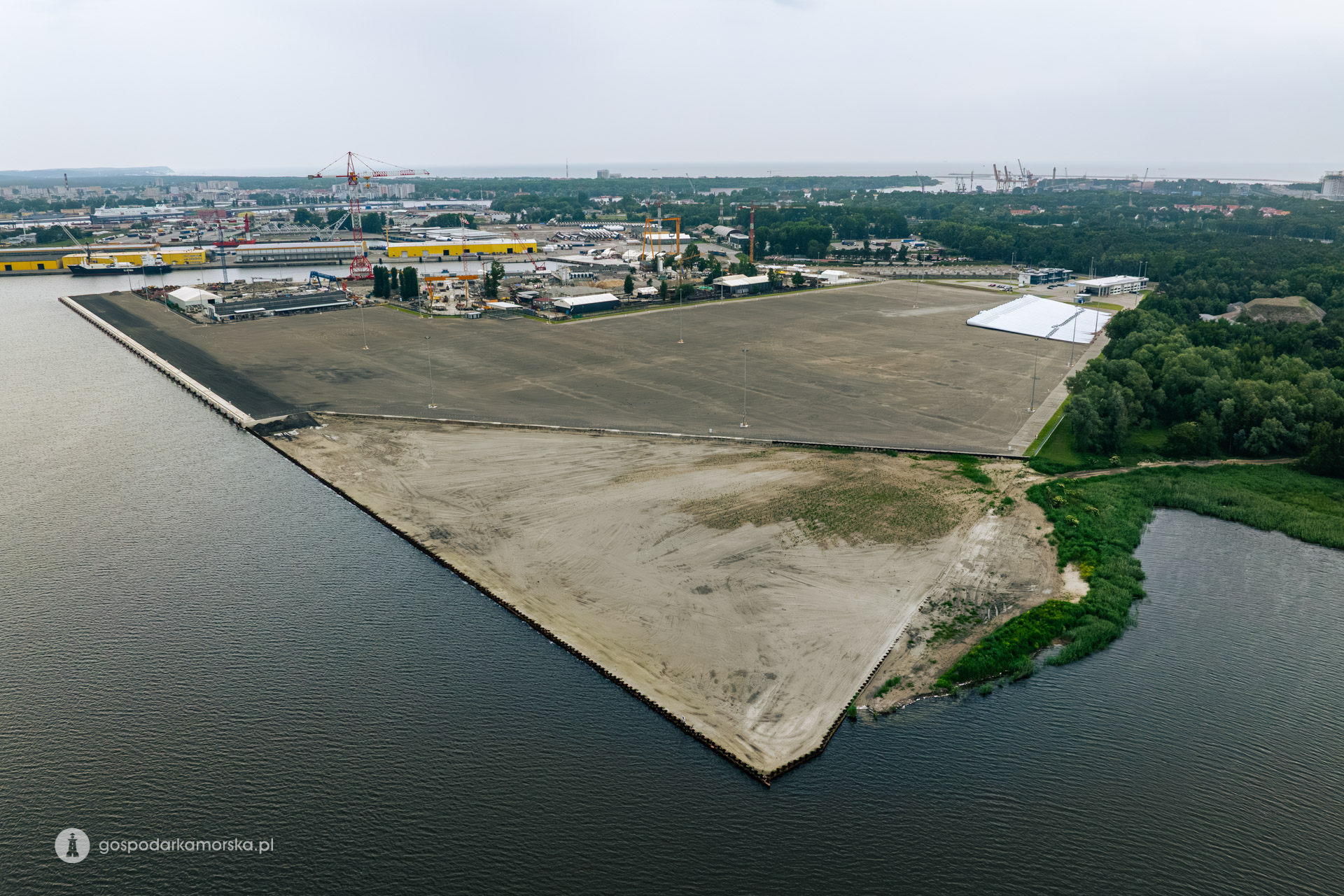


On Monday Juny 8th, in the presence of government representatives, the presidents of Orlen Neptun and the Szczecin and Świnoujście Seaports Authority signed a letter of intent concerning the expansion of the Świnoujście Offshore Terminal. The document itself does not initiate any work nor create any formal obligations for either party; rather, it expresses a willingness to cooperate on the project's further development. However, all stakeholders involved appear determined and prepared to take the first steps, while the offshore wind industry estimates that expanding the terminal's capacity will be beneficial. For now, one thing is missing: funding.
The Świnoujście Offshore Terminal, Poland's first installation terminal dedicated to offshore wind energy, was officially opened in mid-2025. Exactly one year later, Janusz Bil, President of Orlen Neptun, which manages the facility, and Jarosław Siergiej, President of the Szczecin and Świnoujście Seaports Authority, signed a letter of intent regarding the expansion of the infrastructure. Why so soon?
Opened Last Year, Already Planned for Expansion
Indeed, several wind energy projects have already utilised the Świnoujście Offshore Terminal during its first year of operation. Maritime Agency Gdynia has been handling offshore wind component cargo operations there — even during the terminal's official opening on 1 June 2025, components destined for onshore wind projects were being stored on site.
The terminal will also handle foundation deliveries for the BC-Wind offshore wind farm, for which Ocean Winds signed a long-term agreement with Orlen Neptun. The Baltica 2 project, developed by another state-controlled energy group, PGE, in partnership with Ørsted, is also making use of the Świnoujście facility. In cooperation with Maritime Agency Gdynia, a temporary assembly hall built from shipping containers was established at the terminal, where Trident BMC, on behalf of Smulders, is assembling internal steel platforms for the project.
It is also clear that Orlen's terminal will serve as the primary installation base for the company's future offshore projects, including Baltic East, Baltic West and the already under-construction Baltic Power wind farm. Although Baltic Power is currently being installed from another Baltic port, as the Świnoujście terminal was not yet operational when installation began, Świnoujście is also expected to support this project.
The terminal has additionally attracted the attention of developers from other countries. In early May, the first-ever jack-up vessel to call at the facility, Wind Enterprise, arrived in Świnoujście while working on an offshore wind project in German Baltic waters. Thanks to its location, the terminal could become an attractive base not only for Polish and German projects, but also for developments in Sweden and Denmark.
"Our role is to attract investors and generate as much value as possible for Poland. The terminal in Świnoujście serves not only projects carried out by Orlen Neptun, but also companies involved in foreign investments. If we can become an offshore hub for such projects and generate revenue while ensuring foreign companies spend money in Poland, then that is exactly the objective," confirms Arkadiusz Marchewka, Deputy Minister of Infrastructure.
He adds, however, that a balance must be maintained between supporting strategically important domestic projects and maximising revenue through services provided to external clients.
What Could the Świnoujście Offshore Terminal Look Like in the Future?
At present, Orlen's installation terminal in Świnoujście covers approximately 20 hectares directly on the Świna River, including around 16 hectares of storage yards. It features two quays measuring 249 and 246 metres in length, capable of handling vessels with draughts of up to 12.5 metres.
Importantly, because the terminal was designed from the outset specifically for offshore wind projects, the quays offer exceptionally high load-bearing capacity, reaching up to 80 tonnes per square metre in some areas. This enables not only cargo operations and vessel handling, but also the storage of large offshore wind farm components.
The terminal is designed to meet current offshore industry standards and support projects using 15 MW and larger wind turbines, including offshore substation components.
However, this may prove insufficient in the coming years, when several offshore wind projects will be under construction simultaneously in the Baltic Sea. This is already the case, with Baltic Power, Baltica 2, and Bałtyk 2 and 3 currently under development, while BC-Wind is expected to join them shortly.
These projects continue to rely heavily on foreign ports. Nevertheless, Polish developers increasingly want to locate installation bases within Poland. Doing so requires sufficient space and infrastructure.
"It is the responsibility of Polish entrepreneurs and company executives to create conditions that encourage these projects to be based in Polish ports, whether in the Tri-City area or in Świnoujście, rather than forcing them to seek additional capacity at foreign installation ports," says Jarosław Siergiej, President of the Szczecin and Świnoujście Seaports Authority.
"That is why we are considering adding a third quay to the facility, which would allow us to carry out complete offshore wind farm installation campaigns and, with multiple projects expected to be installed simultaneously, secure the supply chain," adds Janusz Bil of Orlen Neptun.
Siergiej specifies that an additional 26 hectares of land remain available for development, along with the possibility of constructing more than 500 metres of new quay infrastructure. This would more than double the size of the Świnoujście Offshore Terminal.
"Following a detailed analysis of developments in the offshore sector, market enquiries and the potential of this location, we decided to move forward with the second phase of the installation terminal," says Siergiej.
Bil notes that the facility may also have a future beyond offshore wind. While its primary purpose will remain offshore energy, it could support other activities, much as it already contributes to onshore wind projects today.
Strong Intentions, But No Funding Yet
It therefore appears that both Orlen and the Szczecin and Świnoujście Seaports Authority are committed to pursuing the investment. Jarosław Siergiej also told Gospodarka Morska that a mature concept for the terminal's expansion already exists.
However, plans and intentions alone are not enough.
"What we currently lack from the port authority's side is financing. At present, we are unable to cover the full cost of the project," Siergiej stresses.
The newly signed letter of intent is effectively another step towards securing the required funding. Another step, because, as Siergiej explained, the first attempt to obtain financing took place last year.
"Last year we submitted an application under the CEF programme. The proposal received a very high evaluation, but funding allocations were ultimately directed towards railway infrastructure. As a result, we were left without the means to finance the project independently. What happened today is Orlen Neptun's declaration that we will jointly organise the project, assess its business case and structure the financing," says Siergiej.
He adds that the Szczecin and Świnoujście Seaports Authority is currently concentrating its own investment resources on its flagship project — the construction of the external port known as Cape Pomerania.
The estimated cost of expanding the Świnoujście Offshore Terminal currently stands at approximately PLN 210 million net. Cooperation with Orlen increases the likelihood of obtaining funding, although it remains unclear whether the partners will once again seek EU support. Various scenarios remain possible, including direct investment by the terminal operator.
Regardless of the financing model, time is short.
Bil says that 2027 should be devoted to analytical work and securing funding, while construction should take place in 2028 so that the expanded terminal is fully operational by the time work begins on the Baltic East offshore wind farm.
Baltic East won Poland's offshore wind auction last year. According to current plans, first power generation is expected in 2032. The project's supply chain plan submitted to Poland's Energy Regulatory Office assumes construction work will begin in 2029. Consequently, the terminal should be fully prepared by that time — ideally sooner.
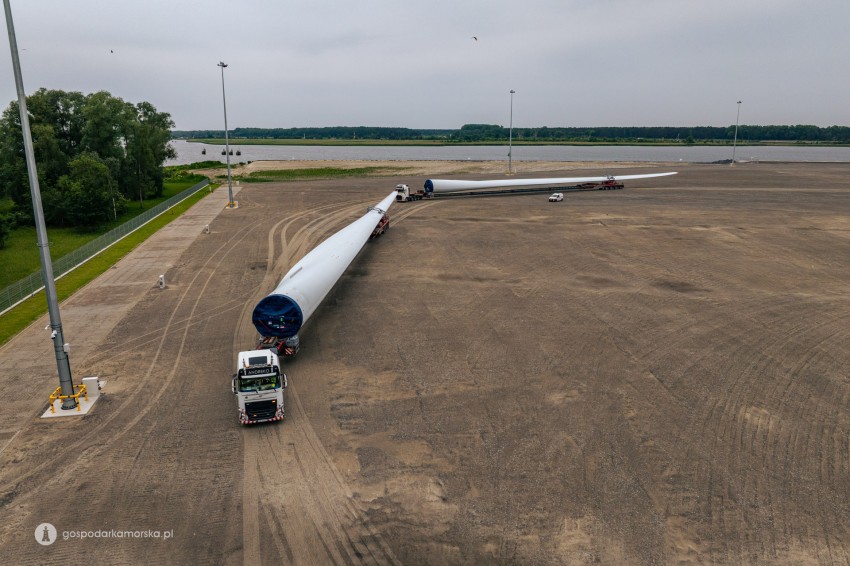
Terminal in Świnoujście, Terminal in Gdańsk
The Świnoujście Offshore Terminal is not the only installation port available to offshore wind developers in Poland. In Gdańsk, the T5 terminal is currently under construction at Baltic Hub.
The facility is leased by PGE, another state-controlled energy group developing offshore wind farms in the Baltic Sea. Although not yet operational, construction is nearing completion. In May, investor Istrana reported physical and financial progress of approximately 85 per cent. Completion is expected in the third quarter of this year.
The terminal will be used for future PGE projects, while Ocean Winds has also signed a reservation agreement for the facility in connection with the BC-Wind project.
Could two installation terminals on Poland's coast, both operated by state-controlled entities, end up competing against each other for projects?
"We do not regard the port in Gdańsk as competition, because there is room for everyone. Considering demand for this type of infrastructure and the availability of ports in the region, we do not view these as competing projects," says Janusz Bil.
For Deputy Minister Marchewka, the existence of two installation terminals reflects an effort to distribute investment across the entire coastline.
"That is precisely why we have two installation ports — one in Świnoujście and one in Gdańsk. In addition, we are developing three service ports financed through the National Recovery Plan, which our government unlocked. Altogether, we are allocating PLN 1.7 billion in non-repayable grants for these investments. They will support the offshore wind sector while providing ports with new development opportunities through entirely new functions. I am convinced that balanced investment along the entire coast will allow us to establish a strong position in the southern Baltic offshore wind sector," says Marchewka.
The expansion of Poland's offshore installation infrastructure is being watched with concern particularly by the Port of Rønne on the Danish island of Bornholm. Two major Polish projects currently under construction — Baltic Power and Baltica 2 — are using Rønne as their installation base.
Once the full capabilities of the terminals in Świnoujście and Gdańsk become available, and with future offshore projects divided between Orlen and PGE, vessels serving subsequent offshore construction campaigns are expected to depart primarily from Polish ports.
"I am not throwing down the gauntlet to anyone, but from my perspective I am looking after the interests of Polish businesses, Polish workers and Polish seaports. That is essentially what drives our actions," comments Jarosław Siergiej.
The Ports Are There. Now It Is Time for the Ships
Poland's performance offshore remains less impressive. While Polish firms frequently conduct environmental surveys and other support work, representatives of the shipbuilding industry continue to point out that Polish shipyards are not building installation vessels and other offshore units for Polish operators — despite constructing such vessels for foreign clients.
The concept of establishing a Polish offshore installation company capable of undertaking the most complex and profitable offshore construction work regularly resurfaces within the industry. Such a company could secure substantial local content while commissioning vessels from domestic shipyards.
Although there are currently no official plans to establish such a state-backed operator, state-owned companies are increasingly looking towards the shipbuilding and maritime sectors.
In an interview with Gospodarka Morska, Deputy Minister Marchewka emphasised that building a terminal is only part of the challenge; the full servicing of offshore wind farms ultimately depends on ships.
"That is why it is important to develop competencies related to vessel construction as well. We already have a very good example: the signing of a letter of intent between Polish companies concerning the construction of a cable-laying vessel. We want these specialised ships to be built here, so that we can participate as extensively as possible in the actual offshore works. This is extremely important both for the offshore wind sector and for supporting the shipbuilding industry," Marchewka said.
The letter of intent regarding the construction of a cable-laying vessel was signed last month by the Industrial Development Agency (ARP) and Tele-Fonika Kable, which has long expressed interest in acquiring such a vessel. Ownership of such a ship would allow the company to offer not only cable supply but also installation services.
Although the agreement remains preliminary, there is little doubt within the industry that the vessel should be built at a Polish shipyard or by a consortium of Polish shipyards.
In March, Vinci, an investment fund belonging to Poland's state-owned development bank group BGK, invested PLN 62.5 million in Mewo, a private marine survey company based in Straszyn near Gdańsk. Mewo is involved in virtually every major Baltic infrastructure project and plans to expand through the acquisition of vessels and subsea equipment.
The total investment programme is expected to exceed PLN 130 million.
"That is exactly what local content should look like — public money invested in Polish companies founded here, employing Polish workers and conducting scientific and research activities for such an important sector as offshore wind," Marchewka said during the signing ceremony between Mewo and Vinci.
State-owned shipping companies also see opportunities in the offshore sector. Polish Baltic Shipping has established a subsidiary, PŻB Offshore, which has already signed a consortium agreement with Szczecin Shipyard Wulkan to build Crew Transfer Vessels (CTVs).
Likewise, Polish Ocean Lines (PLO), another company owned by the Industrial Development Agency, is examining opportunities in offshore wind. In its July 2025 management report, the company stated that offshore investments undertaken by state-controlled companies could become an important additional business segment in the near future, supporting the surveying, construction and operation of offshore wind farms with specialised vessels, while emphasising that shipping operations would remain its core business.
Photos: GspodarkaMorska.pl
 DOWNLOAD PDF