

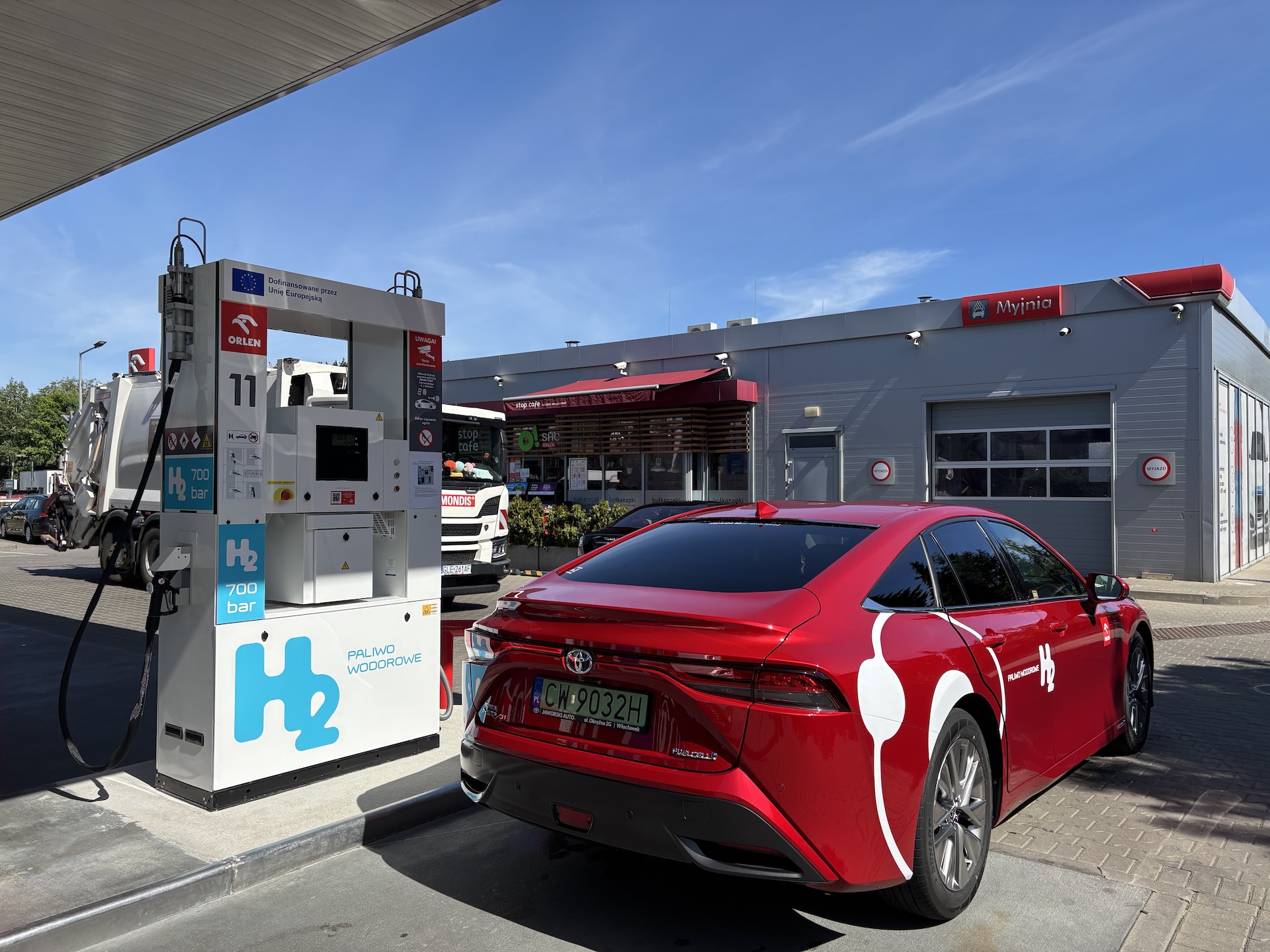


A seventh publicly accessible ORLEN hydrogen refuelling station has been launched in Poland at fuel station No. 650, located at 239 Wielkopolska Street in Gdynia. The facility is designed to serve passenger cars, buses and heavy goods vehicles. Additional stations are planned, including one in the vicinity of the Port of Gdańsk. Offshore wind energy is also expected to play a key role in hydrogen production across the ORLEN Group.
The ORLEN Group already operates public hydrogen refuelling stations in Poznań, Katowice, Wałbrzych, Włocławek, Piła and Płock, as well as in Prague and Litvínov in the Czech Republic. The newly opened facility in Gdynia is somewhat distinctive in that its hydrogen dispenser has been integrated into the existing fuel island rather than being clearly separated, as is the case at other stations. The Gdynia hydrogen station is equipped with a dispenser featuring two refuelling points, operating at 350 bar for passenger cars and 700 bar for buses and trucks. The new facility has a daily capacity of 630 kg of hydrogen.
Jakub Lubiński, Director of Hydrogen Technologies at ORLEN, emphasises that the company is responsible for the entire hydrogen production and transport chain supplying the Gdynia station. Hydrogen is delivered from ORLEN hubs in Włocławek and Trzebinia using dedicated hydrogen trailers. It is then compressed into the station’s buffer tanks and cooled when vehicle refuelling begins. Hydrogen is stored on site in mobile hydrogen trailers with capacities ranging from 500 to 900 kg. These trailers are replaced as the fuel is consumed. During the summer holiday period, a hydrogen-powered bus is expected to begin pilot operations in Gdynia using the new ORLEN station.
– Refuelling a passenger car takes around five minutes, while a bus can be refuelled in approximately 15 minutes. The facility is open to the public and operates around the clock. Six kilograms of hydrogen allow a hydrogen-powered car to travel approximately 500 kilometres. This refuelling speed and range are major arguments in favour of hydrogen vehicles – says Paweł Winnicki, Head of Hydrogen Refuelling Infrastructure Development at the ORLEN Group.
Poland currently has fewer than 200 hydrogen-powered vehicles, although the largest and fastest-growing segment is buses. More than 150 hydrogen buses are already in operation, with additional orders being fulfilled. Hydrogen is also increasingly viewed as a potential fuel solution for heavy road transport. The price of one kilogram of hydrogen at ORLEN stations generally does not exceed PLN 69.
Hydrogen ambitions extend to the ports
In the future, hydrogen stations are also planned in Warsaw, Kraków, Bielsko-Biała and Gorzów Wielkopolski. In addition, a mobile hydrogen refuelling station is already operating at a bus depot in Kraków, serving municipal transport vehicles. By the end of 2028, ORLEN also plans to build a hydrogen station in the vicinity of the Port of Gdańsk.
– The new station in Gdynia expands our domestic network with the first facility located in northern Poland, close to important transport corridors, including the S6 and S7 expressways situated less than 3.5 kilometres away – adds Jakub Lubiński.
He also notes that one of the next stations could be located near the Port of Gdańsk. Naturally, this is a location where demand for hydrogen fuel could be significant. Lubiński does not hide the fact that ports themselves could become major consumers of hydrogen in the future.
– Cargo-handling equipment in ports may in the future be powered by hydrogen fuel. We are already seeing interest from the industry in such solutions – Jakub Lubiński told GospodarkaMorska.
ORLEN’s hydrogen strategy also includes a strong maritime dimension. In the future, electricity generated by the Group’s offshore wind farms could be used to produce green hydrogen. During periods of surplus generation, when electricity from offshore wind is not required by consumers or industry, it could be directed towards hydrogen production through electrolysis. The term “green hydrogen” indicates that the electricity used in the process comes from renewable energy sources, which is important in the context of the energy transition.
Important at the European level
The Gdynia facility was developed as part of the “PureH2” project, co-financed by the European Union through the Connecting Europe Facility (CEF) under the CEF Blending Facility framework. Under its long-term hydrogen strategy extending beyond 2030, ORLEN aims to develop 0.9 GW of combined hydrogen production capacity using electrolysis and municipal waste processing technologies.
New hydrogen stations are being developed systematically as part of the Trans-European Transport Network (TEN-T), facilitating travel between locations across Poland and Europe. Within the next two years, ORLEN plans to build a network of 27 hydrogen refuelling stations serving private, public and freight transport, both road and rail, across Poland.
Photos courtesy of ORLEN
 DOWNLOAD PDF