

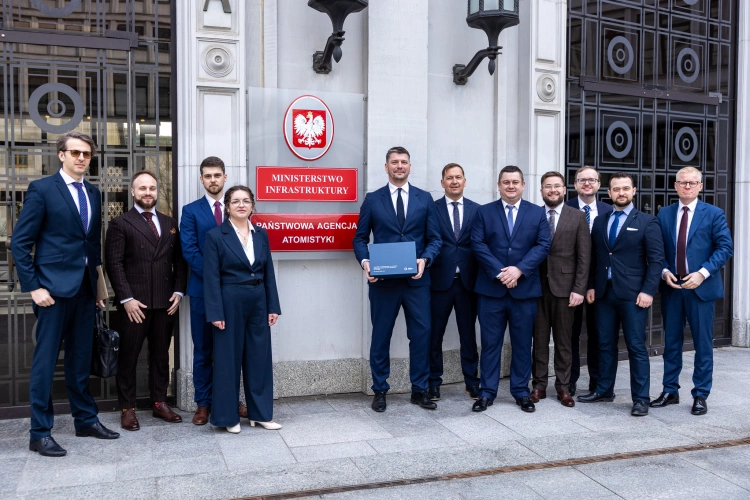


Polskie Elektrownie Jądrowe (Polish Nuclear Plants/PEJ) has submitted a construction permit application to the President of the Polska Agencja Atomistyki (National Atomic Energy Agency) for Poland’s first nuclear power station, to be built at Choczewo in the Pomerania region. The submission comes six months ahead of the schedule outlined in the project timeline, marking a historic milestone for nuclear energy in the country. Under current plans, the first concrete for the plant is expected to be poured in 2028.
“Submitting the application for Poland’s first nuclear power station signals our determined progress on an investment that will guarantee stable energy prices for Polish households for decades and serve as a driving force for modern industry. The supporting documentation confirms that the proposed plant meets the most rigorous international standards and will be safe for both local residents and the environment. There is no room for compromise here,” stated Wojciech Wrochna, Government Plenipotentiary for Strategic Energy Infrastructure.
“This is one of the most important days in advancing the project of Poland’s first nuclear power station. It is the first—and to date the only—such application in the history of modern Poland since 1989. I extend my thanks to everyone involved in preparing this extensive submission, which, as promised, we filed at the end of the first quarter this year. The scale of the work carried out by the employees of Polskie Elektrownie Jądrowe, and the volume of the application including annexes exceeding 40,000 pages, demonstrates how substantial and complex our project is,” said Marek Woszczyk.
Aware of the challenges facing both the investor and the regulator in ensuring the efficient review and assessment of the application, PEJ has been engaged in an intensive pre-licensing dialogue with the Polska Agencja Atomistyki. “I would also like to thank the President and experts at PAA for their ongoing cooperation, which bodes well for the processing of this comprehensive construction permit application,” added Woszczyk.
The submission constitutes a formal investor application, made to the PAA President in accordance with the requirements set out in the Atomic Law. It includes a full set of evidentiary materials confirming compliance with nuclear safety, radiological protection, physical security requirements, and the investor’s capacity to deliver the project.
A key component of the documentation is the Preliminary Safety Analysis Report (PSAR), which provides a detailed description of the plant design and its site, along with comprehensive technical and environmental analyses demonstrating compliance with all requirements for nuclear safety, physical protection, radiological safeguards, and nuclear material security.
The application also incorporates a quality assurance programme, safety classification, a design for the physical protection system of the nuclear facility and nuclear materials, basic information on the management of radiological incidents, and documentation confirming the investor’s technical, personnel, and organisational capabilities to execute the project.
The complete dossier exceeds 40,000 pages, compiled by more than 200 experts across multiple disciplines, particularly in nuclear safety and radiological protection.
The President of PAA will issue a decision on the construction permit within 24 months of submission, excluding any time required for supplementary documentation from the applicant. Construction is expected to commence in the fourth quarter of 2028, beginning with the pouring of the so-called first nuclear concrete. To proceed according to this schedule, the investor must secure both the construction permit from the PAA President and a building permit issued by the Pomorskie Voivode. PEJ plans to submit the building permit application in 2027.
The first Polish nuclear power station will be located at Lubiatowo-Kopalino in the Choczewo municipality. The facility will comprise three AP1000® units with a combined installed capacity of 3,750 MWe. The plant is being constructed by the American consortium Westinghouse-Bechtel. Key administrative approvals, including site and environmental permits, are already in place. Preparatory work at the site has been ongoing since 2025. Construction of each reactor is expected to take approximately seven years, followed by roughly one year of testing and commissioning. The first reactor is scheduled to begin commercial operation in 2036, the second in 2037, and the third in 2038.
 DOWNLOAD PDF