

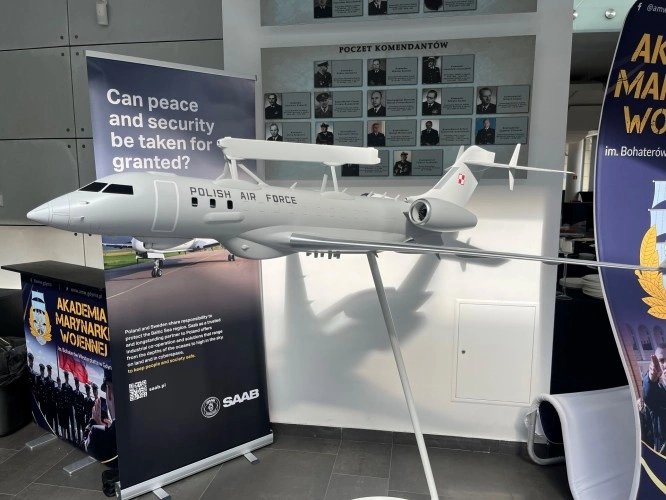


The 4th Polish–Swedish Maritime Technology Forum took place at the Naval Academy of the Heroes of Westerplatte in Gdynia, bringing together representatives from government, the navy, and the defence and technology sectors. The event provided a platform to exchange expertise and discuss avenues for cooperation in enhancing security across the Baltic Sea and beyond.
The recurring forum is organised in partnership with Swedish defence group Saab. Discussions at this year’s event focused on contemporary threats, particularly those arising from Russian activities and the so-called “shadow fleet,” as well as the ongoing aggression against Ukraine that began in February 2022. Topics also included safeguarding maritime assets, critical infrastructure in the Baltic, threats of sabotage, and monitoring of hostile naval operations. Participants debated strategies for strengthening naval forces’ readiness to address modern challenges and enhance operational capabilities.
“For the Naval Academy, the coming years will be extremely challenging. We are fully aware that, in cooperation with the Navy Inspectorate and the Naval Training Centre in Ustka, we must prepare crews capable of operating future vessels. This includes not only the Orka programme but also the Ratownik and Miecznik programmes. As an institution of higher education, the Academy is responsible for preparing officers to serve on these ships. We work closely not only with Saab but also with Babcock and PGZ Shipyard to ensure our academic programmes evolve to meet the practical needs of future crews, as well as surface and submarine vessels,” said Commodore Dr. Bartłomiej Pączek, Vice-Rector for Science at the Naval Academy.
“The forum is part of Saab’s strategic cooperation with the Naval Academy. We believe it is valuable to connect academic institutions, government authorities, and industry in research and development initiatives. Saab sees this approach as highly productive. Our role is to support academic and government partners, facilitating the exchange of ideas that can accelerate innovation, research, and development. Additionally, we assess bilateral R&D activities at both European and NATO levels,” added Jyrki Kujansuu, CEO of Saab Technologies Poland.
Among the attendees were the Swedish Ambassador to Poland, Martina Quick, as well as representatives from both countries’ defence ministries. The conference featured panel discussions on safeguarding maritime resources and critical coastal infrastructure, the use of unmanned platforms for maritime surveillance, and underwater technologies and operations in the Baltic. The forum also provided an opportunity to explore the role of the Polish defence industry in these initiatives.
In recent years, Polish and Swedish institutions and companies have strengthened collaboration on Baltic security. These issues were also highlighted during last week’s Baltic Sea Security Talks: Strengthening the Polish–Swedish Strategic Partnership, attended by the defence ministers of Poland and Sweden and by King Carl XVI Gustaf of Sweden. Current initiatives include procurement of Swedish defence equipment for the Polish Armed Forces.
Under the cooperation with Saab, Poland is building two electronic reconnaissance vessels as part of the Delfin programme. Later this year, a contract is expected for the delivery of new submarines under the Orka programme, comprising three A26-class vessels, with the first scheduled for delivery to Poland by the end of 2030. Meanwhile, as a bridging solution, the Swedish A17-class submarine HMS Södermanland is planned for lease to Poland in 2027.
 DOWNLOAD PDF