

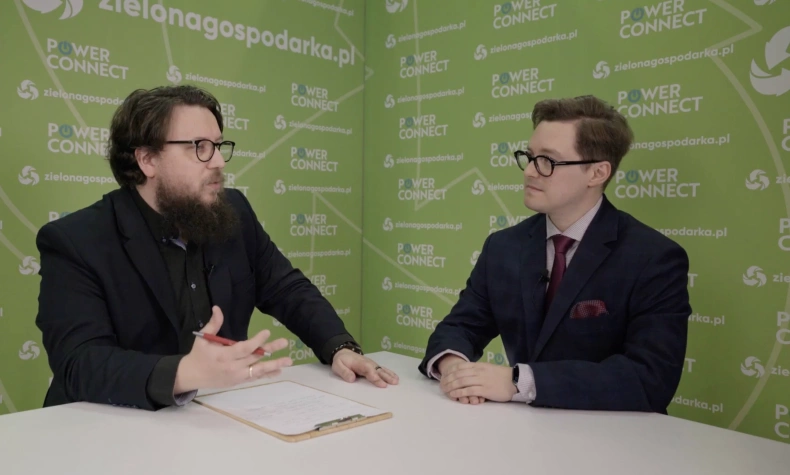


Floating terminal in the waters of Gdańsk Bay represents one of the most significant investments not only for the company itself but for the entire Polish energy sector. Yet many people are not fully aware of what such a facility actually is or how it operates. At the Power Connect energy trade fair, Jakub Milszewski from GospodarkaMorska.pl spoke with Maciej Wawrzkowicz, responsible at GAZ-SYSTEM for the offshore segment of the FSRU Programme, about the details of this unique installation.
An FSRU (Floating Storage & Regasification Unit) is essentially a specialised floating vessel, permanently moored at a berth prepared for its needs, which, in principle, operates much like a conventional onshore liquefied natural gas (LNG) terminal.
“This ship’s role is twofold: to store—or rather, process and hold—in its tanks the LNG delivered by sea and then, within its own facilities, convert the substance from its liquid to gaseous state,” explains Maciej Wawrzkowicz, FSRU Offshore Project Manager at GAZ-SYSTEM.
From the floating terminal, the gas is pumped via connection arms and onshore infrastructure—constructed and managed by GAZ-SYSTEM—into the national transmission system. It is worth noting that Poland already has one gas terminal, in Świnoujście. The FSRU will serve a similar function, but there are significant technical differences between the two facilities.
“The Świnoujście terminal is a typical onshore industrial facility. It is located on land and equipped with three large tanks with a combined capacity of approximately 0.5 million cubic metres of LNG,” says Wawrzkowicz. “The difference with the floating terminal is its flexibility: it can be unmoored, and in the event of unforeseen circumstances—such as a sharp drop in gas demand or a change in the project’s business environment—the vessel can simply leave and operate elsewhere.”
Unmooring an FSRU is, however, a completely different procedure compared with a conventional LNG carrier. The terminal is generally permanently moored to the berth, while LNG carriers dock alongside it in a “ship-to-ship” configuration.
“The mooring infrastructure is designed for the FSRU to remain there permanently,” confirms Wawrzkowicz. In parallel with the project, a protective breakwater is being constructed under the supervision of the Maritime Office in Gdynia. This structure will ensure optimal mooring conditions, mitigating the impact of waves and wind on the vessel and guaranteeing safe technological operations.
Both the onshore and floating terminals share the same mission: to receive LNG deliveries by sea, store them temporarily in a processed form, and then, after regasification, feed the gas into the national transmission system. Both facilities can accommodate the same type of LNG carriers, including the largest vessels capable of accessing the Baltic Sea.
At the Gdańsk terminal, LNG carriers will dock “side by side” with the FSRU, and the transfer of cargo will occur via ship-to-ship technology. Once the vessel is in place and safety checks completed, the loading masters from both the terminal and the ship confirm that the transfer can proceed. LNG is pumped in liquid form into the floating terminal’s tank, which will have a capacity of around 170,000 cubic metres, and then directed to the regasification plant, where it is converted into gas using specialised heat exchangers. Notably, these exchangers can operate in multiple modes depending on factors such as seawater temperature.
“The vessel can also operate in an ‘open loop’ mode, where the only factor causing regasification is the temperature of the seawater. Alternatively, heating may be applied, especially when the sea water is unusually cold. Our floating terminal will be technologically advanced and capable of operating under varying conditions, with the technology adapted for optimal performance,” explains Wawrzkowicz.
The FSRU, currently under construction at Hyundai Heavy Industries in South Korea, will be chartered by GAZ-SYSTEM from White Eagle Energy, a subsidiary of the Japanese Mitsui O.S.K. Lines Group. However, the operation of the berth itself will be managed by GAZ-SYSTEM personnel, who will also be stationed on the vessel.
Importantly, the infrastructure being built by the company is designed to accommodate a second floating terminal if market demand for such a solution is confirmed.
“We are currently constructing the northern section of the berth, where the first FSRU will be moored. We are planning this investment with the future in mind: the berth will have two positions, allowing for additional technical installations and mooring and technological equipment. This will make it much easier to accommodate and safely operate a second unit should additional regasification capacity be required,” Wawrzkowicz explains.
Commercial operation of the FSRU is scheduled to begin at the start of 2028, with the vessel itself expected to arrive in Poland in the fourth quarter of the preceding year.
 DOWNLOAD PDF