

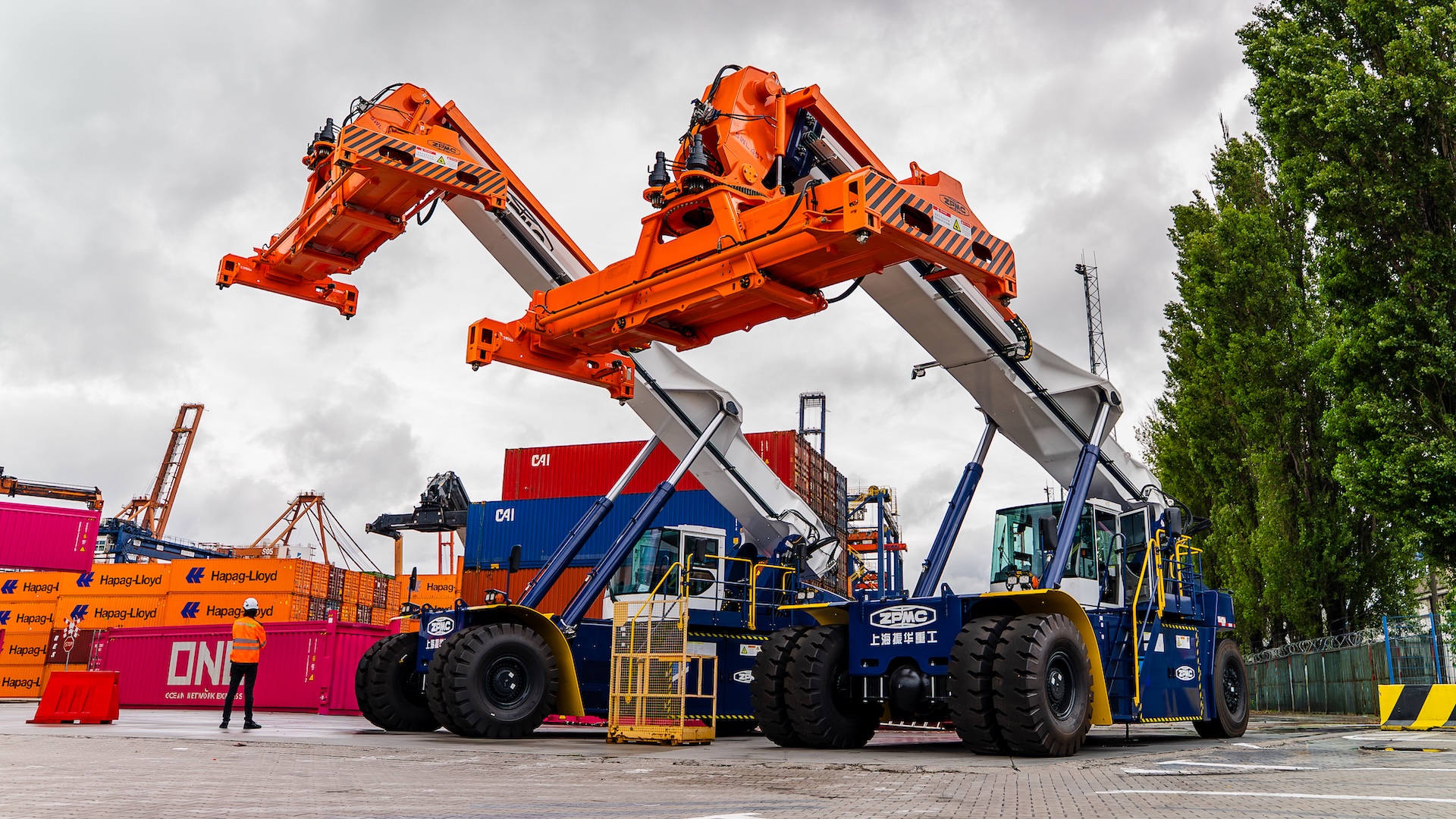


Gdynia Container Terminal is breaking new ground: new electric equipment has begun operating at the terminal, reducing its diesel consumption by one third.
Decarbonisation is an unavoidable challenge for seaports. One of the pioneers of this type of initiative in Poland is Hutchison Ports Gdynia, operator of Gdynia Container Terminal. In recent weeks, a total of 28 new vehicles have been introduced at the Gdynia terminal – all electrically powered. Their deployment will reduce the terminal’s diesel consumption by more than one third.
The new equipment at GCT comprises 24 terminal tractors for container transport, two so-called e-reachstackers for stacking containers, and two e-empty handlers used to move empty containers. GCT President Jan Jarmakowski says that all the new vehicles have already been deployed in cargo-handling operations.
“As far as electric terminal tractors are concerned, there is already some equipment of this kind in Poland. However, we are probably the first container terminal in the country’s seaports to have deployed this type of machinery. We are certainly pioneers when it comes to electric reachstackers and empty handlers. As far as I know, there are no such machines in Poland yet. There are only demonstration units, but none that are already performing regular cargo-handling operations,” says Jarmakowski.
28 new electric vehicles, chargers and a management system
The new reachstackers and empty handlers now operating at the Gdynia terminal were manufactured and supplied by ZPMC Netherlands BV. The reachstackers, known in their electric version as e-reachstackers, are equipped with batteries with a capacity of 508 kWh. The e-empty handlers have 363 kWh batteries, while the terminal tractors have a capacity of 282 kWh. For comparison, according to the International Energy Agency, the average battery capacity of new fully electric cars in the European Union in 2025 was approximately 70 kWh.
The electric reachstackers consume around 40 kWh per hour of operation. They have an unladen weight of 72 tonnes and a lifting capacity of 45 tonnes. The ZPMC empty handlers have different specifications: their energy consumption is 28 kWh per hour of continuous operation, with an unladen weight of 41 tonnes and a lifting capacity of 9 tonnes.
The 24 new terminal tractors are manufactured by Westwell. They are powered by lithium iron phosphate (LFP) batteries with a service life of more than 2,800 charging cycles. Their estimated range is 150 km. Charging using the infrastructure installed at the terminal is fast: recharging the batteries from 20% to 80% takes approximately 45 minutes.
GCT says the entire new fleet is integrated with the AdaOps system, a specialised tool for managing and scheduling traffic. Implementing this management system was one of the project’s components. It enables real-time monitoring of battery charge levels and any technical faults in the vehicles.
“Battery levels are monitored by a centralised system which, by analysing the equipment’s current workload and electricity consumption, alerts the operator when the vehicle should be taken off duty for charging,” explains Jan Jarmakowski.
Charging takes place at a dedicated station built within the terminal. It has six dual charging units with higher power ratings than standard chargers for passenger cars, reflecting the larger battery capacities of the terminal vehicles.
“These machines have much larger batteries. Their capacity is sufficient to provide an energy reserve for around eight hours of uninterrupted operation,” explains the GCT President. “Along with the equipment and chargers, we also had to upgrade our power infrastructure and build additional transformer substations to ensure an adequate electricity supply,” adds Jan Jarmakowski.
Operating the new vehicles does not differ significantly from working with the diesel-powered machines previously used at the terminal. However, employees have received appropriate training to operate the new equipment. The main difference is the need to monitor battery charge levels and connect the vehicles to chargers when their energy levels begin to fall sharply.

50% funded by the National Recovery Plan
The entire project – involving the replacement of terminal tractors, empty handlers and reachstackers with electric alternatives, the purchase and implementation of specialised software to manage the energy use of the entire equipment fleet, the purchase and installation of charging stations, and modifications to the terminal’s electricity infrastructure – was valued at more than PLN 65 million. GCT received funding for its implementation from the National Recovery and Resilience Plan, which covered 50% of the costs.
Tenders for the project began in 2025. The new reachstackers and empty handlers arrived at the terminal directly from China, packed in six containers. The manufacturer's technicians then began assembling the machines on site, after which they underwent tests to verify their full functionality. Finally, in October, the equipment successfully passed the technical acceptance inspection carried out by the Transport Technical Supervision Authority (TDT) and was officially approved for operation. The manufacturer was responsible for the entire transport and assembly process.
One third less diesel – for now
The new equipment is expected to significantly reduce diesel consumption and, consequently, emissions generated by the terminal.
“Ultimately, diesel consumption at our terminal should fall by around 30–33%, or roughly one third compared with current levels. Of course, this will happen once all the equipment has been fully deployed. We expect to reach that level around December,” says Jan Jarmakowski.
The estimated reduction in emissions is even greater. Terminal tractors alone accounted for 38% of emissions last year. Including the new reachstackers and empty handlers, the reduction will be around 45%.
However, further projects are under way that will reduce the terminal’s fuel consumption even more.
“We have managed to agree with TDT on a project to electrify our diesel-powered cranes. The tender is already under way, the funds have been budgeted, and I hope we will finally be able to carry out the project,” says Jarmakowski.
The electrification of a further seven yard cranes at GCT has been under discussion for two years. Last year, the technical design for the upgrade, prepared by Polish engineers, was completed and accepted. The next step is now implementation.
“We are ready and, most importantly, there is strong commitment and support from the Transport Technical Supervision Authority, which also recognises the significant environmental and economic value of promoting projects of this kind,” says the GCT President.

The industry is watching
Jan Jarmakowski also notes that GCT’s experience in introducing extensive electrification at the terminal has attracted the attention of other companies in the industry, which have been asking for further details.
“We are happy to invite others to see this equipment in operation. I think quite a few other port companies in Poland will soon move in this direction. This is one of the areas where we are breaking new ground. To some extent, that is the role of large port groups – to show the way forward. If new approaches are well received in a given market, other players follow suit. And we also learn from others,” Jarmakowski points out.
The electrification of GCT has in fact been under way for years. The terminal already operates its first seven electrically powered yard cranes. All lighting for equipment and storage yards is also based on energy-efficient LED technology.
A separate issue is the provision of shore-side electricity to ships through Onshore Power Supply (OPS) systems. Passenger and container terminals belonging to the TEN-T network are required to implement this technology by 2030. GCT will have to provide shore-side electricity to vessels of more than 5,000 GT during at least 90% of their annual calls at berth. Ships themselves will be required to use the connection if they remain alongside for more than two hours.
However, implementing this technology is not straightforward, as it requires substantial modifications to infrastructure. The terminal is currently in discussions on the subject with its customers and electricity supplier.
Photos: GospodarkaMorska.pl
 DOWNLOAD PDF
