

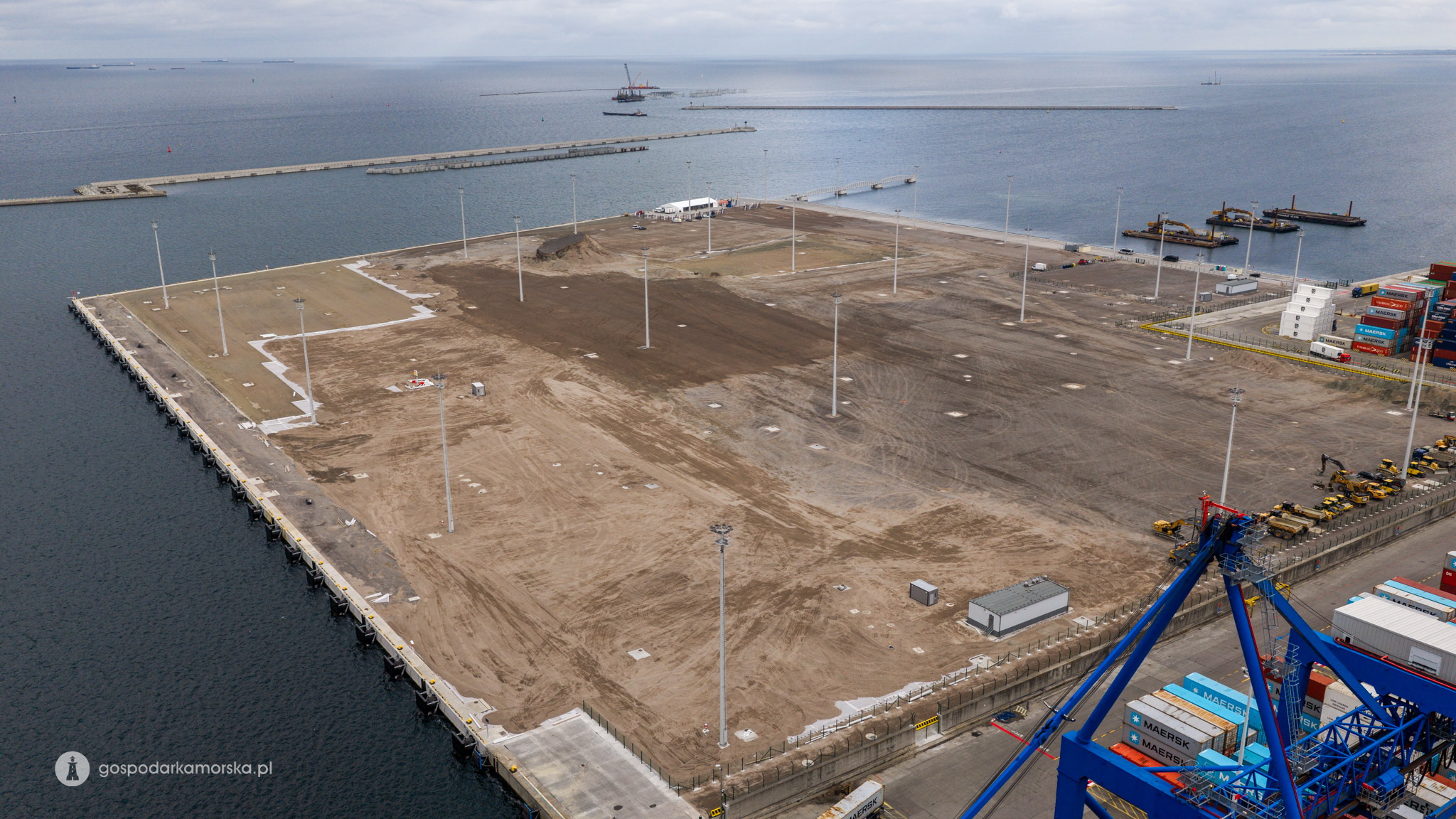


Although work on the T5 terminal is still under way, the new section of Baltic Hub was officially opened today. The facility is intended to serve as an offshore wind installation terminal for PGE, marking an entirely new area of activity for Baltic Hub. Where did the investment originate, and how was it carried out?
On Friday, 30 October, a ceremony was held to officially open the new section of Baltic Hub, known as Terminal T5. The event was held under the slogan ‘More Poland. More Power’. After all, T5 is a new part of the country, created by reclaiming land from the sea – a point repeatedly emphasised during the opening ceremony. The terminal was built with the needs of the offshore wind industry in mind.
The significance of the investment was reflected in the list of attendees at the ceremony. Among those seated in the front rows were representatives of the central government, led by Prime Minister Donald Tusk. He was accompanied by Andrzej Domański, Minister of Finance and Economy; Wojciech Balczun, Minister of State Assets; and Deputy Ministers Eliza Zeidler, responsible for State Assets; Jacek Karnowski, responsible for Funds and Regional Policy; and Arkadiusz Marchewka, responsible for Infrastructure. Local authorities were also represented, but above all there were representatives of the companies and institutions directly involved in the project: Baltic Hub and its owners, led by the Polish Development Fund (PFR); Istrana, the main investor; contractors and subcontractors, including NDI, Transprojekt Gdański and Wuprohyd; Soiltech; and the Port of Gdańsk Authority, which administers the entire area.
A Container Terminal, but Without Containers
Terminal T5 is, in some respects, an unusual investment. It is a new section of Baltic Hub, a container terminal, but T5 itself – as we have reported on several occasions – will have a different purpose, at least during the first few decades of its operation. The facility was designed as an installation base for the offshore wind industry. It was the requirements of offshore installation operations that determined the technical specifications needed for the terminal. Its organisational and ownership structure was also more complex than usual.
T5 is being developed as part of Baltic Hub Container Terminal, which operates within the port area administered by the Port of Gdańsk Authority. However, the main investor is Istrana, in which the majority stake is held by the Polish Development Fund (PFR), a co-owner of Baltic Hub, while the remaining shares belong to Baltic Hub itself. It was Mikołaj Raczyński, President of the PFR Management Board, who acted as host at the T5 opening ceremony, taking to the stage first and inviting Prime Minister Tusk to join him.
PGE Baltica, a developer of offshore wind farms and one of the companies belonging to the state-owned Polish Energy Group (PGE), was also involved in the design and construction phase. Together with Danish offshore giant Ørsted, PGE Baltica is the terminal’s first lessee. T5 is intended to meet their requirements for offshore installation operations.
Speaking at the opening ceremony, Prime Minister Donald Tusk was the first – though not the last – speaker that day to emphasise that T5 represents a new part of Poland.
‘The terminal has been built where there was water until recently. Poland is now 21 hectares larger. We have more Poland, more Gdańsk and more of the region,’ the Prime Minister said.
Indeed, like other sections of Baltic Hub, T5 was created through land reclamation – the process of creating solid land in an area previously occupied by the sea. It covers approximately 21 hectares. A total of 3.5 million cubic metres of suitable sand was needed to create the site. The sand and its delivery were the biggest challenge, Mikołaj Raczyński admitted. Supplies had to be organised at an exceptionally rapid pace, as the construction schedule – which the project managed to meet – was extremely tight. The entire construction process took two years. The site was handed over to the contractor on 13 November 2024.
‘The pace of construction was dictated by the entire process of obtaining all the decisions and permits required to start the works,’ said Lech Paszkowski, President of Istrana, the main investor in T5. Speaking to Gospodarka Morska, he recalled that in 2021–2022 it was still unclear exactly which port would host the terminal. Gdynia was initially under consideration.
‘The decision that it should be located in Gdańsk was made in 2022. Why? Simply because Baltic Hub had an active environmental decision covering the area where we are now standing. This allowed us to significantly shorten the process of obtaining decisions and permits, move more quickly towards the key construction permits and still leave ourselves enough time to carry out the investment itself,’ Paszkowski explained.
Time was crucial for two reasons. First, the investment was closely linked to the construction schedule for the Baltica 2 offshore wind farm, developed by PGE and Ørsted. Second, part of the funding came from Poland’s National Recovery Plan (KPO), meaning that the project had to be settled within the prescribed deadline. The total cost amounted to PLN 1.2 billion. The agreement for the KPO grant was signed on 3 October 2024, securing approximately PLN 900 million. Although the grant has not yet been fully accounted for, it is already clear that the final amount will be lower, probably in the region of PLN 700–750 million.
Mikołaj Raczyński, President of the PFR Management Board, recalled that T5 was one of the first investment projects to land on his desk after he took up his position. He also said that one of the key tasks within the company was to put together the financing structure, as PFR contributed its own funds to the project in addition to the KPO funding.
Once the financing had been secured, tenders were launched and lengthy planning, organisational and documentation work began. NDI won the contract to build the terminal. Shortly afterwards, the general contractor signed an agreement with Transprojekt Gdański, which was tasked with preparing the design documentation and obtaining the required permits.
Transprojekt itself subcontracted part of the design work in the fields of hydraulic engineering, structural and civil engineering, geotechnics, power engineering and telecommunications to a consortium comprising Soiltech and Wuprohyd. The companies had to prepare the site development plan, architectural and construction design, and technical design required to obtain an amended building permit, since the original permit covered a container terminal. They also had to prepare detailed designs incorporating specific structural solutions for each discipline, as well as technical specifications for the execution and acceptance of the works.
The Soiltech–Wuprohyd team prepared the hydraulic engineering designs for both quays, the quay alongside the ro-ro ramp and the terminal’s eastern retaining structure, as well as the design for ground reinforcement beneath the terminal yards. In addition, during the hydraulic fill works carried out under the original building permit for the container terminal, an NDI representative responsible for dredging works acted as lead designer. Once all the amended construction designs had been prepared, Piotr Pawłowski of Wuprohyd was entrusted with this role to support the design team in obtaining the necessary approvals and permits.
‘The terminal was built at an extremely rapid pace,’ said Krystian Curzytek, Senior Expert for Port Investment Delivery at PGE Baltica. He explained that the works included complex marine piling operations carried out with the help of specialist jack-up platforms.
‘These are slightly smaller jack-ups than the ones we use to install turbines at offshore wind farms, but this type of equipment is also used in port construction. It was important to plan everything properly, deal with winter conditions, ensure that the sand arrived on time and then move on to the next stages of construction: reinforced concrete works, piling and the installation of several thousand CFA piles (Continuous Flight Auger piles – ed. note). These are what give the terminal the load-bearing capacity we need for offshore projects.’

Quays, a Ro-Ro Ramp and a Reinforced Seabed
T5 is undoubtedly the most modern offshore wind installation terminal in the Baltic Sea and possibly in the whole of Europe. As Krystian Curzytek pointed out, offshore operations require quays with very high load-bearing capacity. They will be used to handle and store extremely heavy offshore wind farm components, including massive monopiles.
At the new terminal in Gdańsk, the quay in the pre-assembly area, where components will undergo initial assembly, has a load-bearing capacity of 40 tonnes per square metre. One of the facility’s interesting features is a ro-ro ramp with a 176-metre access bridge extending directly out into the sea.
‘Components such as nacelles will be delivered using this ramp and unloaded with the help of specialised SPMT transporters. You do not see anything like this at container terminals,’ Curzytek pointed out.
T5 has deep-water quays with a combined length of 800 metres, while the ro-ro berth is 130 metres long. The ramp itself measures 103 metres, with a further 30 metres at the approach. Importantly, although it is not visible, the seabed alongside the quays has also been reinforced – substantially.
‘Jack-up vessels will be positioned in front of the loading quay. They will stand on special legs and lift themselves up. They need seabed with the appropriate load-bearing capacity. To prevent them from sinking, it must be able to withstand 100 tonnes per square metre. All of this work has been completed: the ground was replaced and all its parameters were tested to ensure that these vessels can safely position themselves here and operate,’ said Krystian Curzytek.
These features mean that as many as five vessels involved in the construction of an offshore wind farm can berth at T5 simultaneously.
‘That is exceptional compared with other ports,’ Curzytek stressed. He added that neither Świnoujście nor the Danish port of Rønne or Germany’s Mukran, which currently handle offshore operations, offer quays of comparable length.
T5 is designed to meet the needs of offshore wind farm construction not only today, but also over the coming decades. This required the terminal to be designed and built with additional capacity in reserve. Wind turbines have grown considerably in recent years and, although the race to develop ever larger and more powerful models has lost momentum, there is no guarantee that it will not pick up again. It is therefore impossible to know what dimensions these machines may reach in the future.
‘We do not know how certain things will be transported or what types of equipment will be manufactured in a few years’ time,’ said Łukasz Jagalski, Deputy Construction Manager at NDI. As he put it, he and a team of more than 50 people had left their blood, sweat and tears at T5, along with ‘pieces of their souls embedded in the sand’.
‘The trolley used to transport a nacelle – the turbine’s machinery housing – weighs 800 tonnes. To transfer that load onto the surface, we needed a certain level of expertise and had to research exactly how the process works and how the load is transferred further down,’ he explained.
Enough Work Until 2032
The terminal will not begin operations immediately. According to Łukasz Jagalski, the contractor is already leaving the construction site, but final ground tests and compaction works remain to be completed. No new structures will be built at T5, although the terminal will eventually undergo some further changes. These will now be the responsibility of the investor and the users.
‘We now face the entire process of handing the terminal over for operation,’ said Lech Paszkowski, President of Istrana. ‘Starting on Monday, we will begin acceptance inspections together with our user, Elektrownia Wiatrowa Baltica 2. The coming weeks will involve a painstaking review of documents, site visits and the signing of handover protocols. Then, probably in early December, the first items of terminal equipment will arrive here. We should remember that we have built the platform, but that alone is not enough for offshore wind components to be delivered here. The terminal still needs to be properly equipped with cranes, offices and warehouses.’
Krystian Curzytek of PGE Baltica added that, after the acceptance inspections, the next stage would be to hand the terminal over to Siemens Gamesa, the company responsible for supplying the turbines for the Baltica 2 offshore wind farm. Siemens Gamesa will be responsible for mobilising the terminal and establishing the infrastructure it needs.
The first vessel carrying offshore wind components is expected to arrive in early January. These will initially be deliveries of components. The most spectacular operations, involving installation vessels, are currently scheduled for April 2027.
The T5 operations calendar is already full for the coming years. During the opening ceremony, handover documents for the infrastructure were symbolically signed with PGE Baltica and Ørsted, together with an agreement with PGE Baltica on leasing the terminal for the development of further offshore wind projects by the developer.
As Bartosz Fedurek, President of PGE Baltica, said from the stage, work on the Baltica 2 project is naturally the first priority. However, in 2028 T5 will be subleased to another developer, Ocean Winds, which will use the terminal for its BC-Wind offshore wind farm. Further PGE projects, Baltica 9+ and Baltica 3, are next in line.
‘This is excellent news for us. The term “local content” has been repeated in every possible context today. We have spoken many times about the fact that local content can only become a reality if there is a continuous flow of orders. The same applies to an installation terminal,’ said Lech Paszkowski.
‘If there is no traffic at this terminal, if there is no offshore activity, other companies interested in handling cargo – though not necessarily offshore cargo – will quickly take an interest in it. The decision to carry out Baltica 3 and Baltica 9+ from this terminal allows us to look ahead with greater confidence to the years after the Baltica 2 project, with a horizon of 2032, perhaps 2034,’ Paszkowski added.
Another Energy Building Block for the Port
The new T5 terminal brings additional functions to Baltic Hub, which until now had been dedicated exclusively to container handling, with only occasional project cargo operations. It also adds a new dimension to the Port of Gdańsk itself.
‘This is particularly important for the Port of Gdańsk because, from today, we are genuinely becoming an installation port,’ said Dorota Pyć, President of the Port of Gdańsk Authority.
Until now, the Port of Gdańsk had played a much smaller role in the development of offshore wind in the Baltic. Vessels carrying out surveys and preparatory work at wind farm sites did operate from the port, but installation vessels and ships delivering wind farm components sailed from other locations. Such vessels can be seen, for example, in neighbouring Gdynia, where the installation vessel Svanen has been based for some time. However, large offshore vessels will appear at T5 as early as next year.
For Dorota Pyć, President of the Port of Gdańsk Authority, the launch of the installation terminal is particularly symbolic. She has academic links with the offshore wind industry and, as a former Undersecretary of State, also took part in processes related to its development.
‘The first permits to construct offshore wind farms were issued in 2012 and 2013. It is now 2026, and we are delighted because the first offshore wind farm in Poland’s exclusive economic zone has been commissioned. Next year, PGE will have its first offshore wind farm. And there is much more potential. Specialists have calculated that the capacity which could be developed in the southern Polish part of the Baltic Sea exceeds 30 GW,’ Dorota Pyć said.
Offshore wind is also another building block in the Port of Gdańsk’s development as an energy hub.
‘This is where the LNG terminal is being built and where the fuel terminal is being expanded. The Port of Gdańsk is becoming a genuine energy hub and a pillar of our security,’ said Arkadiusz Marchewka, Deputy Minister of Infrastructure.
‘We are developing well. We naturally have ambitious plans for building an energy hub at the Port of Gdańsk. This is the direction we will continue to follow, and the opening of the installation terminal is a very significant step towards implementing our energy hub strategy,’ added Dorota Pyć. The Port of Gdańsk Authority President also pointed to another planned element: OPS, or Onshore Power Supply. This system will allow vessels to receive electricity from the quay, reducing emissions generated while ships are berthed in the port, but also increasing demand for electricity.

Once from Denmark, Now from Gdańsk and Świnoujście
The Gdańsk T5 facility is Poland’s second offshore wind installation terminal. The first was built in Świnoujście by another Polish offshore wind developer, Orlen. It is also a relatively new facility, officially opened in June last year. However, it has shorter quays with a lower depth and a smaller storage area, although its functionality is also rated very highly.
Deputy Minister Arkadiusz Marchewka, who is responsible for maritime affairs and inland navigation at the Ministry of Infrastructure, is not concerned about potential competition between the two Polish installation terminals.
‘There is a great deal of work to be done along the entire coastline. We have installation ports and service ports. What matters is that we have the capacity to carry it out. There is no risk here that one company will have more work while another has nothing to do. There are so many projects being carried out by both Orlen and PGE that I am convinced they will complement each other very well, allowing Polish ports and the maritime economy to develop,’ Marchewka said.
Four offshore wind farms are currently under construction in Polish Baltic waters. Baltic Power, owned by Orlen and Northland Power, is already undergoing testing and commissioning. All the foundations for Baltica 2, developed by PGE Baltica and Ørsted, have been completed. The foundation installation phase has also been completed at the Bałtyk 2 and 3 projects, developed by Polenergia and Equinor. Construction of the BC-Wind project, developed by Ocean Winds, has not yet moved offshore. The developer is currently carrying out onshore works.
Further projects are also in the pipeline. Last December, Orlen’s Baltic East, PGE’s Baltica 9+ and Polenergia and Equinor’s Bałtyk 1 projects received support in Poland’s first auction for the right to cover the negative balance of electricity sales. PGE Baltica and Orlen Neptun, the companies responsible for developing offshore wind projects within the PGE and Orlen portfolios respectively, are also preparing further projects for upcoming auctions.
Baltic Power, the first offshore wind farm in Polish waters, had to use the installation port of Rønne on the Danish island of Bornholm because of the project schedule. The logistics teams working on the Bałtyk 2 and 3 projects are also using foreign facilities. Baltica 2, however, will be the first wind farm to use a Polish installation port – T5 itself – for turbine installation. BC-Wind, in turn, will use both the Gdańsk T5 facility and Świnoujście Offshore Terminal for the transport and installation of its monopiles and turbines. Future PGE and Orlen projects will be carried out from Gdańsk and Świnoujście.
‘The Danes were our formidable, though friendly, competitors. Today, we have decided to take the initiative and take the helm ourselves. Thanks to this terminal, we will be able to develop our energy potential much more efficiently. The skills we acquire may even allow us to compete beyond the Baltic Sea,’ Prime Minister Donald Tusk said at the T5 opening ceremony.
And There Is Local Content Too
‘PGE’s offshore investments are long-term projects. We already have further developments ready to be carried out. One of PGE’s objectives is to increase the share of local content to more than 65%,’ said Dariusz Lubera, President of the Polish Energy Group.
Carrying out offshore work using Polish ports is an important element in increasing the participation of domestic companies in major infrastructure projects. This, in turn, translates into higher revenues for the state treasury and local residents.
‘Local content means security, resilience, independence and control over supply chains. It is not a return to state protectionism, nor is it a return to the communist era. It means being sufficiently capable, intelligent and effective in thinking about how the Polish economy should continue to develop,’ said Wojciech Balczun, Minister of State Assets. He also cited estimates by analysts at PKO BP suggesting that a 10% increase in local content could translate into a 3.6% rise in GDP and an increase in state revenues of approximately PLN 30 billion.
‘Everything here is thoroughly Polish, including the contractor from my beloved Sopot. It is not just that Poles designed the project, engineered it and carried out works on the water, making Poland bigger. This project will also allow more Polish companies to take part in future offshore investments,’ said Donald Tusk.
‘This is a measure of our investments and our success, but what else this terminal can demonstrate remains to be seen,’ argued Mikołaj Raczyński, President of the Polish Development Fund.
Baltic Hub Continues to Expand
The completion of work on T5 does not mean an end to investment at Baltic Hub. In the summer, the company signed an agreement with the Port of Gdańsk Authority under which it became the lessee of a further 26 hectares of land directly adjacent to the terminal’s existing area, with access to deep water and the existing Ore Pier.
This will make it possible to extend Baltic Hub’s Quay II by approximately 70 metres and expand its storage yards. The main project, however, is the construction of a new railway siding with seven tracks, each 750 metres long.
In addition, the environmental documentation dated July 2025, prepared for the Baltic Hub expansion project involving improvements to the terminal gate complex, contains a statement that ‘Terminal T4 will be designed in the future’. Like T3 and T5, it will also be developed as an outer port, with part of the water area reclaimed to create new land.
Photos: GospodarkaMorska.pl
 DOWNLOAD PDF
