

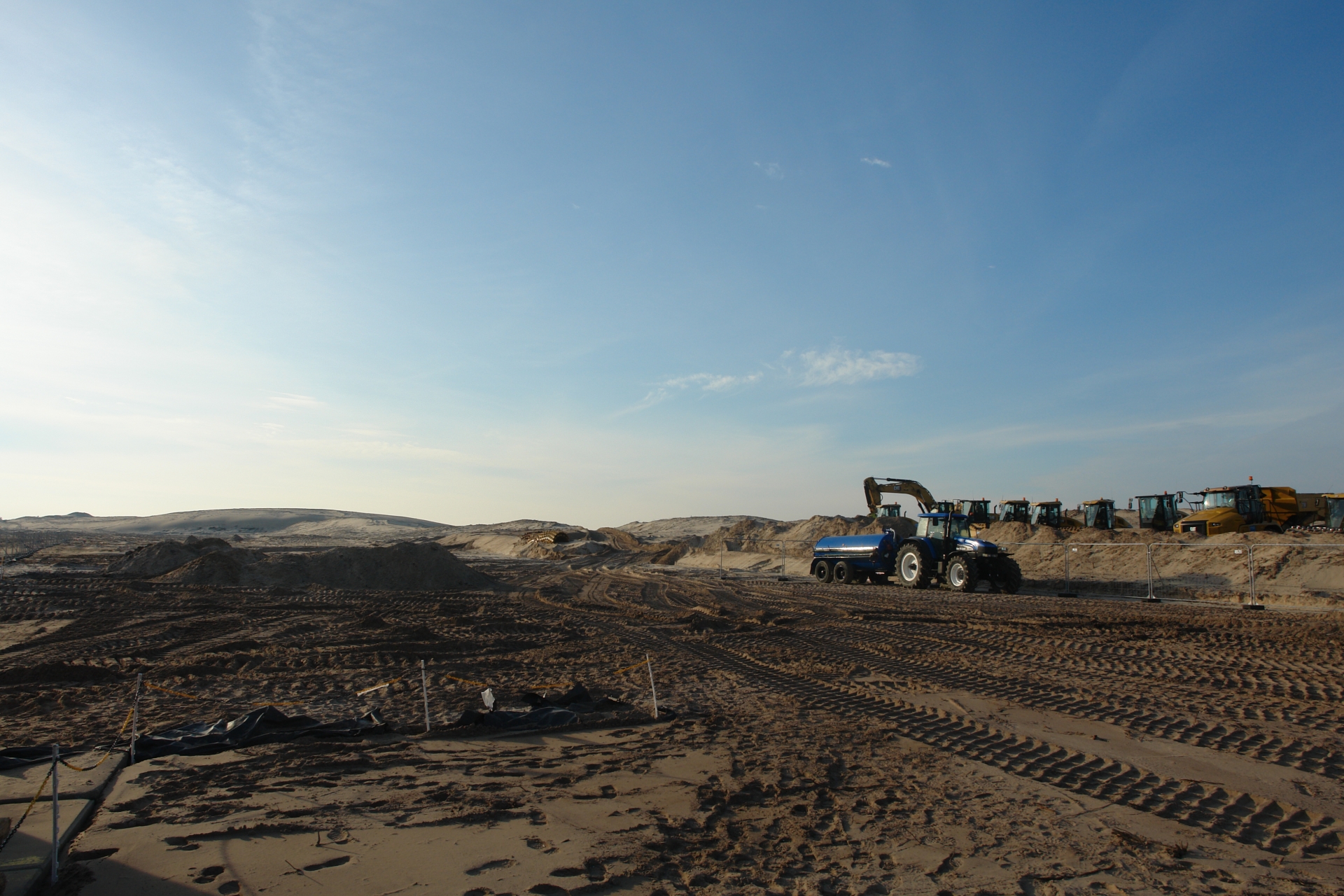


Polskie Elektrownie Jądrowe (PEJ)/Polish Nuclear Power Plants will submit an application to the Pomeranian Voivode by the end of October for a permit to carry out preliminary construction works at the site of the future power plant, PEJ President Marek Woszczyk has announced. The company expects to obtain approval next year. The work will then focus primarily on deep excavations for the reactor foundations, drainage and land reclamation, and other earthworks.
Marek Woszczyk spoke to journalists at the power plant construction site on Wednesday, 21 October. Gospodarka Morska was there. The media had been invited to see the progress of the initial earthworks, which involve levelling the site for the power plant. The work is being carried out by Budimex, which is expected to move as much as 7 million cubic metres of earth.
Meanwhile, Bechtel, the company responsible for building the plant, is conducting geological surveys of the ground at the future reactor locations, as well as surveys of the seabed off the nearby beach at Słajszewo. Tunnels for the reactors’ cooling systems will be built there, along with a MOLF (Marine Off-Loading Facility) — effectively a seaport that will enable many of the project’s most important components to be delivered to the site.

The work currently under way does not constitute the actual construction of the power plant; it is site preparation. As Woszczyk emphasised, the preliminary construction works permit is a new legal instrument under Polish law. PEJ plans to obtain the main construction permit in 2028. Two separate approvals will be required: one from the Pomeranian Voivode and the other from the President of the National Atomic Energy Agency. In addition to clearing the site, access roads have been provided and welfare facilities for workers are being built. The central site compound, connected to the offices, has an electricity supply and a telecommunications mast, as well as access to water, sewage facilities and medical care.
Polskie Elektrownie Jądrowe and Bechtel are negotiating the construction contract. The companies aim to sign it in the first quarter of next year. The first pour of nuclear-grade concrete — a material with special properties designed to provide radiation shielding — is scheduled for the third or fourth quarter of 2028, or, at the latest, the first quarter of 2029.

More Than Just a Power Plant
PEJ Vice-President Michał Olszewski pointed out that numerous associated projects are under way alongside the construction of Poland’s first nuclear power plant. Although they are not part of the plant itself, they are no less important to the overall investment. The aim is to develop the transport infrastructure needed to serve the facility. A new section of national road No. 69 is being built to provide direct access to the plant, while approximately 150 kilometres of railway lines are being constructed or modernised. This is the largest railway project in Poland since 1989.
The PLN 5 billion programme will also include a new power grid, sewage infrastructure and drainage works. The roads and railway infrastructure developed for the power plant will remain fully accessible to the public. This will also benefit local residents, who stand to gain from the improvements. The first 11-kilometre section of national road No. 69 is due to open in May or June 2027.

A modular accommodation complex for 1,000 power plant workers will also be built on site. It will include comprehensive welfare and recreational facilities, including sports infrastructure. At the peak of construction of Poland’s first nuclear power plant, the workforce is expected to reach as many as 10,000 people. Initially, these workers will be among those to benefit most from the new road and rail connections.
Leszek Hołda, President of Bechtel Polska, stressed that although the project is still at an early stage, the work planned for the power plant represents the largest undertaking to date for many of the contractors involved. This applies to Budimex, Unihouse, which will be involved in the planned modular accommodation complex, and Polimex Mostostal, which will build the halls for assembling Westinghouse AP1000 reactors. Westinghouse will supply the technology for the Polish plant. Contracts worth PLN 1 billion have so far been awarded to Polish contractors.

Around 150 Polish engineers are currently working on the project, which will also help develop a workforce for future nuclear power plants in Poland. According to PEJ President Marek Woszczyk, the power plant in the municipality of Choczewo is expected to supply its first electricity in 2036. By 2038, it is projected to meet between 10 and 15 per cent of Poland’s total electricity demand.

Photos: MarinePoland.com
 DOWNLOAD PDF
