

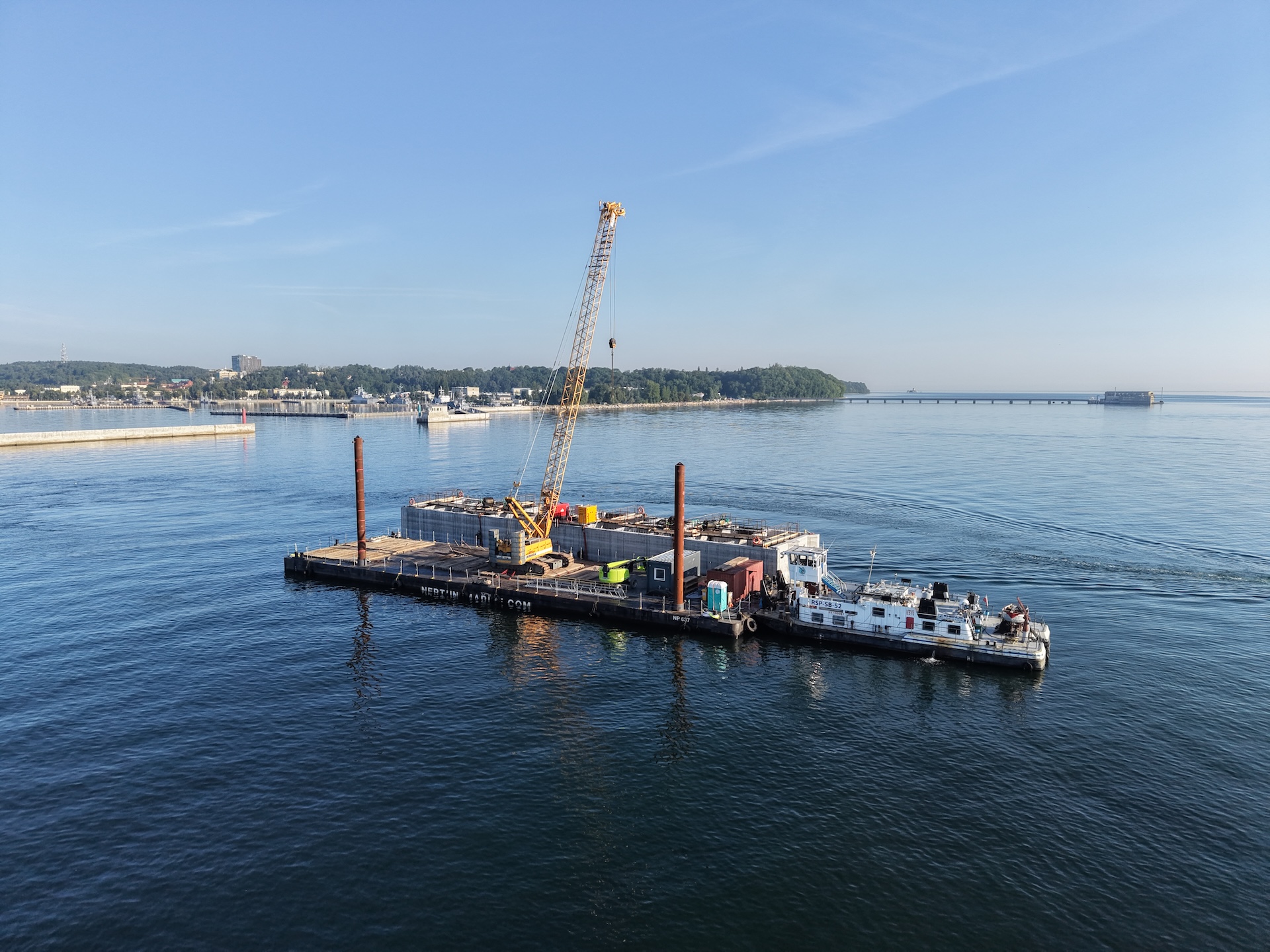


At the Port of Gdynia, the first reinforced concrete caisson intended for the construction of the protective breakwaters for the Outer Port has been towed to its installation site. This is an important stage of the hydrotechnical works preparing the infrastructure for one of the most significant development investments in the Polish maritime economy. Nearly 50 caissons will be launched over the next year.
The protective breakwaters will safeguard the future Outer Port and reduce wave action in the area of the new port basins. Their purpose is to create conditions for safe navigation both within the planned Outer Port pier and in the area of the fairways leading to the inner port and the Polish Navy fairway.
The Outer Port is intended to create new development space for the Port of Gdynia — ultimately approximately 150 hectares of water area and land designated for future port infrastructure. In the first stage, the investment is to enable the operation of a container terminal with a handling capacity of at least 2.5 million TEU annually.
Nearly two and a half kilometres of breakwaters
The designed hydrotechnical system comprises four independent breakwaters with lengths of 250, 800, 850 and 500 metres, as well as the reinforcement of the existing breakwater. The structure has been designed taking into account extreme wave conditions, including the so-called 100-year wave.
The first caisson installed as part of the project is almost 50 metres long, more than 13 metres wide and nearly 12 metres high. Its construction required 1,465 cubic metres of concrete and 185.8 tonnes of reinforcing steel. Ultimately, the system of four protective breakwaters with a total length of nearly 2.5 kilometres will consist of 49 reinforced concrete caissons.
– Over the past several months, the Outer Port project has clearly gathered momentum. We are at the most advanced stage in years of the procedure to select a private partner, we are constructing the breakwaters, preparing the access infrastructure and completing successive elements of this multi-layered investment process. The launch of the first caisson brings us closer to the start of the key stage of the investment, which will strengthen the potential of the Port of Gdynia and the entire Polish maritime economy – said Piotr Gorzeński, President of the Management Board of the Port of Gdynia Authority.
Technology on a modern scale
The reinforced concrete caissons are being constructed directly on the water in the port basin alongside the Bulgarian and Puck Quays, using a floating pontoon and slip-form shuttering. This method makes it possible to carry out the work approximately twice as fast as with traditional solutions. The construction of one caisson takes around seven days and is carried out around the clock. The structure rises at a rate of approximately 10–15 centimetres per hour.
Once completed, the caissons are towed by tugboats to their final location in the Gulf of Gdańsk and placed on the prepared seabed. Some of them will be equipped with special chambers designed to dissipate wave energy, enabling the breakwaters to protect the future port basins more effectively.
– Launching a reinforced concrete caisson is a demanding hydrotechnical operation, preceded by the construction of a large-scale structural element and detailed planning of works on the water. Structures of this type must meet stringent technological requirements, as they will form part of the protective breakwaters for the future port infrastructure – said Grzegorz Małasiewicz, Contract Director at Budimex S.A.
A project being carried out simultaneously on several levels
The contract for the "Construction of protective breakwaters constituting the water access infrastructure to the Outer Port in the Port of Gdynia under the design-and-build formula" was concluded between the Maritime Office in Gdynia and the Port of Gdynia Authority, and the general contractor, a consortium comprising Budimex S.A. (leader), Roverpol Sp. z o.o. (partner) and Rover Maritime S.L. (partner). Implementation of the project began in October 2024. In May 2026, the Pomeranian Voivode approved the architectural and construction design and granted the building permit.
The construction of the protective breakwaters is one of the key elements of the infrastructure preparations for the Outer Port. The works require close cooperation between the contractor, the maritime administration and the Port of Gdynia, as well as precise coordination of operations carried out in marine waters.
– The implementation of this investment constitutes a key stage of preparations for the construction of the Outer Port, enabling the handling of the largest vessels capable of entering the Baltic Sea, with Baltimax parameters. Although breakwaters often remain an unseen element of infrastructure, they are precisely what forms the foundation for the safe development of new port areas. The launch of the first caisson is an important milestone in the implementation of the project, confirming the transition from the preparatory phase to the main stage of hydrotechnical works carried out on the water – said Anna Stelmaszyk-Świerczyńska, Director of the Maritime Office in Gdynia.
The reinforced concrete caisson technology also has a historical dimension in Gdynia. Similar hydrotechnical solutions were used during the construction of the port more than one hundred years ago. Today, the same engineering concept—implemented on a modern scale and in accordance with contemporary standards—is returning as part of the works preparing the Port of Gdynia for its next stage of development.
The Outer Port is intended to strengthen the cargo handling potential of the Port of Gdynia, increase the competitiveness of Polish ports on the Baltic Sea and improve the resilience of national supply chains. It is an investment of importance not only for Gdynia and the Pomeranian region, but also for Poland's economic security and the continued development of the country's maritime economy.
Photo courtesy of Port of Gdynia
 DOWNLOAD PDF