

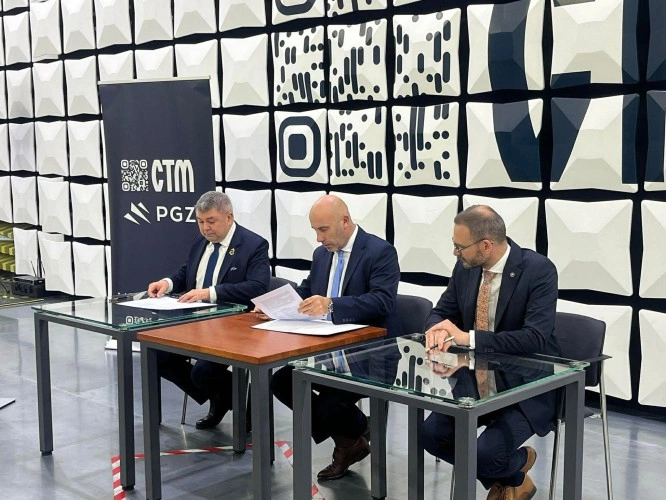


Polska Grupa Zbrojeniowa S.A. (PGZ) and Ośrodek Badawczo-Rozwojowy Centrum Techniki Morskiej S.A. (ORB CTM) have signed an agreement in Gdynia for the construction of the Systems and Armaments Integration Centre (CISU), a project linked to the implementation of the "Narew" air defence programme.
The agreement was concluded on 15 March at the headquarters of OBR CTM. The document was signed by Adam Leszkiewicz, President of PGZ, Jan Grabowski, Member of the PGZ Management Board, and Marcin Wiśniewski, President of OBR CTM.
The “Narew” programme is a key pillar of Poland’s air defence modernisation, centred on short-range air defence (SHORAD) missile systems with an engagement range of approximately 25–45 kilometres. Its objective is to counter aircraft, helicopters, missiles and unmanned aerial vehicles within the short-range layer.
Ultimately, 11 batteries are to be deployed to protect both military forces and critical infrastructure, operating in conjunction with the Wisła air defence programme (medium range) and Pilica Plus / Poprad system (very short range). A central element of the programme is the transfer of technology and the localisation of missile and launcher production in Poland.
The system architecture is to include iLauncher launchers, CAMM missile missiles (and eventually the extended-range CAMM-ER), Polish Soła and Sajna radar systems, and the Zenit command and control system.
The prime contractor is the PGZ-Narew consortium, comprising 11 companies led by PGZ. The principal foreign partner is MBDA UK. According to the schedule, deliveries of key system components are planned for the 2027–2035 period.
Project origins and industrial cooperation
Project origins and industrial cooperation The project formally began last year, with the foundation stone for the new facility laid on 21 May 2025. During the ceremony, a time capsule was embedded beneath the future site. Attendees included Paweł Bejda, Konrad Gołota, representatives of PGZ, local authorities, and U.S. defence officials.
The event also saw the signing of a letter of intent between OBR CTM and Wojskowe Zakłady Elektroniczne S.A. regarding cooperation on a contract for Raytheon. Under this arrangement, OBR CTM will manufacture printed circuit assemblies (CCA) for the energy storage module of the LTAMDS radar, a fixed, three-faced radar system providing full 360-degree coverage.
This will also establish domestic capabilities for production, testing and maintenance of advanced electronic components. As a result, the integrated systems are expected to significantly enhance Poland’s ability to counter a broad spectrum of aerial threats—from unmanned systems to aircraft and missile systems.
As highlighted during the ceremony, the new Centre of Military Electronics will form an important component of Phase II of the Wisła, Narew and Pilica Plus programmes. It is also intended to facilitate technology transfer under offset agreements, including specialised manufacturing equipment, testing systems, tooling, documentation and technical support, thereby strengthening Poland’s long-term defence-industrial base.
 DOWNLOAD PDF