

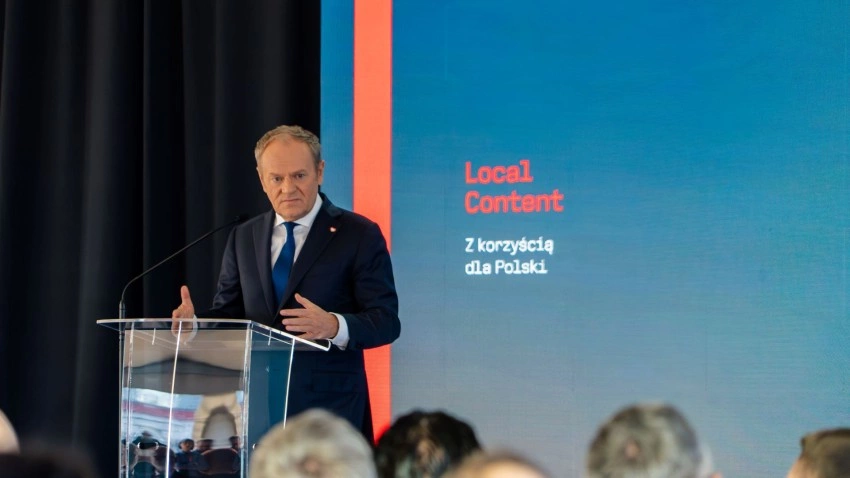


Prime Minister Donald Tusk and Minister of State Assets Wojciech Balczun on Thursday, April 9th presented the framework of the “Local Content. For the Benefit of Poland” initiative. It forms the basis of a new government economic philosophy that places Polish industry, enterprises, solutions and services at its core. As the Prime Minister stated, the objective is to “repolonise” supply chains in key investments, particularly those delivered by state-owned companies. These include port infrastructure, nuclear energy and offshore wind.
The details of the initiative were outlined by Minister Balczun at the headquarters of Apator SA in Ostaszewo near Toruń. The venue was not incidental, as the company has signed a contract with Enea for the delivery of 750,000 advanced smart meters with remote reading capability—effectively sophisticated energy monitoring systems. The presentation was attended not only by government officials but also by the chief executives and representatives of key state-owned enterprises.
Following months of preparatory work, the Council of Ministers unveiled a formal definition of local content, developed by the inter-ministerial task force on domestic participation in key investment processes, established and led by Minister Balczun. In essence, local content has been defined as “the value of goods or services produced or delivered by a domestic entity”. The policy is intended to promote economic patriotism—understood not as protectionism, but as the prioritisation of domestic capital in economic decision-making to ensure that as much value as possible remains within the national economy. In doctrinal terms, this marks a shift that will guide the modernisation of Poland’s armed forces, energy sector, infrastructure and digitalisation efforts. The adoption of local content principles by both public institutions and private enterprises is expected to strengthen Poland’s strategic autonomy and economic security, enhancing resilience to external pressures. Despite this inward-looking shift, the government stresses that it remains fully compliant with European Union law and will continue to support the EU’s “Buy European” agenda. Detailed implementation guidelines, in the form of a Code of Good Practice, are to be published shortly.
“There is no turning back from the path of repolonising our industry and economy. The need for repolonisation is embodied in local content […] It pays to choose Polish over foreign solutions. We believe that investing in domestic enterprises, fostering cooperation and creating synergies between Polish firms constitutes the true engine of our economy. Poland must be the first choice […] When we observe the consequences of the war in Ukraine or developments in the Middle East, we clearly see how the concept of sovereignty translates into concrete economic decisions, compelling us to safeguard the sovereignty of our supply chains to the greatest extent possible,” Prime Minister Donald Tusk said in Ostaszewo.
The redefined procurement process under the local content framework is intended to enhance supply security, ensure the local presence of subcontractors and build domestic capabilities. It will also introduce expanded technical dialogue and market consultations, alongside the creation of supplier catalogues. Greater emphasis will be placed on non-price criteria in supplier and contractor selection, as well as on procurement models favouring shorter supply chains. Qualitative metrics, transparent payment terms, milestone-based settlements, access to guarantee instruments and cyclical local content reporting are also envisaged.
Local content plenipotentiaries will be appointed within major state-owned enterprises to ensure continuous dialogue on implementation. The government also plans to organise supplier days and dedicated local content stands at major economic events, as well as webinars, lectures and seminars for potential suppliers, alongside ongoing refinement of the adopted criteria.
Four pillars of local content. Energy sector first
The concept of increasing the participation of Polish companies in supply chains for strategic investments is built on four pillars:
1. Strengthening the market position of domestic firms by integrating them into major investment supply chains and enhancing strategic business and manufacturing capabilities;
2. Reinforcing supply security in a volatile geopolitical environment, particularly in strategic sectors such as energy and defence;
3. A long-term state procurement policy, whereby public contracts support economic development;
4. Support from expert teams within key financial institutions to develop instruments facilitating corporate investment.
The government has also outlined instruments to oversee implementation of the new policy framework, including:
1. A formal definition and methodology for calculating domestic content, with the Statistics Poland responsible for measuring national contribution to investments;
2. A Code of Good Practice to level the playing field for domestic firms competing for contracts awarded by state-owned entities;
3. Key Performance Indicators (KPIs), under which supervisory boards of state-controlled companies will assess management performance against local content objectives;
4. The State Procurement Policy adopted by the Council of Ministers at the end of March.
The programme will be piloted in the energy sector. As part of this process, contracting authorities, along with their suppliers and subcontractors, will be required to complete reporting forms for Statistics Poland, disclosing the structure of supply chains within a given project. These forms will be submitted upon contract signature and annually thereafter. The government argues that this will enable precise measurement of domestic content shares. Additionally, already at the tender stage, contracting authorities will be required to inform bidders of mandatory subcontracting disclosure obligations.
The results of the energy-sector pilot will serve as the basis for extending local content reporting across other sectors of the economy.
“We have introduced Polish-oriented thinking into the management boards of state-owned companies. The impact on local communities is becoming increasingly important, but we are approaching this in a systemic way. Thanks to Statistics Poland, we will know how much of public investment is actually delivered by Polish companies and will assess this across three tiers of execution. We also encourage private Polish firms to join the local content programme,” said Minister Wojciech Balczun in Ostaszewo.
The energy sector is of particular importance, as investments totalling approximately PLN 1 trillion are planned over the next decade. This includes nuclear energy and offshore wind, as well as transmission infrastructure required as Poland’s energy centre of gravity shifts from the south to the north. The local content accounting system is intended to facilitate the participation of small and medium-sized enterprises in supply chains and to reward companies implementing these principles.
Local content in numbers
The Code of Good Practice developed by the task force sets out weighted criteria for assessing the “domesticity” of entities cooperating with state-owned companies:
– 25% weight for the ultimate parent entity being headquartered in Poland;
– 25% weight for the main business activity being conducted in Poland;
– 15% weight for tax residency in Poland;
– 15% weight for employing more than 50% of staff who are Polish citizens or residents paying taxes and social security contributions in Poland;
– 10% weight for having a registered office in Poland (KRS/CEIDG) and operating continuously for at least three years;
– 10% weight for generating more than 50% of annual turnover in Poland.
Shared responsibility
The Minister of State Assets described the coming decade as a “decade of major investments”. The local content framework is to be applied across projects in seaports, defence, road and rail infrastructure, energy, digitalisation and aviation. France and Italy were cited as examples of successful implementation of similar policies. As the Prime Minister underlined, reducing supply chain exposure to external shocks such as armed conflicts is critical to maintaining national security and economic development.
The new policy, as emphasised by Donald Tusk, constitutes a shared responsibility for all market participants. Local governments will also be involved and assessed against their application of local content principles in investment decisions.
“We are dealing with a major undertaking involving new regulations and recommendations that will form Poland’s local content framework. This requires flexibility, creativity and determination. Wherever services and products are procured, we will enforce this principle […] We will introduce a ranking system for local governments, assessing how effectively they implement local content. There will be consequences. Everyone must comply with the new rules. This is to be our shared obligation,” the Prime Minister stressed.
Accordingly, for an enterprise to be recognised as a domestic entity under the local content framework, it must meet criteria such as having its registered office, tax residency and principal business activity in Poland, as well as generating at least 50% of turnover domestically. These indicators will be measured by the government and Statistics Poland.
A model example
As an illustration of local content in practice, the Council of Ministers points to the agreement between Apator SA and Enea. The contract for 750,000 smart meters, valued at approximately PLN 300 million, is presented as a model case. These devices not only measure energy consumption but also monitor grid parameters, enable optimisation and detect irregularities, thereby enhancing system security and stability. A total of 29 entities—including universities, research institutes and technology firms—were involved in their development.
“We are not merely a recipient of this technology, but also its co-developer. From the outset, we adopted an innovative partnership model in which we do not purchase off-the-shelf solutions, but jointly develop products tailored to the real needs of our network and customers with a Polish partner, Apator. This approach fully aligns with our local content strategy, which in practice means building a strong domestic value chain—from design and production to competence development and cooperation with academia. In doing so, we are not only investing in modern infrastructure, but also strengthening Poland’s economy and energy security,” said Grzegorz Kinelski, CEO of Enea.
The smart metering project exemplifies the practical application of local content principles—from building domestic technological capabilities to leveraging the potential of Polish firms in large-scale investment programmes of state-controlled companies. It also represents a model of cooperation between industry, academia and the state in the field of advanced technologies.
“Technological partnership with Enea demonstrates how much can be achieved by combining the competencies of Polish leaders in energy, business and science. Together, we have developed a meter that not only addresses Enea’s current needs related to grid digitalisation, but significantly expands its capabilities. It ensures full control over energy, data security and readiness for the energy systems of the future. The energy transition should strengthen not only system security, but also domestic industrial and technological capabilities. The participation of Polish companies in this process is crucial, as it enables the development of technological sovereignty and ensures control over solutions critical to infrastructure. This represents a real opportunity to enhance the long-term competitiveness of the Polish economy. We hope that local content and the participation of Polish firms in investment processes will remain a key element of government policy,” said Maciej Wyczesany, CEO of Apator SA.
 DOWNLOAD PDF