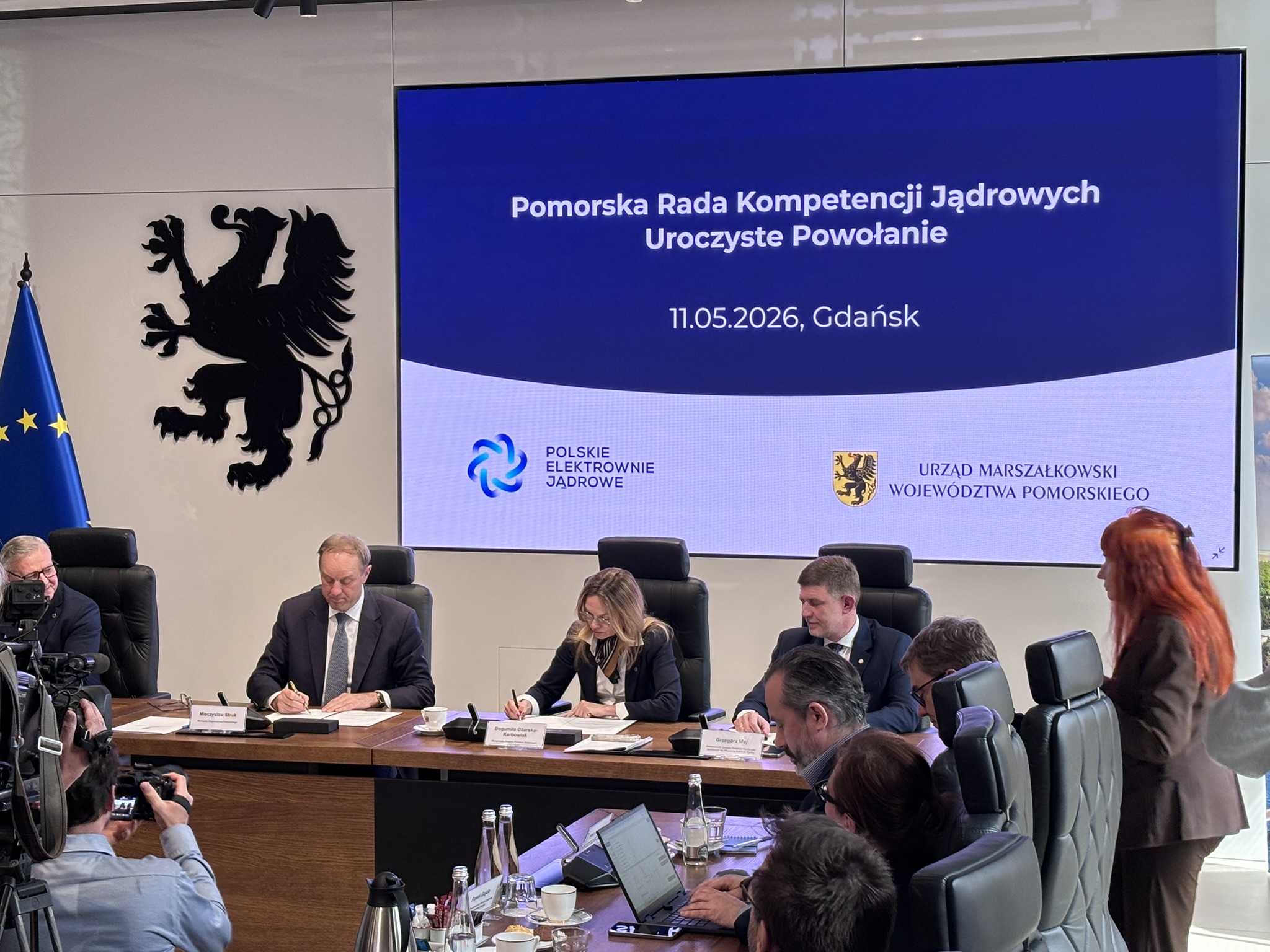
On Monday, 11 May, the activities of the Pomeranian Nuclear Skills Council were officially inaugurated at the Marshal’s Office in Gdańsk. During the ceremony, Marshal of the Pomeranian Voivodeship Mieczysław Struk and Vice President of Polish Nuclear Power Plants (PEJ) Bogumiła Ożarska-Karbowiak signed a cooperation agreement, while newly appointed council members received their nominations. The first closed-door session of the new body was also held.
The ceremony began at 1:00 p.m. in the Heraldic Hall of the Marshal’s Office. Speakers during the open session included the Marshal of the Pomeranian Voivodeship, the PEJ Vice President and Grzegorz Maj, PEJ Management Board Plenipotentiary for Market Development Support. The Pomeranian Nuclear Skills Council is intended as a platform for cooperation between public administration, business and the education sector, aimed at preparing skilled personnel for Poland’s first nuclear power plant. The joint declaration signed by the Pomeranian Voivodeship and Polish Nuclear Power Plants marks a new stage in efforts to develop competencies for the Lubiatowo-Kopalino Nuclear Power Plant project.
Opening the Council’s work, Marshal Mieczysław Struk stated that the construction of a nuclear power plant is not only an energy investment worth around PLN 200 billion, but also a civilisational project. He stressed that Pomerania has long been investing in vocational and higher education to provide the workforce required for the new facility. He described the power plant as the largest infrastructure project in the history of the region.
– This investment will change Poland’s energy security for decades and will undoubtedly transform Pomerania as well. Our region is becoming the location of the most important investment in the history of the Third Polish Republic [...]. We are convinced in the Pomeranian Voivodeship that nuclear energy is the foundation of an entirely new energy system [...]. We all know perfectly well that without personnel, without people and without their competencies, it would be impossible to deliver such a major project. [...] As Pomerania, we are taking co-responsibility for the success of this undertaking – said the Marshal.
Struk reminded participants that the construction of the nuclear power plant will require filling thousands of jobs, mainly with residents of nearby towns and counties as well as graduates of Pomeranian universities. He expressed confidence that Poland’s energy transition, aimed at ensuring security for future generations, cannot be achieved without nuclear energy. The power plant will become part of a broader system that will also include offshore wind farms, the FSRU floating gas terminal in the Gulf of Gdańsk and a new gas-fired power plant in Gdańsk. Earlier on the same day (11 May), the foundation stone for the latter investment was laid.
The PEJ Vice President said that Poland is currently in a difficult phase of nuclear energy development, as foreign intelligence services are monitoring the project and attempting to delay or disrupt it. She therefore called on the entire Council to focus its efforts on achieving an educational breakthrough for both Pomerania and Poland.
– I believe that local governments, central administration, universities, technical schools and vocational schools will gradually come to realise that this is a tremendous opportunity for us — one capable of positioning Poland in the region as a country operating a nuclear power plant based on the safest technology in the world. No safer technology than Westinghouse’s AP1000 has ever been built. I believe educating young people, parents and children about nuclear energy is extremely important. To achieve that, we need to build cadres who understand how to educate others and who can foster the conviction that this is an area worth investing in and worth learning about. For us, this is something entirely new — a transition to another phase of economic development, particularly here in Pomerania. National support for nuclear power stands at 80%, and we should be pleased about that, but we must not stop our efforts to maintain and even increase that support – said PEJ Vice President Bogumiła Ożarska-Karbowiak.
Grzegorz Maj praised the cooperation between PEJ and the Marshal’s Office, saying it had allowed the investment to move forward rapidly. He warned, however, that the project represents not only an opportunity, but also a major challenge. The PEJ plenipotentiary responsible for market development support said that, taking into account local content — meaning Polish companies and workers — the company has every reason to believe the project will succeed.
– We are talking about 24,000 jobs, 10,000 people employed at the peak of construction in 2031–2032, and more than a thousand people that we need to prepare for the operational phase. Pomerania will become a centre for building nuclear competencies in general, not only for the needs of the first nuclear power plant – said Grzegorz Maj.
The Pomeranian Nuclear Skills Council will operate in an advisory and consultative capacity, with an open and flexible structure. Its role will include initiating analyses, recommending education pathways, supporting dialogue between stakeholders and developing competency models tailored to the needs of a modern economy.
The establishment of the Council sends a clear signal that Pomerania is not only preparing for nuclear energy, but is actively helping shape its future — by investing in people, knowledge and cooperation. It is these competencies that are expected to form the foundation of one of the most important investments in the history of the Polish energy sector.




 DOWNLOAD PDF