

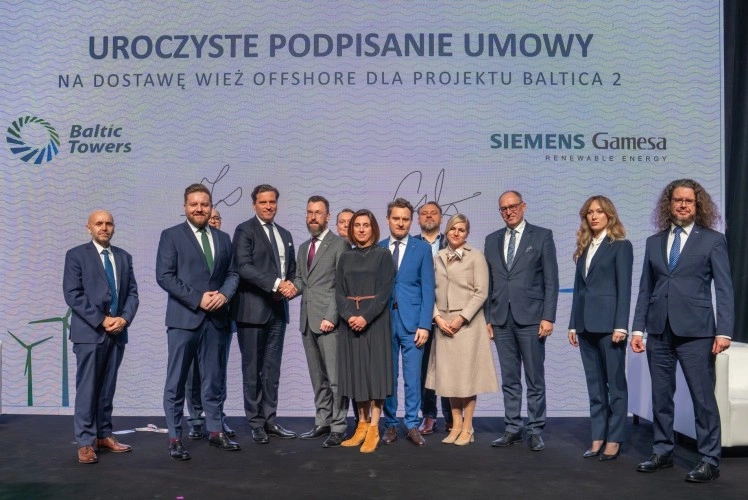


A significant milestone was marked at this year’s PowerConnect energy trade fair in Gdańsk, with the signing of a contract for the supply of offshore wind turbine towers for the Baltica 2 project by Polish manufacturer Baltic Towers. Baltica 2 is a joint initiative between PGE and Ørsted. The fair also served as a symbolic starting point for the contracting process of PGE’s next offshore wind farm: Baltica 9+.
At PowerConnect, Siemens Gamesa—the turbine supplier for PGE and Ørsted—formalised an agreement with Baltic Towers for the delivery of turbine towers. For Baltica 2, the deal is significant not only from the perspective of local content but also in ensuring that the offshore construction schedule remains on track.
Speaking to ZielonaGospodarka.pl, Piotr Dziubałtowski, Vice President of PGE Baltica, highlighted the historical and cultural significance of tower production at the Gdańsk Baltic Towers facility.
“Baltic Towers is located on the grounds of the Gdańsk Shipyard. We see a transition from the shipbuilding facilities we knew many years ago to a modern plant producing wind turbine towers on the same site. This energy transition opens a new chapter, creating enormous potential for the shipyard, local residents, and all those historically connected to this location,” said Dziubałtowski.
The towers manufactured in Gdańsk will be deployed offshore as part of the Baltica 2 wind farm, which PGE is developing in partnership with Ørsted. PGE Baltica is also preparing for its next initiative, Baltica 9+.
“Baltica 9+ combines our existing Baltica 9 project with assets acquired from the German company RWE. Through this acquisition, we have consolidated a large area where we will develop a new project with a capacity exceeding one gigawatt,” Dziubałtowski explained. “We are now entering a very dynamic development phase, preparing supply chains and tender documentation for the first and most critical procurement group, Tier 1.”
Tier 1 contracts cover the largest and most crucial components, which also represent the most sensitive bottlenecks in the project. These include turbines, foundations, and electrical substations. The procurement schedule was published at the start of the year, and negotiations with potential suppliers are already underway.
“We are leveraging the contracting experience gained from Baltica 2, but we are also developing new procurement strategies with two key objectives. First, to deliver the project on schedule, and second, to maximise local content. We are structuring tender packages to open them as widely as possible, even taking on certain risks ourselves. For example, we are splitting contracts to allow greater direct participation for Polish companies,” said Dziubałtowski.
Splitting contract packages represents a deliberate departure from approaches sometimes used by other developers, who tend to bundle large contracts and encourage suppliers to bid in consortia. According to Dziubałtowski, PGE Baltica’s approach aims to achieve a minimum 45% local content threshold for Baltica 9+. The Vice President also noted that numerous companies present at PowerConnect could play a role in the supply chains for the new project.
 DOWNLOAD PDF