

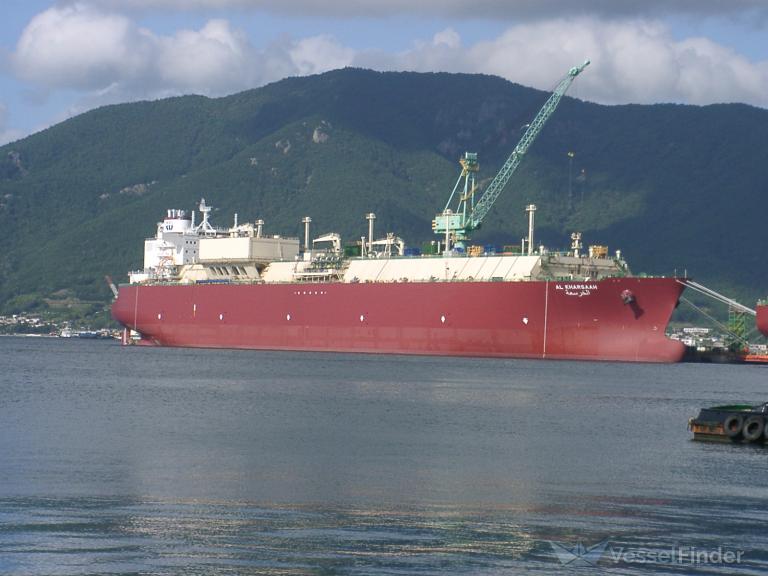


QatarEnergy has resumed gas deliveries to Poland after a break of several months, Reuters has reported. The news agency has thus confirmed earlier information from Gospodarka Morska about the LNG carrier Al Kharsaah, which is heading for Świnoujście.
A week ago, we reported that the Al Kharsaah was sailing to Poland via the Red Sea, most likely carrying an LNG cargo from Qatar for Orlen. This would mean that QatarEnergy had resumed gas exports to the Polish company under a long-term agreement. Deliveries were halted in March following attacks on infrastructure belonging to the Qatari company. Although neither Orlen nor QatarEnergy has yet officially confirmed the resumption of shipments, Reuters reported today that the first cargo from Qatar since deliveries were suspended is due to arrive in Świnoujście in mid-November.
As we reported in our article, the route chosen by the Al Kharsaah was surprising. The vessel passed through the Strait of Hormuz and the Bab al-Mandab Strait, both of which have recently been dangerous because of Iranian and Houthi activity, before sailing through the Red Sea. It is also possible that the voyage was not without dangerous incidents. The LNG carrier was reportedly fired upon. Read more: LNG Carrier Takes Dangerous Route to Poland. It May Have Come Under Fire.
The Al Kharsaah is currently in the Mediterranean. On Monday morning, it was at anchor northeast of Malta. The vessel is expected to arrive at the Świnoujście LNG terminal on 14 November. This will be its fourth call in Poland.
QatarEnergy announced the suspension of LNG production on 2 March 2026, just three days after the United States and Israel began their war against Iran. The decision followed Iranian attacks on the Qatari company's industrial facilities at Ras Laffan and Mesaieed. Two days later, QatarEnergy formally declared force majeure to its LNG customers. This mechanism can release one of the parties to a contract from liability for failure to fulfil its obligations when specified contractual conditions beyond the parties' control are met. It does not, however, mean that the contracts themselves are cancelled. According to Reuters, on 6 March Orlen was informed that two LNG cargoes scheduled for April and May could consequently be delayed or cancelled. The Polish company said that the interruption to supplies from Qatar would not affect the country's gas security, as it would use other LNG sources during that period.
The following weeks brought QatarEnergy no closer to resuming deliveries. In mid-March, further missiles struck production infrastructure at Ras Laffan. The company estimated that repairs could take three to five years.
PKN Orlen has a long-term LNG supply contract with QatarEnergy. The Qataris also supply the commodity to other customers in Europe and Asia, including in Italy, Belgium, China and South Korea.
Although the Al Kharsaah is sailing to Poland with an LNG cargo, the force majeure declaration has not yet been lifted.
The interruption to supplies from Qatar caused disruption in the market. Customers deprived of gas under their contracted deliveries had to seek supplies on the spot market, driving up prices. The situation began to change in September 2026, when the LNG carrier Al Marrouna passed through the Strait of Hormuz for the first time in a long while. This showed that shipping along the shortest route between Qatar and Europe was gradually becoming possible again, although, for the time being, individual transits were being arranged through negotiations.
Thanks to the diversification of Orlen's supply sources and its activity on the spot market, Poland was less affected by QatarEnergy's difficulties than some other countries. These included Pakistan and Bangladesh, which are heavily dependent on Qatari supplies and cannot afford to pay higher prices on the spot market. Pakistan, for example, rejected cargo offers from BP Singapore twice because the prices were too high.
Oil and gas companies in the European Union, particularly those that had previously been QatarEnergy's largest customers — companies in Italy, Belgium and Poland — were able to afford the higher costs. Orlen, however, also demonstrated flexibility. Brendan A'Hearn, a gas market specialist at ICIS, an international analytics company covering commodities and energy markets, told EnterpriseAM that the Polish company had used LNG carriers it had chartered to arrange replacement deliveries from the United States. The analyst also linked QatarEnergy's difficulties to lower gas stocks in Europe. He noted that arranging replacement supplies did not mean that the safety buffer had been restored, as European buyers had ultimately failed to purchase enough gas to maintain their previous rate of storage injections.
Commentators point out that, although Iranian attacks during the war with the United States and Israel caused disruption in Qatar, the Americans have benefited from the situation. The United States has become Europe's primary source of replacement supplies for the Qatari gas volumes that were lost. US LNG exports rose by 23% in the first half of the year. The United States is now also attracting interest from Qatar itself, which is looking for gas it can supply to its own customers under existing contracts.
 DOWNLOAD PDF
