

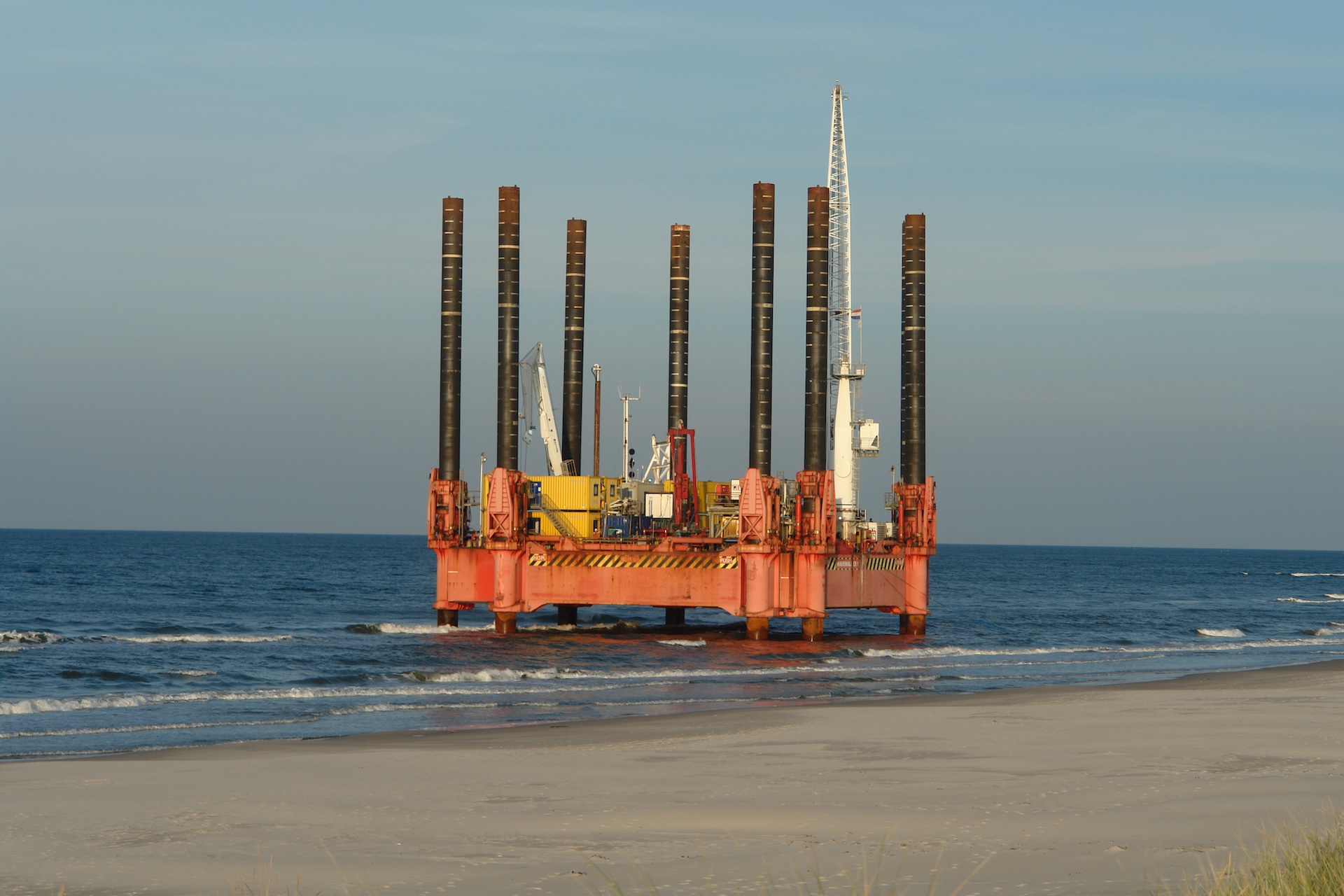


What is it that walks along the seabed and carries out surveys? Contrary to what you might think, this is not the opening line of a joke, but a question with a perfectly serious answer: it is the WaveWalker 1, a specialist self-elevating platform that can slowly walk along the seabed thanks to its hydraulic system of eight legs. It can currently be seen near Choczewo, where it is taking part in geological surveys for the construction of Poland’s first nuclear power plant.
In recent years, with more and more work being carried out along our coastline, we have been seeing a wider variety of self-elevating platforms, known as jack-ups, off the Polish coast. But the platform that has been involved in geological surveys near Choczewo for some time is exceptional. That is because it can walk under its own power.
The WaveWalker 1 is an offshore platform that can walk along the seabed using a specialised hydraulic system. It belongs to WaveWalker BV, a joint venture between two well-known offshore contractors: Fugro, which specialises in geotechnical and geophysical surveys and marine environmental data acquisition, and Van Oord, which carries out dredging, coastal engineering and offshore infrastructure projects, among other activities. The WaveWalker 1 was built to their order in 2012 and is registered under the Dutch flag.
How Does the WaveWalker 1 Walk?
In its most common configuration, a self-elevating platform has three or four long legs, which can be seen from a considerable distance when the unit is berthed in port. These massive columns often rise above the surrounding buildings. Once a jack-up has been towed to its work site, its legs are gradually lowered until they reach the seabed and lift the platform’s hull to the required height, usually several metres above the water. This allows the platform to remain stable, without the risk of drifting away from its intended position.
The WaveWalker 1, however, has as many as eight legs. It can, of course, operate in the conventional mode described above, resting on four of them. What makes it unique, however, is its ability to use all eight legs to walk along the seabed. The eight supports are divided into two groups. While four legs stand on the seabed and raise the hull above the water, the other four are lifted and slowly moved four metres forwards by a specialised hydraulic system. They are then lowered to take the weight of the hull, while the four legs that had been supporting the platform are raised and moved forwards by four metres, carrying the hull with them. They are then lowered again, allowing the other set of legs to take the next step. In this way, the WaveWalker 1 can move around its work site without having to be towed to each new position.
The platform itself measures 32 by 32 metres, providing sufficient space to accommodate a crew of 32 for the duration of an operation. Each leg is up to 40 metres long, allowing the WaveWalker 1 to operate in water more than 30 metres deep. The legs have a diameter of 1.8 metres, and the maximum distance between them is 29.5 metres. Each step taken by the platform covers four metres. According to its operator, in favourable conditions the platform can reach a speed of up to 40 metres per hour in any direction. One complete cycle, or step, can therefore take around six minutes.
The platform can carry a maximum payload of 850 tonnes, although this falls to 400 tonnes when it is operating in walking mode. The WaveWalker 1 is also equipped with an opening in its deck through which autonomous underwater vehicles, probes or divers can be lowered into the water. The opening also allows drilling operations and the installation of offshore infrastructure, such as cables and pipelines. Known as a moonpool, it measures 17 by 9 metres and can be covered. The platform is also fitted with two integrated cranes: a wire-rope crane with a lifting capacity of 92.9 tonnes at an operating radius of eight metres, and a knuckle-boom crane with a lifting capacity of 10 tonnes at a working radius of four metres.

All Right, But What Is It Used For?
The unit was built at the Dutch Neptune Shipyard in Hardinxveld-Giessendam. Its keel was laid on 4 April 2012, and the naming ceremony took place on 21 September that year. The order for the WaveWalker 1 was linked to a specific project undertaken by Van Oord. The company had secured a contract to dredge the outer access channel to the Port of Suape in Brazil. The work required drilling and blasting in heavy swell, making conventional floating platforms unsuitable. In November 2012, the WaveWalker 1 arrived in Brazil aboard the barge Osprey Trader, towed by the tug Compass. It began its first assignment in early 2013.
Since then, the WaveWalker 1 has worked on projects around the world. The platform has been deployed in the construction of offshore wind farms, including Gemini in the North Sea and Arklow in the Irish Sea. It has carried out seabed surveys off the French coast near Saint-Nazaire and has also been used in the construction of a quay for the Hinkley Point C nuclear power station in the United Kingdom. The quay was used to deliver aggregate. The operator reported that, during this project, the WaveWalker 1 walked more than eight kilometres along the quay route. The assignment illustrates the challenging conditions for which the platform was designed: the wave height off the UK coast during construction of the quay reached 13 metres.
Eliminating the need to tow the platform every few metres along a planned route significantly reduces the cost and duration of operations carried out by the WaveWalker 1. It can also work in places that other units cannot reach. The platform is particularly well suited to operations in the surf zone and in shallow waters, where conventional vessels — and even tugs designed for shallow-water operations — cannot work. This makes the walking platform suitable for a wide range of seabed geotechnical surveys, drilling, excavation and other marine construction work where stability is essential, but some ability to manoeuvre or change position is also required.
The unusual unit is now operating in Polish waters. The WaveWalker 1 is taking part in the GEO-3 geological and geotechnical survey campaign associated with the construction of the Lubiatowo-Kopalino nuclear power plant. The surveys, conducted in cooperation with another, conventional platform, Excalibur, include drilling beneath the seabed. Their purpose is to gather the necessary information on the ground’s bearing capacity, the arrangement and properties of soil layers, geological composition and other conditions required to design the plant’s specialised cooling-system tunnels.
As we have reported, Polskie Elektrownie Jądrowe, the company overseeing the construction of Poland’s first nuclear power plant in the Choczewo-Kopalino area of Pomerania, is currently carrying out site preparation works as well as ground investigations at the location where the so-called MOLF (Marine Off-Loading Facility) will be built. This will be a jetty extending out to sea, used to unload the largest components required for construction of the power plant.
It is possible that the Polish project has brought the WaveWalker 1 to the Baltic Sea for the first time. We have found no confirmation that the unit has carried out any previous work in the Baltic.
Photos: MarinePoland.com
 DOWNLOAD PDF
