

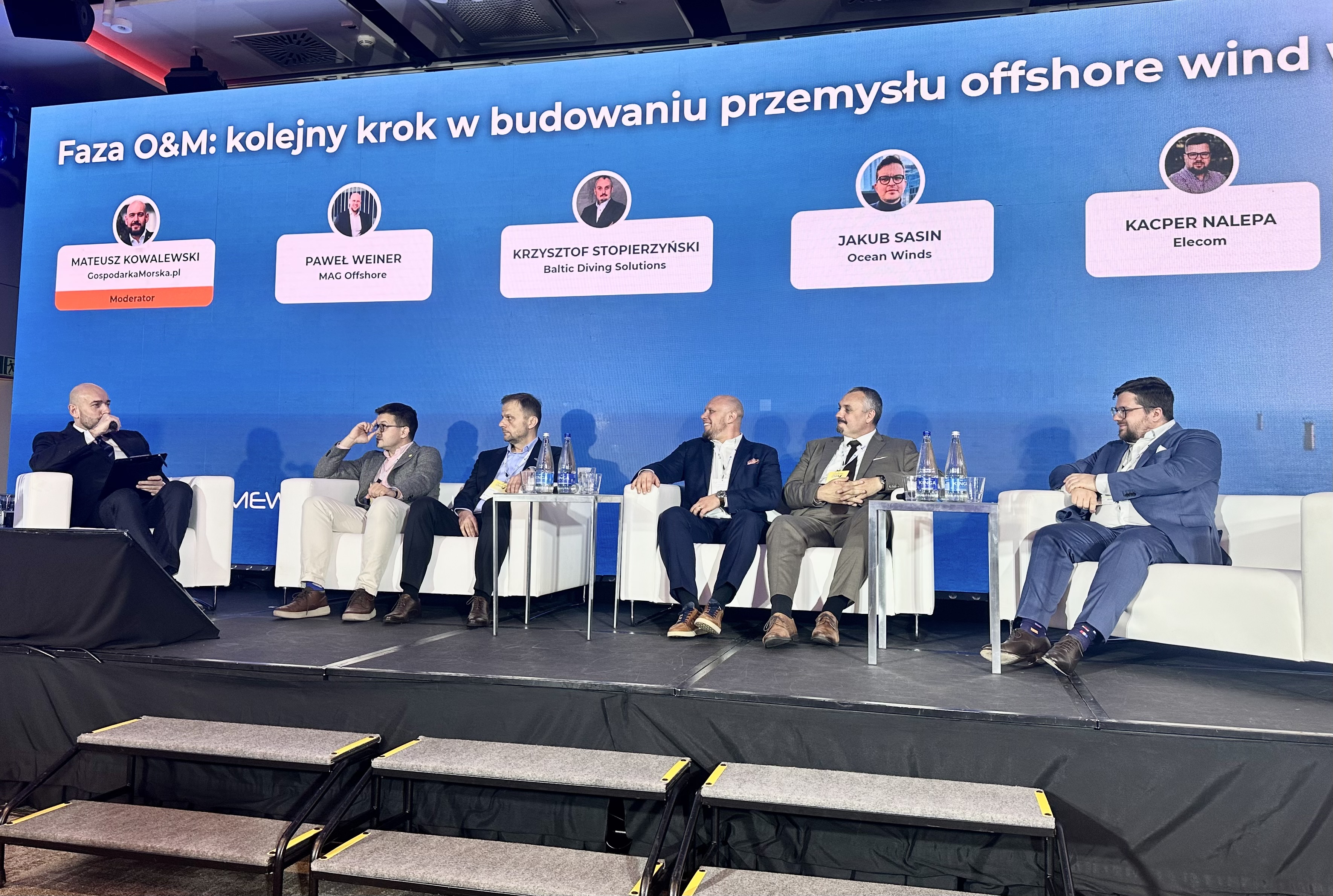


Polish companies have the skills, experience and technical capabilities to take part in the operation and maintenance (O&M) of offshore wind farms. However, their greater participation in the market is being constrained by factors including contracting practices and organisational and administrative requirements. These issues were discussed by participants in the panel entitled “The O&M Phase: The Next Step in Building a Sustainable Offshore Wind Industry in Poland” at the 15th edition of the Offshore Wind – Logistics & Supplies (OWLS) conference, organised by the Polish Offshore Wind Energy Society (PIMEW). The two-day event began on Wednesday, 21 October, at the Radisson Hotel in Gdańsk.
The panel was moderated by Mateusz Kowalewski, publisher of the GospodarkaMorska.pl and ZielonaGospodarka.pl websites and President of the Management Board of the Maritime Employers’ Forum. The discussion featured Paweł Weiner, President of the Management Board of MAG Offshore; Krzysztof Stopierzyński, President of Baltic Diving Solutions; Jakub Sasin, Senior Legal Counsel at Ocean Winds; Kacper Nalepa, President of the Management Board of Elecom; and Paweł Siwak, Director of Operations & Maintenance at PGE Baltica.
O&M: A Long-Term Opportunity for Polish Companies
The panellists stressed that the development of Poland’s offshore wind sector should not focus exclusively on building offshore wind farms. Their subsequent operation is equally important, as each project will remain in service for several decades.
Krzysztof Stopierzyński of Baltic Diving Solutions pointed out that Polish companies have the expertise needed to expand their activities in offshore wind services. In his view, however, investors and developers are not yet making full use of this potential.
“Polish companies have strong capabilities in services, but this potential remains on the sidelines. Yet services will play a key role over the next 30 years and are fundamental to the operation of the offshore wind sector. We supply the products used to build wind farms over a period of two years, but they then need to be serviced and maintained for 30 years. I am pleased that this issue has been raised, because there is still a great deal to be done. Companies with a broad range of capabilities operate in Poland, yet their potential is still not being used often enough,” he said.
Paweł Weiner, President of the Management Board of MAG Offshore, expressed a similar view. He said Polish companies had operational knowledge, an understanding of local conditions and the experience needed to provide services in the Baltic Sea. However, they found it harder to compete with foreign contractors in terms of financial resources and organisational capacity.
“In Poland, we have the experience, tools and know-how, but the problem is that we lack the capital available to foreign contractors. These companies spent years building their position in the oil and gas sector, and they are now using the resources and experience they acquired to develop offshore wind technologies. In Poland, we need to look at the offshore sector more broadly than simply through the prism of offshore wind farms. It also involves expanding ports, reconstructing breakwaters, dredging port basins and maintaining approach channels, as well as all the infrastructure needed to service wind farms. Building a wind farm is only the beginning — 25 to 30 years of operation lie ahead of us,” he said.
As he emphasised, ensuring the reliable operation of wind farms and uninterrupted electricity supplies is crucial. Yet many Polish companies are involved in international projects primarily as subcontractors.
“Polish companies have the necessary capabilities, but they often work as subcontractors for foreign businesses. On the one hand, this allows us to gain experience and build relationships; on the other, it limits our participation in more advanced processes. Another barrier is that smaller Polish companies do not always have the organisational resources to meet the extensive procedures imposed by international developers. We need to close this gap gradually so that Polish businesses can make greater use of the opportunities offered by the expanding offshore wind market,” he noted.
Large Contract Packages Limit Local Content
One of the main topics of discussion was how orders are structured and contracts awarded. Industry representatives argued that large service packages can exclude smaller companies, even when they have the expertise required to carry out individual elements of the work.
Kacper Nalepa of Elecom said companies specialising in particular technological fields could successfully participate in offshore wind projects as subcontractors. However, this would require orders to be structured appropriately, taking account of the capabilities of smaller suppliers.
“The current approach to O&M contracting and the way developers structure packages do not favour companies like ours — smaller businesses operating in a very specialised field,” he said.
Requirements to demonstrate a proven track record can also present difficulties.
“The question of a so-called track record comes up frequently. We are told that we have experience in a particular field, but not in offshore wind. Yet the skills acquired through shipbuilding can also be useful in offshore wind energy,” Nalepa stressed.
Krzysztof Stopierzyński highlighted the need to divide large contracts into smaller work packages accessible to specialised companies.
“Breaking a project down into smaller packages is absolutely fundamental if local content is to become a reality at all,” he argued.
As an example, he cited the bundling of geotechnical and geophysical surveys into a single package. Such a contract may be accessible only to a handful of the largest contractors. Separating the different scopes of work could, by contrast, open the market to a wider range of specialised Polish companies.
Extensive contracting procedures are another obstacle, involving lengthy agreements, numerous annexes and detailed formal requirements. For smaller businesses, preparing the documentation and completing the entire tender process can entail additional costs and require resources they do not always have in sufficient quantities.
Developers: Local Content Must Be Considered from the Negotiation Stage
Jakub Sasin of Ocean Winds emphasised that efforts to increase the participation of Polish companies should begin when contractors are being identified. It is not enough to consider local suppliers only once a contract is being executed.
“The best contract is the result of everything that happened beforehand, during the contractor search phase. That is the time to make sure local content is properly addressed,” he said.
He noted that Ocean Winds seeks out local suppliers and takes their participation into account during negotiations. The quality of cooperation during project delivery is also important.
“We see that when Polish contractors identify a problem, or realise that one may arise, they communicate it to us. They are open to discussion, and together we can work out a solution,” he said.
This approach makes it possible to identify potential difficulties earlier and find solutions before they develop into more serious problems during contract execution.
PGE Baltica Seeks to Develop a Multi-Contract Model
Paweł Siwak of PGE Baltica highlighted the importance of the operational phase in the overall life cycle of an offshore wind farm. He noted that operating and maintenance costs account for a substantial proportion of the expenditure associated with running such a project.
“We started talking about the operational phase somewhat too late. Operating costs can account for around 30–40% of a wind farm’s total budget, depending on the calculation method used. We are somewhat disappointed that Poland and Polish companies did not participate more extensively in the construction phase. It represents a huge injection of money, but the situation is different when it comes to operations. We are talking about a wind farm operating for 25, 30 or even 35 years, which creates long-term opportunities for Polish businesses,” Paweł Siwak of PGE Baltica said.
PGE Baltica is developing the capabilities needed to service offshore wind farms in the future, including asset management, engineering, procurement, safety and the maintenance of power infrastructure.
The company has also declared an interest in a multi-contract model, in which large orders are divided into smaller packages. This approach can make it easier for companies that are unable to deliver an entire service package independently to participate.
“We are trying to introduce multi-contracts wherever possible, taking on a greater number of risks ourselves and providing the resources needed to manage them,” Siwak noted.
The PGE Baltica representative also pointed to initiatives involving market research, consultations and workshops for potential suppliers. Such activities can help businesses better understand developers’ requirements and prepare to participate in future tenders.
Local Content Also Means Jobs and Infrastructure
The panellists stressed that the participation of domestic companies in offshore wind should not be assessed solely by the value of contracts awarded to Polish businesses. Other important factors include job creation, skills development, port infrastructure, the availability of specialised vessels and opportunities for cooperation between companies.
PGE Baltica has highlighted the importance of local employment in turbine servicing. Recruiting technicians from the Łeba and Słupsk areas could reduce commuting times and support the development of the labour market in Pomerania.
However, the sector also needs specialists in electrical power engineering, automation and IT. As Paweł Siwak pointed out, wind turbines are primarily electrical power systems, meaning that workforce development cannot be limited to traditional maritime occupations.
Ports are another essential part of the infrastructure supporting offshore wind. Krzysztof Stopierzyński highlighted the limited availability of berths for vessels servicing offshore projects and the importance of port infrastructure for the development of domestic services. Without adequate facilities, efficient administrative procedures and requirements tailored to the specific nature of maritime operations, it will be difficult to realise the full potential of Polish companies.
Administrative Barriers
Businesses also pointed to difficulties arising from the interpretation of regulations and changing administrative requirements.
Kacper Nalepa cited the example of radio permits for buoys used in offshore wind farm areas. He said changes to the rules and costs associated with obtaining permits had made it harder for companies to plan their activities.
“The lack of understanding on the part of the state authorities of what this involves and how it should work, combined with an unwillingness to engage in dialogue, is simply alarming,” he said.
Krzysztof Stopierzyński, meanwhile, drew attention to the costs associated with qualification requirements for crews of vessels. In his view, some of these requirements can increase the cost of services provided by Polish shipowners and affect their competitiveness relative to foreign companies.
Recruiting and retaining qualified employees also remains a significant challenge. Polish companies operating in international markets must compete for specialists with foreign employers, who are also looking for experienced personnel.
Polish Companies Ready for O&M
The discussion showed that Polish businesses have the capabilities needed to play a greater role in the operation and maintenance of offshore wind farms, but their potential does not always translate into access to contracts.
“Polish companies are ready for this phase. With good cooperation with developers, an appropriate approach to packaging orders and support from legislators, they can participate in O&M and benefit in ways that will allow them to grow beyond Poland as well,” concluded Kacper Nalepa, President of the Management Board of Elecom.
As the panellists agreed, the ability to make decisions, build relationships and adopt a ‘we can do this’ attitude are also important.
Photo: MarinePoland.com
 DOWNLOAD PDF
