

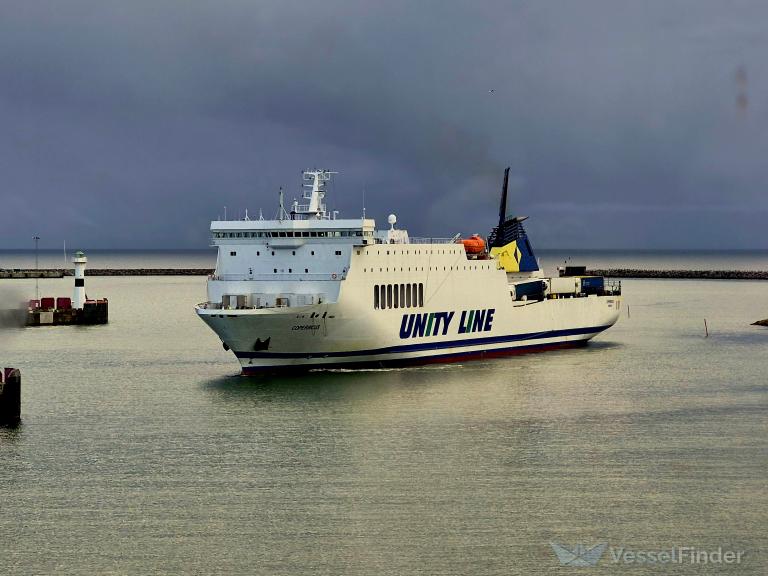


On the Sunday morning of 31st of May, the ferry Copernicus, previously operating under Unity Line, berthed at Westerplatte Quay in the Port of Gdańsk. The vessel, which until now has sailed between Świnoujście and Trelleborg, is preparing to enter service on the new Gdańsk–Karlshamn route.
Copernicus departed Świnoujście on Saturday evening 30th of May and arrived in Gdańsk Sunday morning 31st of May. As previously reported, the vessel carried out a trial berthing operation at Westerplatte Quay ahead of the launch of the new connection between Gdańsk and Karlshamn, to be operated by POLSCA Baltic Ferries — the company bringing together Unity Line, Polferries and EuroAfrica.
Plans to launch the new route were first announced in February, when Polferries confirmed that an agreement had been signed with the port of Karlshamn. The route is to be served by two vessels: Skania, which carried out trial calls last week, and Copernicus.
– Gdańsk–Karlshamn will form a new transport corridor between Poland and Scandinavia. In practice, it will compete with the existing connection between Gdynia and Karlskrona – said Paweł Pluto-Prądzyński, member of the management board of POLSCA Baltic Ferries. – For us, this is a new solution that gives us greater flexibility. We are already present on routes between Poland and Nynäshamn, covering the more northern part of Sweden, as well as Ystad and Trelleborg further to the south-west. What we lacked was a presence in the central part of Sweden, hence the idea of Karlshamn.
The vessels are officially expected to enter service in the middle of the year.
– This is due to the need to prepare the port infrastructure. We need our own terminal, staff to operate it and the proper preparation of IT systems, including booking systems and their integration with port systems – Pluto-Prądzyński explained in April.
The crossing between Gdańsk and Karlshamn is expected to take approximately 13 hours. Ferries will operate six times a week, departing in the evening and arriving the following morning. The operator openly states that the route is intended primarily for freight traffic rather than passenger services, which is reflected in the choice of vessels.
Copernicus, which still carries the Unity Line logo on its hull, is chartered from EuroAfrica. The vessel was built in 1995 and underwent an extensive modernisation programme in 2018, including upgrades to both the hotel facilities and propulsion systems. The ferry measures 150 metres in length and offers accommodation for 126 passengers in 51 cabins. Its cargo decks can accommodate up to 100 freight units thanks to a loading lane length of 1,830 metres. The ro-pax ferry is operated by a crew of 35 and sails under the Cypriot flag.
The management of POLSCA Baltic Ferries does not hide the fact that the introduction of new vessels — such as Jantar Unity, which entered service on the Świnoujście–Trelleborg route in January this year, and Bursztyn Unity, scheduled for delivery later this year — together with the merger of the former Unity Line and Polferries operators under a single brand, creates greater opportunities for expansion and fleet deployment.
In addition to the Gdańsk–Karlshamn route, the company is also actively considering other new destinations. In an interview with Gospodarka Morska, Paweł Pluto-Prądzyński admitted that discussions are ongoing regarding potential services to the Finnish ports of Turku and Helsinki, while the Mediterranean Sea also remains under consideration in the longer term. Before that happens, however, ferries carrying the POLSCA logo are expected to appear in Germany.
– The next connection we want to develop is a route between Rostock and either Trelleborg or Ystad – Pluto-Prądzyński revealed.
Work on this route is already underway, although no detailed information has yet been disclosed. A potential launch could take place next year following the entry into service of another new ferry, Bursztyn Unity.
– We are analysing various possibilities and developing different combinations of routes between ports, for now mainly in the form of plans and feasibility studies, but I believe that within the next year this will evolve into a concrete strategy. At present, our main objective has been to expand operations and organise the existing network. The next step will certainly involve further growth in the Baltic Sea region — including Finland — but potentially also the North Sea, and we are likewise considering more southern destinations such as the Mediterranean – said the POLSCA board member.
Photo: Aaron / VesselFinder.com
 DOWNLOAD PDF