

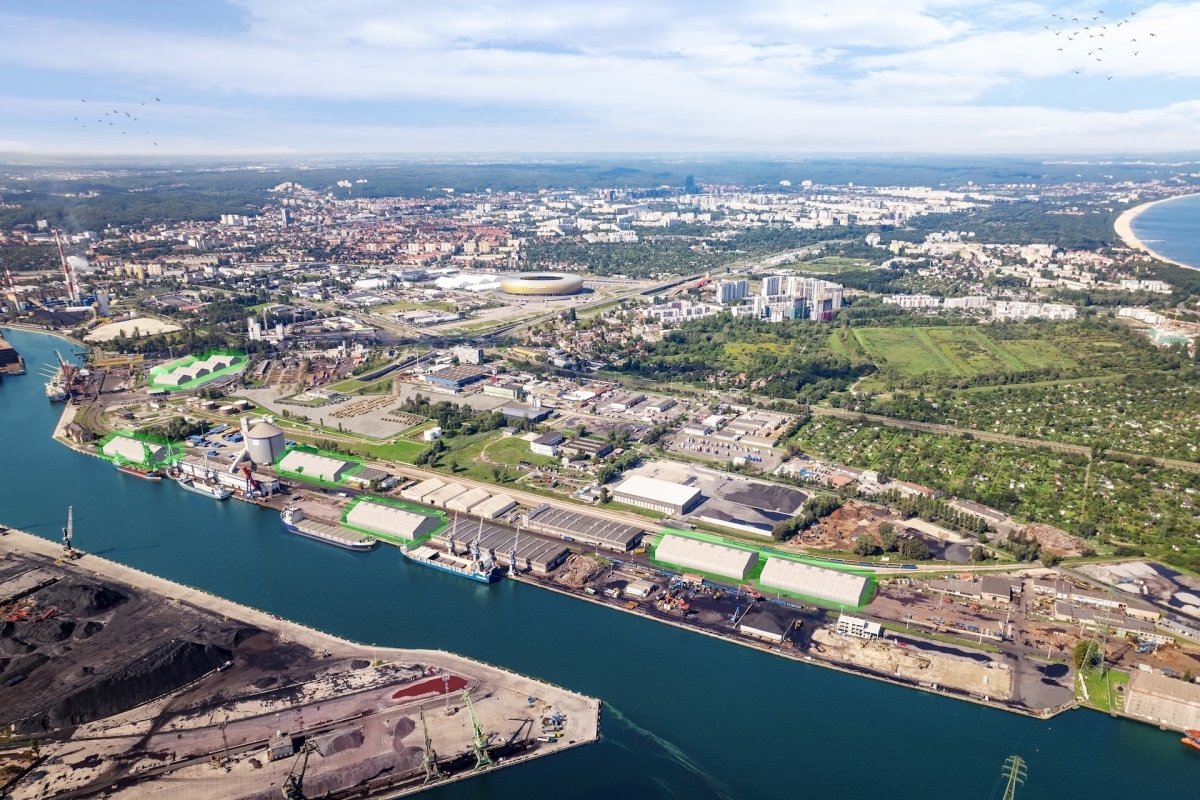


Port Gdańsk Eksploatacja has announced that approval has been granted for the implementation of the project titled “Construction of the Gdańsk Agro Terminal (GAT).” Once completed, the terminal will enable the handling of approximately 3 million tonnes of cargo annually, strengthening Polish agricultural exports and the competitiveness of domestic products on foreign markets.
The first stage of the investment includes the construction of a warehouse hall at the Szczecińskie Quay. Due to its location in a flood-prone area, it was necessary to obtain a water-law permit. The efficiently conducted administrative process now allows the project to move into the implementation phase of this strategic investment for Poland’s agri-food sector.
The project is being implemented entirely with domestic funding by PGE S.A., a state-owned company, and enjoys the support of the highest representatives of the government administration. It is an investment of strategic importance for the development of port infrastructure, food security, and Poland’s economic sovereignty.
It should be recalled that on 7 July this year, Port Gdański Eksploatacja S.A. (PGE), a company from the capital group of the Port of Gdańsk Authority, signed a contract with Premium Quality Care for the construction of a large flat warehouse at the Szczecińskie Quay as part of the first stage of the Gdańsk Agro Terminal (GAT) project. The project envisages the creation of a modern grain terminal capable of handling around 3 million tonnes per year.
The GAT project is being developed in two stages.
Stage I (2025–2026) involves the construction of a flat warehouse at the Szczecińskie Quay (currently under implementation, gross value: PLN 13.8 million, financed from PGE’s own funds), with the contract signed on 7 July 2025.
Stage II (2026–2028) includes the construction of a complex of silos and integration with the infrastructure of the Wiślane Quay.
A more detailed investment plan is currently as follows:
– Construction of one large flat warehouse at the Szczecińskie Quay with an area of 7,000 m² and a capacity of 30,000 tonnes (implementation: 2025–2026);
– Construction of a complex of steel flat-bottom silos with a total capacity of 100,000 tonnes at the Wiślane Quay (implementation: 2026–2028);
– Construction of a modern ship loading and unloading system with a capacity of 1,000 tonnes per hour;
– Integration of the entire facility with the port’s rail, road, and cargo-handling infrastructure.
The Gdańsk Agro Terminal is a modern infrastructure investment responding to the needs of the agri-food market and the diversification of exports. Ultimately, the terminal will have a total storage capacity of 160,000 tonnes and a transshipment capacity of up to 3 million tonnes per year. This is more than four times its current capacity, which stands at 35,000 tonnes of storage space and 0.7 million tonnes of grain handled annually.
In the inner port of Gdańsk, grain is handled by eight operators: Port Gdański Eksploatacja (PGE), Magrol, Gdańskie Młyny, GBT, Handel i Minerały, Jargut, Speed, and Fast Track. Thanks to both its own investments and those of its partners, the Port of Gdańsk has doubled its grain handling capacity over the past five years, from 2 million tonnes in 2019 to 4.3 million tonnes at present. Last year, grain handling increased to 3.1 million tonnes, mainly in export operations. Between January and October this year, 2.4 million tonnes of grain were handled. Over the next three years, the Port of Gdańsk Authority will allocate more than PLN 500 million for the reconstruction of quays and railway lines in the inner port.
 DOWNLOAD PDF