

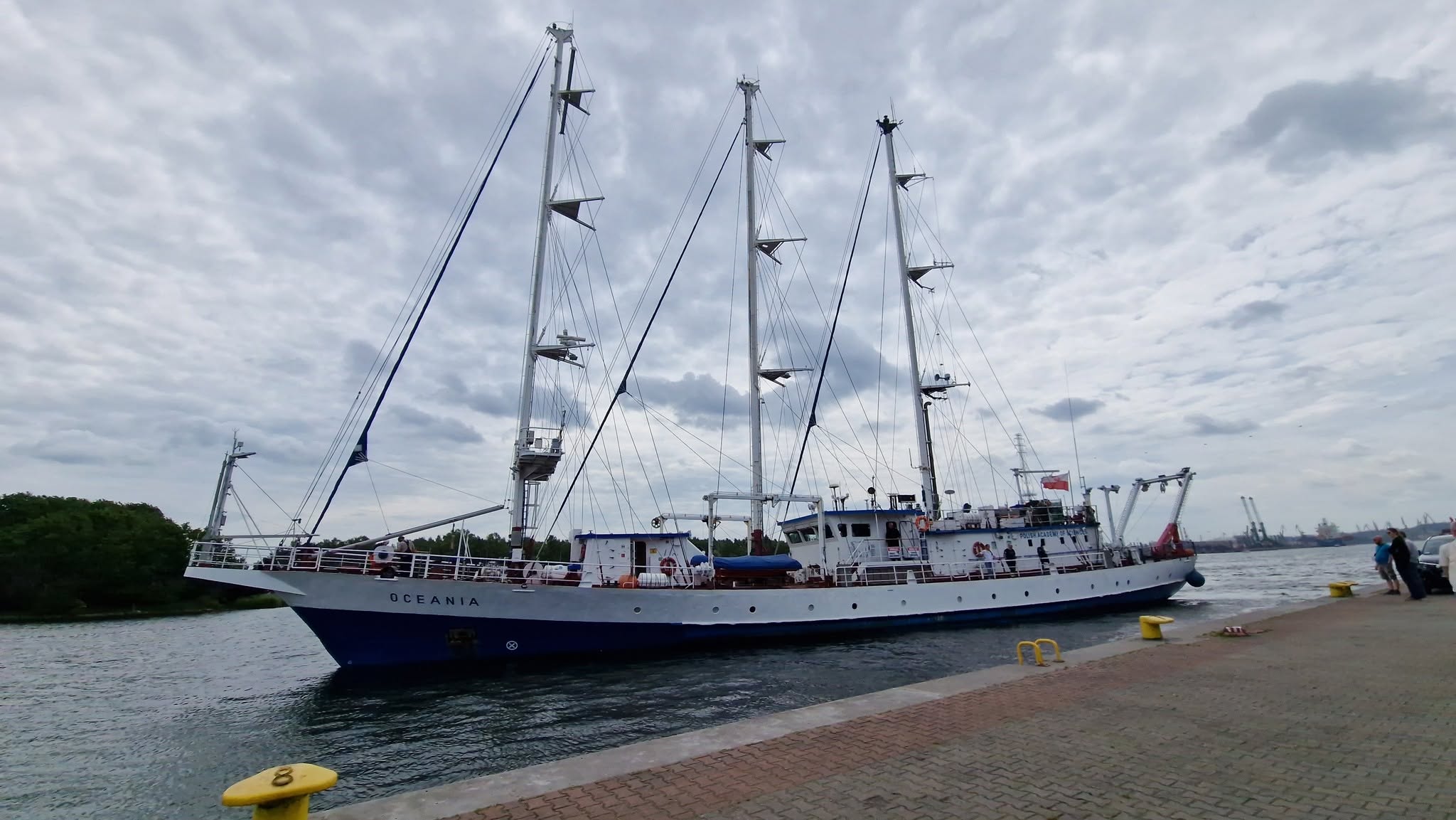


The Institute of Oceanology of the Polish Academy of Sciences (IO PAN) has announced the departure of its research vessel Oceania on the 40th anniversary edition of the Arctic Expedition (AREX) to Spitsbergen. The annual scientific mission to the Arctic has been conducted without interruption since 1987.
Each summer, Oceania follows a route through the Baltic Sea, the Danish Straits, the Norwegian Sea and the Barents Sea to the western coast of Spitsbergen, reaching areas including the Fram Strait and Arctic fjords. Long-term observations carried out using the same network of sampling stations enable scientists to monitor the pace and scale of environmental change in the Arctic, one of the regions considered most vulnerable to the effects of global warming.
During this year's expedition, researchers will conduct a comprehensive programme of oceanographic, biological, biogeochemical, atmospheric, optical and acoustic studies. The data collected will be used to analyse ongoing changes in the waters of the European Arctic, assess the functioning of marine ecosystems, and improve understanding of the interactions between the ocean, atmosphere and sea ice.
Since 1987, scientists from the Institute of Oceanology of the Polish Academy of Sciences have carried out regular environmental monitoring in the European Arctic, creating one of the region's longest-running and most valuable scientific observation records. This year's expedition marks a symbolic milestone, celebrating four decades of continuous Polish scientific research in Arctic waters.
About Oceania
Oceania is a sailing research vessel owned by the Institute of Oceanology of the Polish Academy of Sciences. Built at the Gdańsk Shipyard in 1985, the vessel is 48.9 metres long and 9 metres wide. It carries a 280 sq m sail plan and has a crew of 13, with accommodation for a further 14 people, including scientific personnel.
Designed for operations in demanding marine environments, Oceania has an operational endurance of up to 30 days and is equipped to conduct research in almost all weather conditions. Over the past four decades, the vessel has served as a scientific platform for hundreds of researchers carrying out projects in oceanography, marine biology, environmental chemistry and climatology.
In recent years, the vessel has also become an important platform for education and public outreach. Each year, Oceaniaspends between 230 and 250 days at sea, undertaking, among other missions, its annual scientific expedition to the Nordic Seas and Spitsbergen (June–August), as well as a series of research cruises in the Baltic Sea. The vessel also hosts international training schools for students and early-career researchers, art projects combining science and the arts, documentary film and television productions, and educational initiatives promoting knowledge of the oceans and climate change.
The vessel has also been at the centre of debate over funding for maintenance work and scientific research. In October 2024, Poland's Ministry of Science and Higher Education announced that it would allocate PLN 8 million annually over a three-year period—PLN 24 million in total—to support the operation of Oceania. The funding represented a 25% increase compared with previous government support.
The 40th anniversary AREX expedition is not only another stage in long-term scientific research but also a testament to the continuity of Poland's research presence in the Arctic. At a time of accelerating climate change, the long-term observations carried out by the Institute of Oceanology of the Polish Academy of Sciences are of vital importance for understanding the processes taking place in the oceans and their impact on the environment and society.
According to the Polish Academy of Sciences, although Oceania remains one of Poland's most important scientific research vessels, it is now more than 40 years old. For decades, the ship has enabled research in the Baltic Sea, the Nordic Seas and the Arctic. However, the increasing demands of modern marine science, the need to accommodate state-of-the-art scientific equipment, and the importance of ensuring the continuity of Poland's marine research capability have led the scientific community to call for the construction of a new research vessel for many years.
A modern replacement would enable a broader range of scientific programmes, strengthen Poland's participation in international research projects, and ensure a stable long-term research presence on the world's seas and oceans. Researchers also hope that, following the example of the new research vessels commissioned for the Gdynia Maritime University and the Szczecin University of Technology, they too will eventually receive a new vessel dedicated to scientific research.
Photo courtesy of Polska Akademia Nauk
 DOWNLOAD PDF